
26,3% of households participated in gambling in 2025.
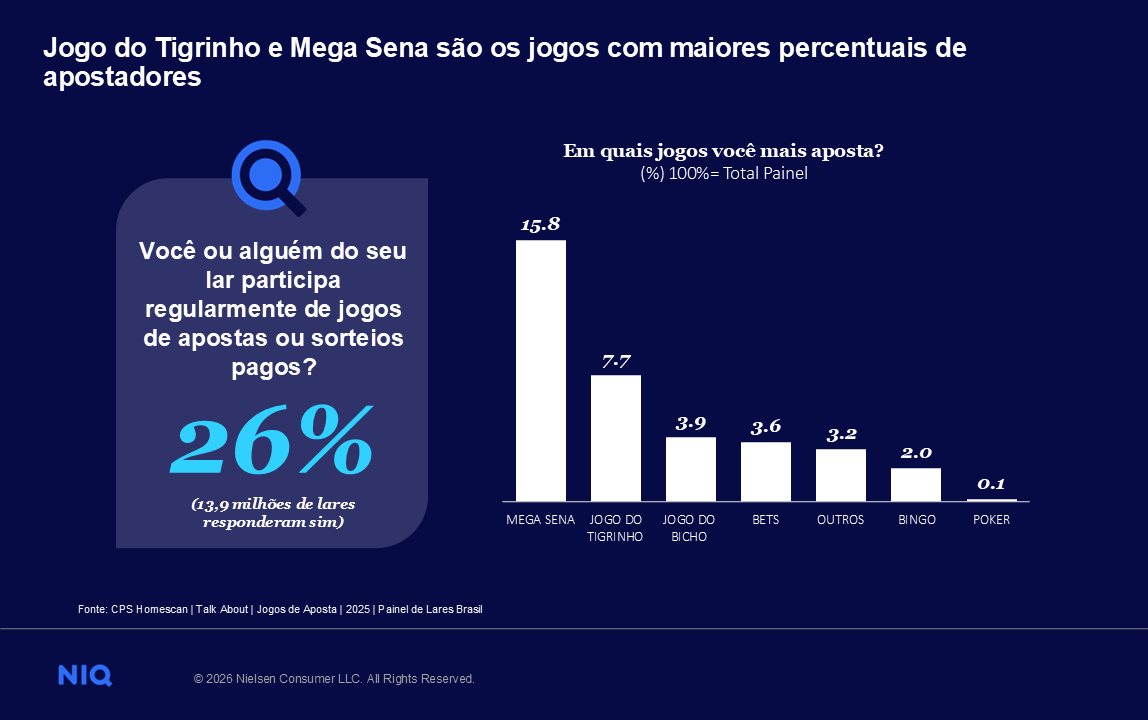
A groundbreaking study, "Bets on the Table, Consumption in Play," by NielsenIQ Brazil revealed that 26,3% of households placed some type of bet during the year, showing that betting has gained ground in household spending by 2025. Among these households, 49% see the practice as a way to obtain extra income.
According to the research, only 10% of gambling households admit to replacing some expenses due to betting. Among them, 47% indicate that the food category loses ground, while 45,3% say that betting impacts fixed expenses (water, electricity, internet) the most.
The main strategy adopted by consumers who gamble to accommodate this new expense is to reduce the number of items purchased — 60% of categories registered a decrease in the volume acquired.
“We had already identified that betting has become a popular and common practice in the daily lives of Brazilian consumers. Now, the numbers also show the extent to which this practice is impacting household spending and the income of bettors.” Gabriel Fagundes, Industry Insights Leader, NielsenIQ.
Modalities and profile
The main types of bets adopted by Brazilians are Mega-Sena and Slot (Jogo do Tigrinho), indicated by 15,8% and 7,7% of betting households, respectively. Jogo do Bicho and other bets follow, with 3,9% and 3,6%.
For 49% of bettors, the motivation is to obtain extra income; while 43,5% hope for a major life change. This second profile is more common in Mega-Sena and tends to involve more casual games, played less frequently.
The Tigrinho lottery shows a higher presence of bettors from the middle socioeconomic level (SEL) (63,3%). In Mega-Sena, players from the high SEL are more frequent (45,5%). The research also showed that younger households have a greater presence in Tigrinho, with 42,4% of bettors under 35 years old. In Mega-Sena, 49,1% are over 51 years old.
In the regional breakdown, the Northeast appears as the region with the highest number of gambling households (29%), followed by the South (28,3%).
The research identified three profiles of gamblers: casual, who gamble at least once a month; "Pro," who gamble once a week; and "Elite," who also gamble weekly and spend more than R$100 per month. Among gambling households, 73% are classified as casual, 28% as "Pro," and 9,3% as "Elite." Among the "Pro" gamblers, 65,8% seek extra income; among the "Elite," this percentage is 63,2%.
Impact on income
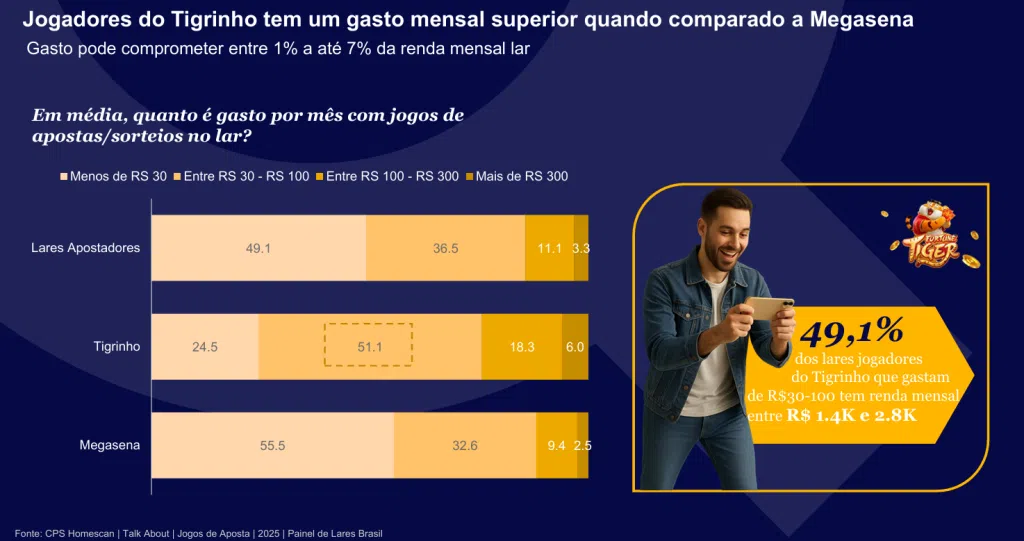
The research also analyzed the impact of betting on Brazilians' income. Among households with bettors on the "Jogo do Tigrinho" (a Brazilian lottery game), 51,1% spend between R$ 30 and R$ 100 per month. These Brazilians have a monthly income between R$ 1.400 and R$ 2.800, and spending on bets represents 1% to 7% of that income.
In the Mega-Sena lottery, the scenario is more moderate: with more sporadic bets, 55,5% of participants spend up to R$ 30 per month.
Categories and channels
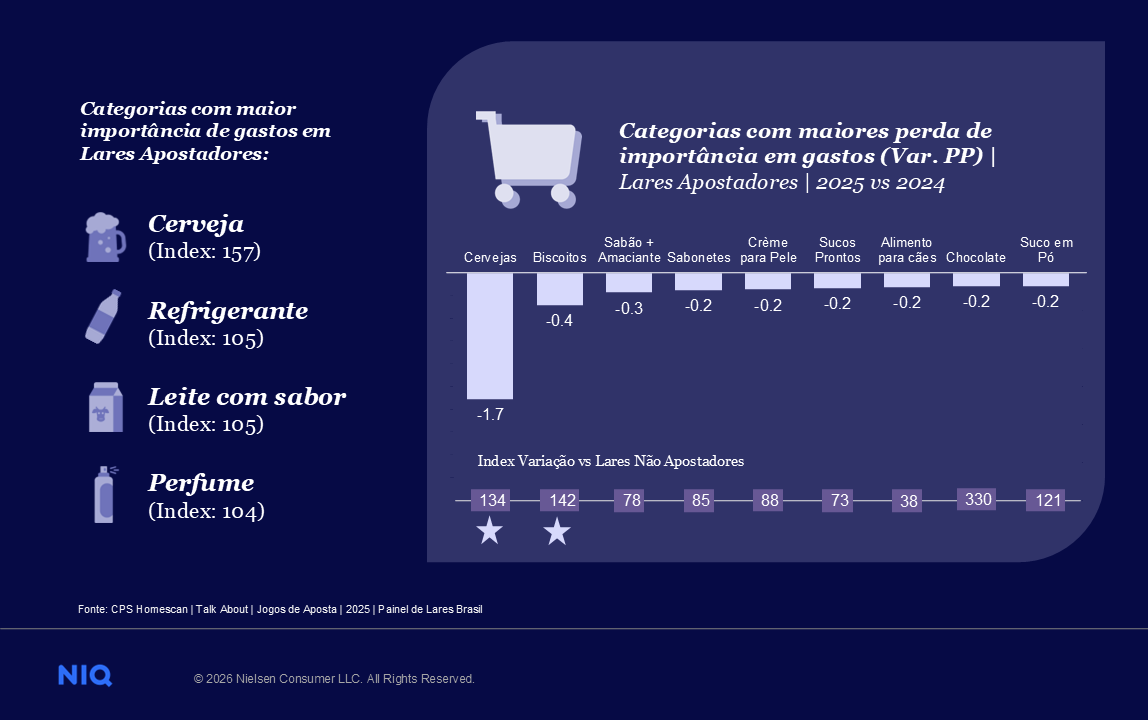
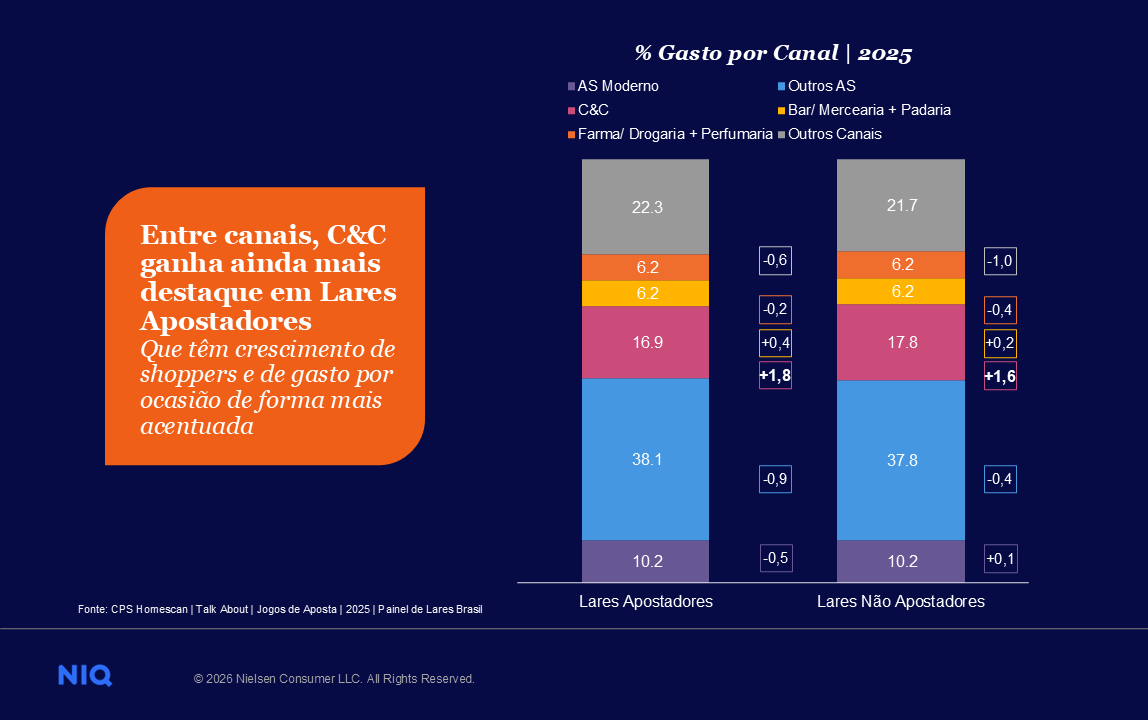
Categories related to indulgences are the most impacted in gambling households. Although important within the household budget, they are also the ones that suffer the most from spending substitutions. Beer, for example, registers the largest decrease in the basket, with a drop in spending share of -1,7 percentage points. Next are biscuits, which decreased by -0,4 percentage points. Soft drinks and perfumes also show similar impacts. The channel that stood out the most was Cash & Carry (Wholesale), both among gambling and non-gambling households. In the first group, the channel grew by 1,8 percentage points; in the second, by 1,6 percentage points, in 2025.
'Bets on the Table, Consumption in Play'
Betting is a new competitor in the consumer's share of wallet.
Households with high gambling appetites show greater commitment to debt and social events, and a slight deprioritization of FMCG (Fast-Moving Consumer Goods). This puts pressure on manufacturers to compete with a "new parallel shopper journey" that captures attention and income.
Brands need to act with greater precision in communication, pricing, and activation to regain relevance in the face of this new competitor: the very habit of gambling.
Brazilian gamblers are not a homogeneous group:
Tigrinho attracts young people and those with a middle socioeconomic status (SES), with high frequency of visits, while Mega Sena is stronger in older, more mature households without children and with a middle/high SES status.
Penetration varies significantly between regions, with the Northeast and South being more relevant for Tigrinho and the East/Interior of São Paulo being stronger for Mega Sena.
Intensity of play is the true driver of impact:
Households with high betting intensity are even more concentrated in the Northeast and South of Brazil. The main motivation for betting is the search for a change in lifestyle and habits, followed by entertainment. Bettors classified as Pro and Elite already demonstrate behavioral changes compared to the average, with a greater demand for Tier Low brands and impacts on the frequency and intensity of consumption.

