
Gamblers in the Federal District are mostly young men with incomes between 1 and 3 minimum wages.
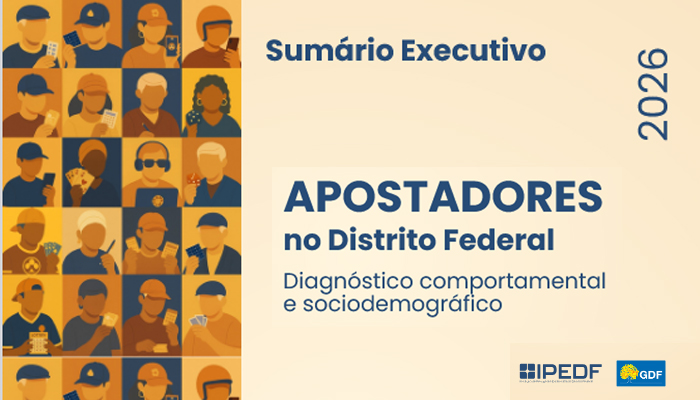
The Research and Statistics Institute of the Federal District (IPEDF) has begun a study to map the profile of gamblers in the federal capital. The research, titled "The Profile of Gamblers in the Federal District," began on Wednesday (January 29th) in partnership with the State Secretariat for Family Affairs of the Federal District. The objective is to identify who the citizens participating in gambling are, their motivations, and the impacts of these activities.
Uniformed researchers are administering questionnaires at high-traffic locations throughout all administrative regions of the Federal District. The survey targets individuals over 18 years of age, both gamblers and non-gambling individuals, guaranteeing the anonymity of participants.
The study analyzes different types of games played by the population and organizes the results by factors such as gender and income bracket. The methodology was developed to guide the creation of public policies specific to the local context.
Rodrigo Delmasso, Secretary of State for Family Affairs of the Federal District, explained the reasons for conducting the research: “Gambling, especially in the digital environment, has ceased to be merely a recreational activity and has begun to generate real impacts on the lives of families, such as indebtedness, family conflicts, and emotional distress. This unprecedented study allows us to understand who the gamblers are in the Federal District, where they are located, and how this behavior affects family dynamics. With technical data, the Federal District Government will be able to formulate preventive public policies focused on financial education, mental health, and strengthening families, especially protecting the most vulnerable.”
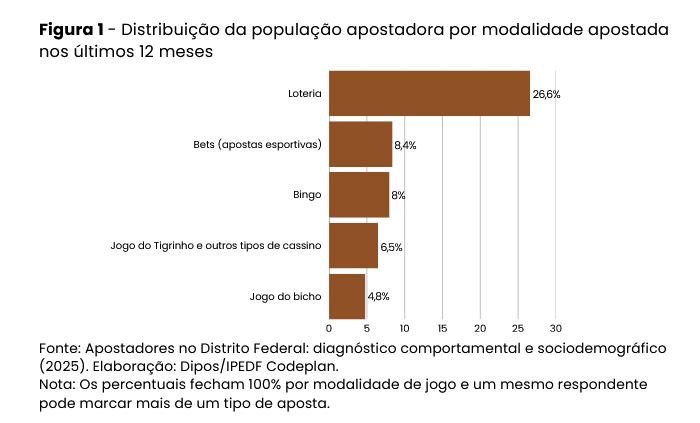
The distribution of the gambling population by type of gambling in the last 12 months is: lottery – 26,6%, sports betting – 8,4%, bingo – 8%, Jogo do Tigrinho and other types of casino – 6,5%, and Jogo do Bicho – 4,8%.
Data for public policies
The CEO of IPEDF, Manoel Barros, highlighted the importance of the survey for the development of government actions. “IPEDF's mission is to produce qualified information to guide decision-making in the area of public policies. This study, on the profile of gamblers in the Federal District, is fundamental to understanding a phenomenon that has been intensifying and has direct impacts on the lives of families, especially regarding indebtedness and social vulnerability. By offering objective and territorially-specific data, the research contributes to enabling the public authorities to act preventively and based on evidence,” he stated.
Marcela Machado, director of Studies and Social Policies at the Institute, highlighted the relevance of the topic: “With the rapid expansion of online gaming platforms and easy access to betting, it becomes essential to produce a consistent diagnosis of the profile of bettors and the possible consequences of this habit on the financial, social, and health lives of the population. The study allows for a better understanding of this phenomenon in the specific context of the Federal District and supports public policies that can address the problems surrounding betting.”
National and local context
This initiative comes at a time of growth for digital betting platforms, known as " bets ," throughout Brazil. Preliminary national data shows that the predominant profile of bettors is in the 16 to 34 age range. There is also significant participation of retirees in this market.
The study conducted by IPEDF and the Secretariat of Family Affairs seeks to verify if this pattern is repeated in the Federal District and to identify specific characteristics of the local population. The results will serve as a basis for the development of preventive programs adapted to the reality of the federal capital.
This research represents an effort by the local government to understand the social, financial, and health effects related to gambling. The data collected will allow for a territorialized view of the phenomenon, enabling interventions targeted to the needs of each administrative region of the Federal District.
Concerning results
The first results of the survey, which interviewed 1.827 men and women between September 8 and 25, 2025, reveal alarming data. In the Federal District, only 5,8% of gamblers received some type of social benefit, a percentage lower than that observed among non-gambling individuals, which reaches 8,9%.
According to the study, the number of people who placed some type of bet in the last 12 months is more than a third (35%), a higher value than that verified in the National Survey on Alcohol and Other Drug Consumption Patterns (Lenad) of 2024 for the Midwest (18,7%).
Marcela Machado explained that, although 5,8% may seem like a low percentage, it is concerning when analyzed in conjunction with other data. "Looking at this information alongside other data, such as income, where the majority of gamblers are in the lower-middle and lower income brackets, it is striking," she stated. According to her, part of this group likely uses the benefit, directly or indirectly, to gamble.
“Instead of investing in buying food for the family, in health, a percentage of that income is being allocated to gambling. It's not 0,1%. It's 5,8%. That percentage is striking. And people weren't ashamed to say it. They said: I receive social benefits and I'm gambling,” he warned.
Among those who participate in the program, 64,9% receive Bolsa Família (a Brazilian social welfare program), 21,6% use the Cartão Prato Cheio (a program providing affordable meals), 8,1% receive retirement or disability benefits, 8,1% are beneficiaries of BPC/LOAS (a Brazilian social assistance program), 5,4% receive gas assistance, and 2,7% each receive DF Social (a social assistance program) and survivor's pension.
Bettors profile
According to the study, gambling is more common among men, young adults, and people with incomes between one and three minimum wages. Gamblers are mainly employed in the private sector (38,3%) and self-employed individuals (22,5%). Unemployed individuals make up 3,9%, while business owners represent 4,8%. In the public sector, participation reaches 8,4%, and retirees account for 11,6% of gamblers.
Regarding education level, bettors are concentrated among those with completed high school education (44,4%) and incomplete higher education (10,2%), while non-bettors have a higher presence among those with completed higher education (19,9%).
The most frequently reported motivation among respondents was financial gain (85,5%), followed by pleasure or fun (11,1%) and socializing with family and friends (7,3%). “These are low-income men. They don't have enough income to cover daily expenses, but they spend on gambling, hoping for easier winnings,” Machado pointed out.
The study also reveals a migration to digital platforms. Lotteries remain the most popular modality, with more occasional use and a higher prevalence among older audiences. Digital modalities, such as online casinos (like the "Tiger Game") and sports betting ( bets ), attract younger users, exhibit higher daily usage frequency, greater financial commitment, and higher spending volume.
Regarding the regulation of virtual casinos and sports betting, opinions are divided between those in favor and those against. According to Machado, responsible regulation would bring a policy of prevention, clearer information for the consumer, protection for vulnerable groups and people receiving social benefits.
The research presented in this report is the result of a partnership established between IPEDF Codeplan and the State Secretariat for Family Affairs of the Federal District. It is a groundbreaking study on gamblers in the Federal District, aiming to identify the sociodemographic profile of gamblers in the DF, as well as the motivations that lead them to engage in different forms of gambling. Furthermore, it sought to understand gamblers' perceptions of the personal and social impacts associated with gambling, consumption patterns, and the financial aspects involved in participating in games of chance—factors that influence their adoption and the maintenance of their motivations for gambling. The perceptions of non-gambling individuals in the Federal District regarding gambling are also captured. The research considers legal and illegal, in-person and online betting, with the objective of capturing the diversity of behaviors and profiles involved, in a scenario of overlapping norms, platforms, and incentives for engaging in this practice.
Report – Gamblers in the Federal District – Behavioral and Sociodemographic Diagnosis (61 pages)
HOW TO CITE
IPEDF – Institute for Research and Statistics of the Federal District. Gamblers in the Federal District – Behavioral and sociodemographic diagnosis. Report. Brasília: IPEDF, 2026.
IPEDF – Institute for Research and Statistics of the Federal District. Gamblers in the Federal District – Behavioral and sociodemographic diagnosis. Executive summary. Brasília: IPEDF, 2026.
RESEARCH DATA
– Database

