
Lottery associations call for presidential debate on the market.
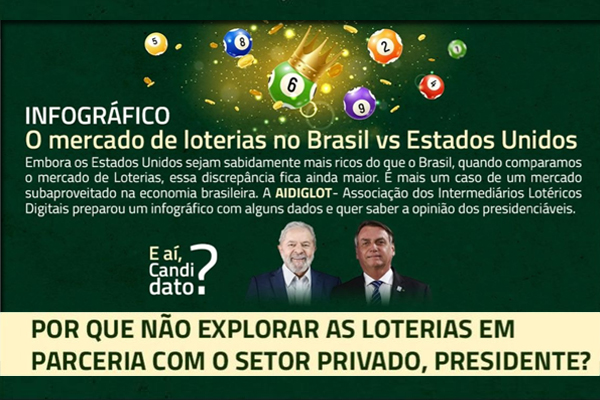
Lotteries are important sources of revenue for healthcare and social projects, but they could be much more beneficial if there were partnerships with the private sector.
Earlier this month, Brazil experienced the largest regular Mega-Sena prize, R$ 317 million, which was split between two bettors. This Thursday (27) Brazil's most popular lottery is once again accumulated with an estimated prize of R$ 130 million.
This is very little compared to the American market, which on this same Thursday presents one of its most popular lotteries, Powerball, with an estimated prize of US$800 million (approximately R$4,3 billion). Other examples of accumulated prizes would be Mega Millions with US$64 million, Euromillions with 130 million Euros, and Italy's SuperStar with 297,7 million Euros.
Mathematics helps us understand better. Brazil's GDP in 2021 was around R$ 8,7 trillion, while the US GDP, converted to Brazilian currency, was around R$ 109 trillion, 12,5 times larger than Brazil's.
Still, it's very difficult to accept or explain the difference in prizes paid out between the two markets. Lotteries work in a very simple way: they pay out a portion of what they collect. The remainder, generally speaking, goes to the government for administration and social causes.
This year, while Brazil paid out its highest Mega-Sena prize ever, Mega Millions paid out one of its third-largest prizes in history, US$1,3 billion, almost R$7 billion in a single prize. This amount is 23 times greater than that of our Mega-Sena, which cannot be explained solely by the greater wealth of the United States, but by the greater virtuosity of its market, characterized by public-private partnerships, while Brazil insists on operating with a fully state-owned model.

Largest prizes ever paid out in the history of US lotteries.
- US$ 1,586 billion, Powerball, January 13, 2016 (three tickets, from California, Florida, Tennessee)
- US$1,537 billion, Mega Millions, October 23, 2018 (one ticket, from South Carolina)
- US$1,337 billion, Mega Millions, July 29, 2022 (one ticket, from Illinois)
- US$1,05 billion, Mega Millions, January 22, 2021 (one ticket, from Michigan)
- US$768,4 million, Powerball, March 27, 2019 (one ticket, from Wisconsin)
Biggest prizes paid out by Mega-Sena:
| Order | Competition | Date | Total Prize | winners | Prize per Winner |
| 1 | 2150 | 11/05/2019 | 289.420.865,00 BRL | 1 | 289.420.865,00 BRL |
| 2 | 2237 | 27/02/2020 | 211.652.717,74 BRL | 2 | 105.826.358,87 BRL |
| 3 | 1764 | 25/11/2015 | 205.329.753,89 BRL | 1 | 205.329.753,89 BRL |
| 4 | 1772 | 22/12/2015 | 197.377.949,52 BRL | 2 | 98.688.974,76 BRL |
| 5 | 2464 | 19/03/2022 | 189.381.872,36 BRL | 2 | 94.690.936,18 BRL |
But what are the impacts on the Brazilian market?
When was the last time you saw an instant lottery ticket (scratch-off ticket)? The more observant reader may have noticed in movies or TV series the sale of lottery tickets in convenience stores and gas stations in the United States (including this $1,3 billion prize, which was sold at a gas station in the state of Illinois).
– Products: Brazil has not operated instant lotteries (scratch-off tickets) for over 10 years. In the United States, instant lotteries account for approximately 70% of the revenue in a virtuous market worth over US$110 billion – R$583 billion – while Brazil still has a modest share of R$18,5 billion.
– Points of sale: Law 6259/44 prohibits the resale of lottery tickets, guaranteeing the state monopoly to Caixa Econômica Federal and its lottery network with a current total of 13.500 lottery outlets, in addition to its own website and applications. To give you an idea, this is the number of points of sale in the state of Florida alone in the United States. Conclusion: fewer points of sale: less sales, less revenue for the state, and smaller prizes for the bettor.
– Low Payouts: For every R$100,00 wagered, only 32% returns to the bettor in prizes, representing one of the lowest percentage prize values in the world, making the lottery less attractive. The remaining amounts are allocated to Caixa's administrative management, taxes, and social benefits. Conclusion: lower attractiveness, with fewer bettors, lower betting values, lower nominal revenue, and lower prize values.
Proposals from industry associations for the next government.
In 2022, two associations were created: AIDIGLOT - Association of Lottery Intermediaries and ANJL - National Association of Lottery Games, with the goal of making this market more virtuous.
Among the proposals is the opening of the lottery market to public-private initiatives.
Permission for intermediation of betting on apps to expand points of sale. However, the market lacks a broader discussion in the name of developing this sector, which can still add significant value to the economy, increasing its contribution to the State and society in a way that does not require an increase in the tax burden, minimizing the need to create new taxes.