Bacelar forwards document regarding the Pro-Gambling Parliamentary Front
 With the aim of gathering the necessary information to request a new registration for the Parliamentary Front for the Approval of the Regulatory Framework for Games in Brazil, which was dissolved after the end of the 55th Legislature of the Chamber of Deputies, Deputy Bacelar (Pode-BA) forwarded the text below to the parliamentarians.
To create a parliamentary front, the deputy who authored the proposal needs the support of one-third of his colleagues, which means gathering 171 signatures.
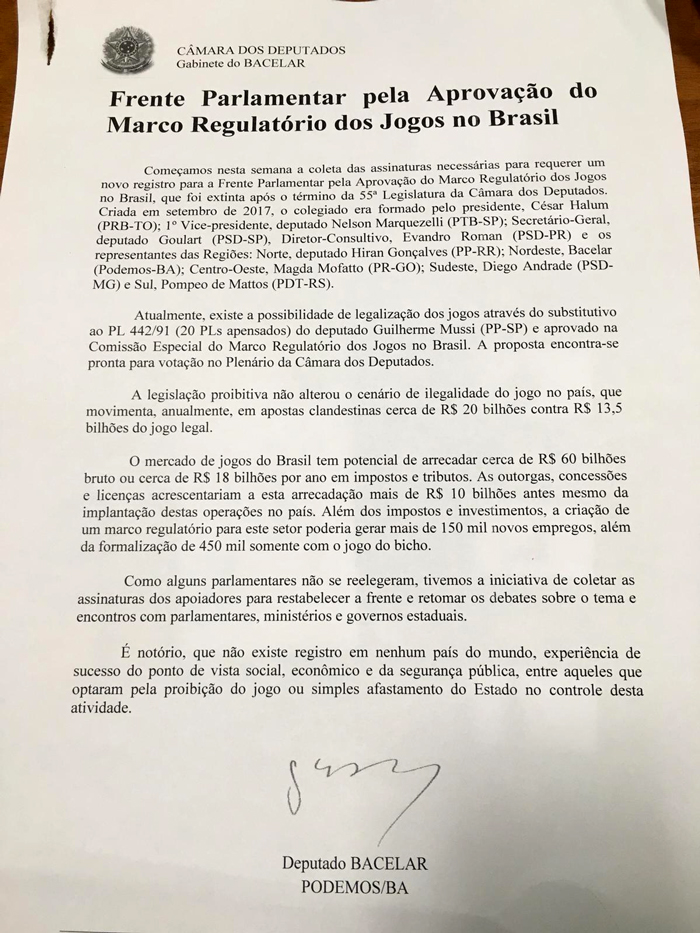
Parliamentary Front for the Approval of the Regulatory Framework for Gambling in Brazil
This week we began collecting the necessary signatures to request a new registration for the Parliamentary Front for the Approval of the Regulatory Framework for Games in Brazil, which was dissolved after the end of the 55th Legislature of the Chamber of Deputies. Created in September 2017, the group was composed of the president, César Halum (PRB-TO); 1st Vice-President, Deputy Nelson Marquezelli (PTB-SP); Secretary-General, Deputy Goulart (PSD-SP); Advisory Director, Evandro Roman (PSD-PR); and the representatives of the Regions: North, Deputy Hiran Gonçalves (PP-RR); Northeast, Bacelar (Podemos-BA); Midwest, Magda Mofatto (PR-GO); Southeast, Diego Andrade (PSD-MG); and South, Pompeo de Mattos (PDT-RS).
Currently, there is a possibility of legalizing gambling through the substitute bill to PL 442/91 (20 attached bills) by Congressman Guilherme Mussi (PP-SP), approved by the Special Committee on the Regulatory Framework for Gambling in Brazil. The proposal is ready for a vote in the Plenary of the Chamber of Deputies.
Prohibitive legislation has not altered the landscape of illegal gambling in the country, which annually generates around R$ 20 billion in clandestine bets compared to R$ 13,5 billion from legal gambling.
The Brazilian gaming market has the potential to generate approximately R$ 60 billion in gross revenue, or about R$ 18 billion annually in taxes and duties. Grants, concessions, and licenses would add more than R$ 10 billion to this revenue even before these operations are implemented in the country. In addition to taxes and investments, the creation of a regulatory framework for this sector could generate more than 150 new jobs, as well as formalize 450 jobs related to the jogo do bicho (illegal lottery) alone.
Since some parliamentarians were not re-elected, we took the initiative to collect signatures from supporters to re-establish the front and resume debates on the topic, as well as meetings with parliamentarians, ministries, and state governments.
It is well known that there is no record in any country in the world of a successful experience, from a social, economic, and public safety standpoint, among those that have opted for the prohibition of gambling or simply the removal of the State from the control of this activity.