
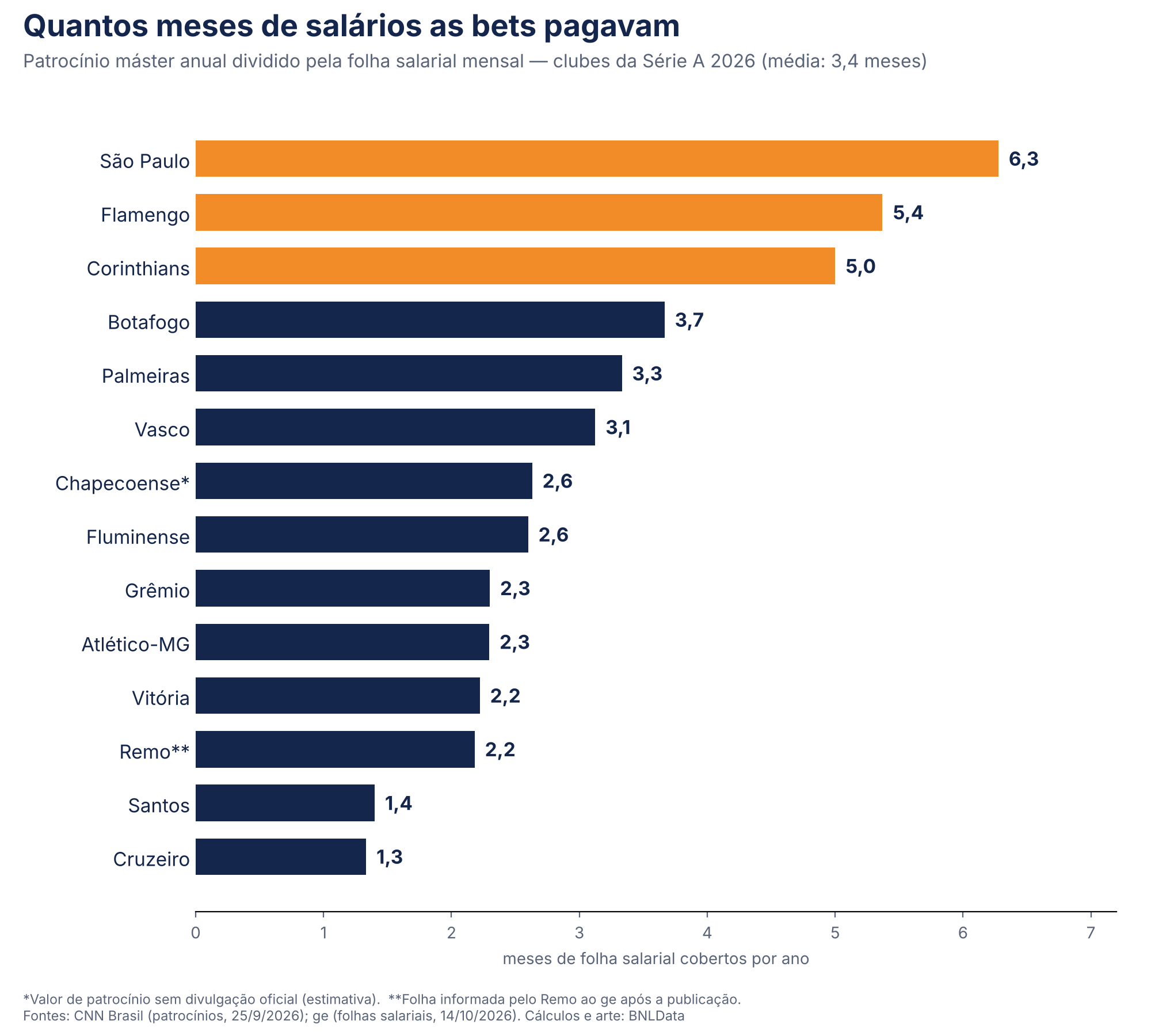
Betting companies were paying more than three months' salary per year to Serie A clubs; at São Paulo, it was more than six.
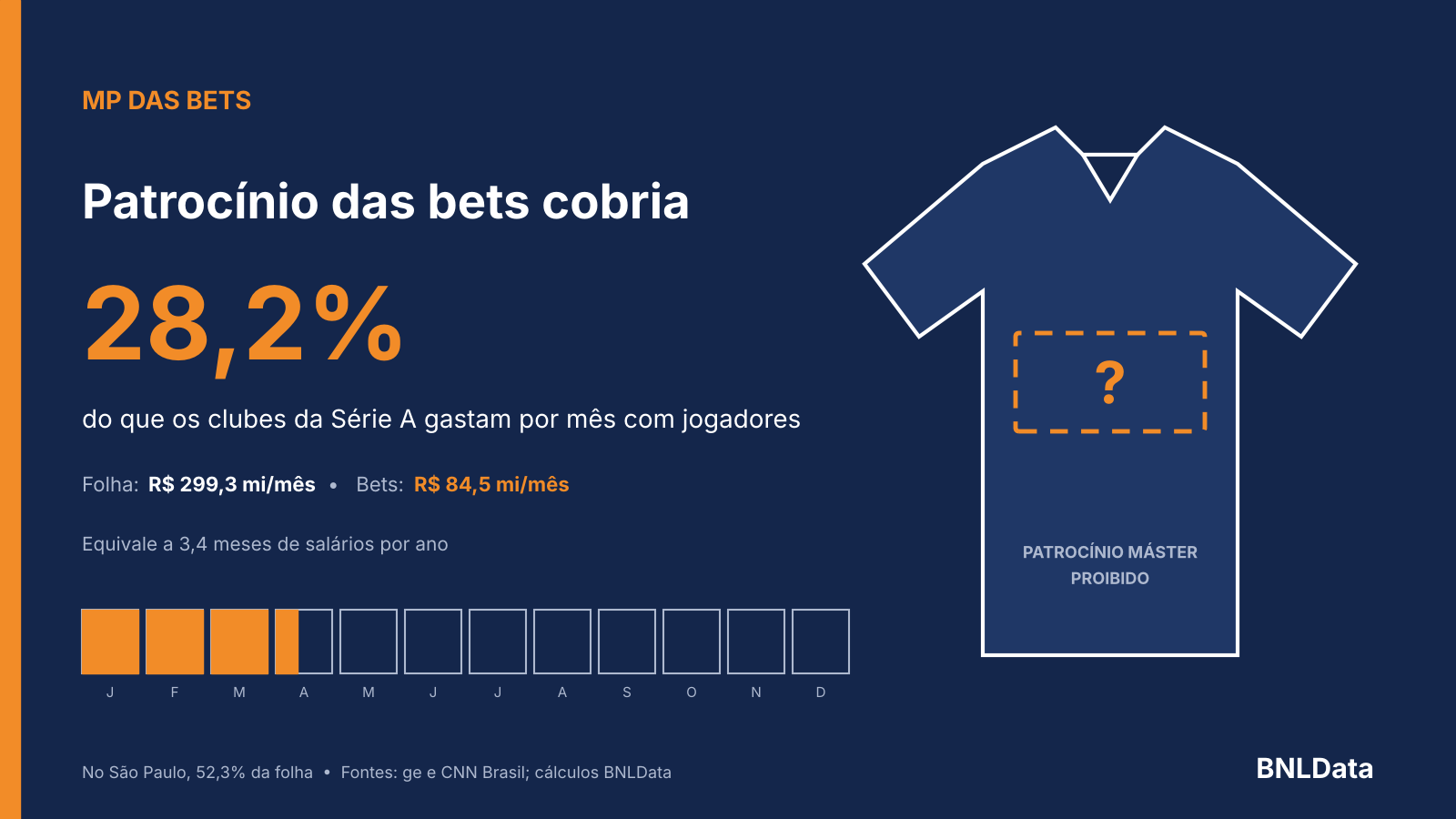
The money that betting companies paid to the 14 Serie A clubs sponsored by them in the prime part of the shirt was enough to pay more than three months of salaries for these squads per year. This is shown by a cross-referencing done by BNLData between the values of the master sponsorship contracts and the ranking of payrolls published this Wednesday (14) by ge Globo.
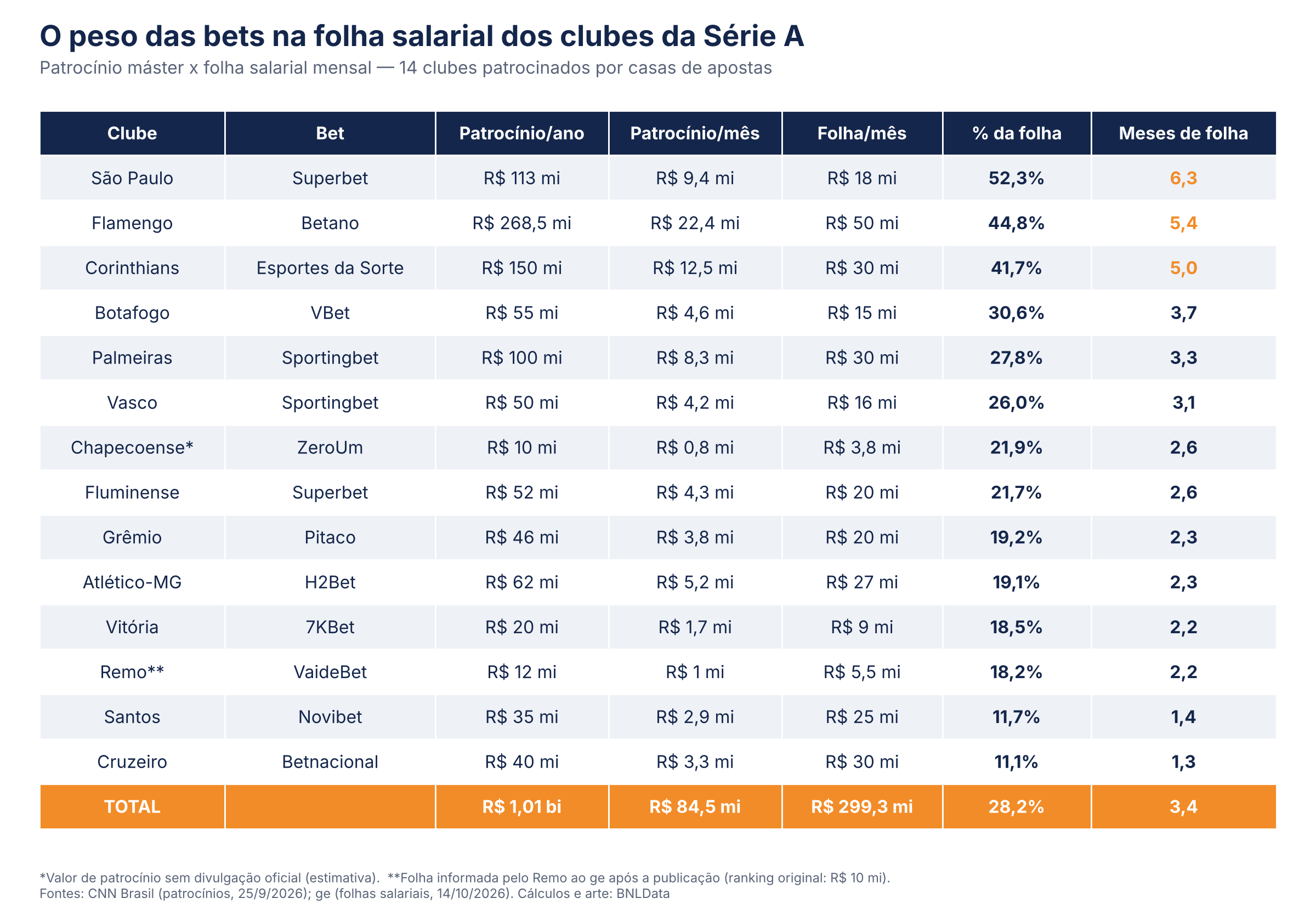
Combined, the main sponsorships from betting companies amounted to approximately R$ 1,01 billion per year, or R$ 84,5 million per month. The payrolls of these 14 clubs total R$ 299,3 million per month. On average, therefore, betting sponsorship covered 28,2% of what the clubs spend each month on their players.
The calculation dismantles the argument used by President Luiz Inácio Lula da Silva when announcing Provisional Measure No. 1.394/2026 on September 25th, on the eve of the first round of elections. In responding to complaints from clubs, Lula stated that sponsorship from betting companies would represent between 6% and 7% of a team's budget. This number may even be closer to reality when considering the total budget, which includes TV rights, ticket sales, and player transfers. However, the payroll is a fixed monthly expense that cannot be delayed. It is in this area that the cuts will be most significant.
São Paulo, Flamengo, and Corinthians are the most exposed.
The most serious case is that of São Paulo. The contract with Superbet, worth R$ 113 million per year, yielded R$ 9,4 million per month, equivalent to 52,3% of the club's payroll, estimated by ge at R$ 18 million per month. In practice, the betting company was paying more than six months' worth of salaries for the São Paulo squad per year.
Flamengo comes next. Owner of the highest payroll in the country, at R$ 50 million per month, and the largest sponsorship contract in the history of Brazilian football, at R$ 268,5 million per year with Betano, the club had 44,8% of its squad's salaries covered by the betting company, equivalent to 5,4 months of payroll. Even considering only the fixed part of the contract, of R$ 220 million according to Folha, the coverage would be 36,7%, or 4,4 months.
Corinthians comes in third. The R$150 million annual revenue from Esportes da Sorte covered 41,7% of the R$30 million payroll, which is equivalent to five months' salaries.
Botafogo (30,6%), Palmeiras (27,8%) and Vasco (26%) complete the group of clubs where the bet paid out more than three months' payroll per year.
The club-to-club crossover
A number that is difficult to measure, and therefore conservative.
Even ge itself acknowledges that the payroll figure is difficult to pinpoint. Associations and SAFs (Sociedades Anônimas de Futebol, or Football Associations) do not disclose in a standardized way how much they spend solely on the squad, and the ranking values are approximate, constructed from balance sheets and information gathered from the clubs.
The Palmeiras case illustrates the magnitude of the difference. According to monthly financial statements, the football department costs around R$ 45 million per month. However, club officials cite a payroll of R$ 30 million, a figure used by ge Globo. With the total cost of the department, the Sportingbet sponsorship would cover 18,5% of expenses, or 2,2 months per year.
The comparison is also conservative for another reason: it only considers the main sponsorship. Secondary properties, billboards, activation campaigns, and performance bonuses stipulated in various contracts are excluded. When assessing the impact of the Provisional Measure, the president of Flamengo, Luiz Eduardo Baptista, known as Bap, estimated that the club could lose more than R$ 430 million, including sponsorship and other revenues linked to the sector. For Brazilian football as a whole, he projects losses of R$ 2,5 billion.
One third of the commercial revenue
The figures from the cross-referencing are consistent with other surveys. According to a report by the consulting firm Convocados, cited by CNN Brazil, betting revenue accounts for 33% of the clubs' commercial and marketing revenue, estimated at R$ 3,069 billion. In 2025, first division clubs raised R$ 1,03 billion from sponsorships from betting companies, according to Folha de S.Paulo.
Convocados itself estimates that, for most teams, sponsorship accounts for between 5% and 8% of the total budget, but reaches 12,85% for Flamengo and 10,5% for Corinthians and São Paulo. In other words, even by budget criteria, the three most affected teams are well above the range cited by the president.
Clubs without sponsorship and without short-term alternatives.
Only Athletico-PR, Bahia, Coritiba, and Internacional have no connection with the sector. Mirassol and Bragantino have bets only as secondary sponsors.
The decree gave clubs until October 5th to remove all advertising and sponsorship signs from betting sites, and the authorizations from operators may expire on October 25th. Operators have begun notifying clubs about the termination or suspension of contracts. Finding sponsors capable of covering three to six months of payroll in the final stretch of the season and on the eve of 2027 planning is a task that no marketing department can accomplish in weeks.
The financial impact helps explain the reaction of the clubs, which culminated in the protest by Flamengo and Fluminense at the Fla-Flu match on October 11th, broadcast nationwide. While the Provisional Measure is being processed in Congress and lawsuits pile up in the Supreme Court, the clubs are doing the math and the payrolls continue to be due every month.

