
Brazil collected R$ 8,747 billion from betting and gambling between January and July.

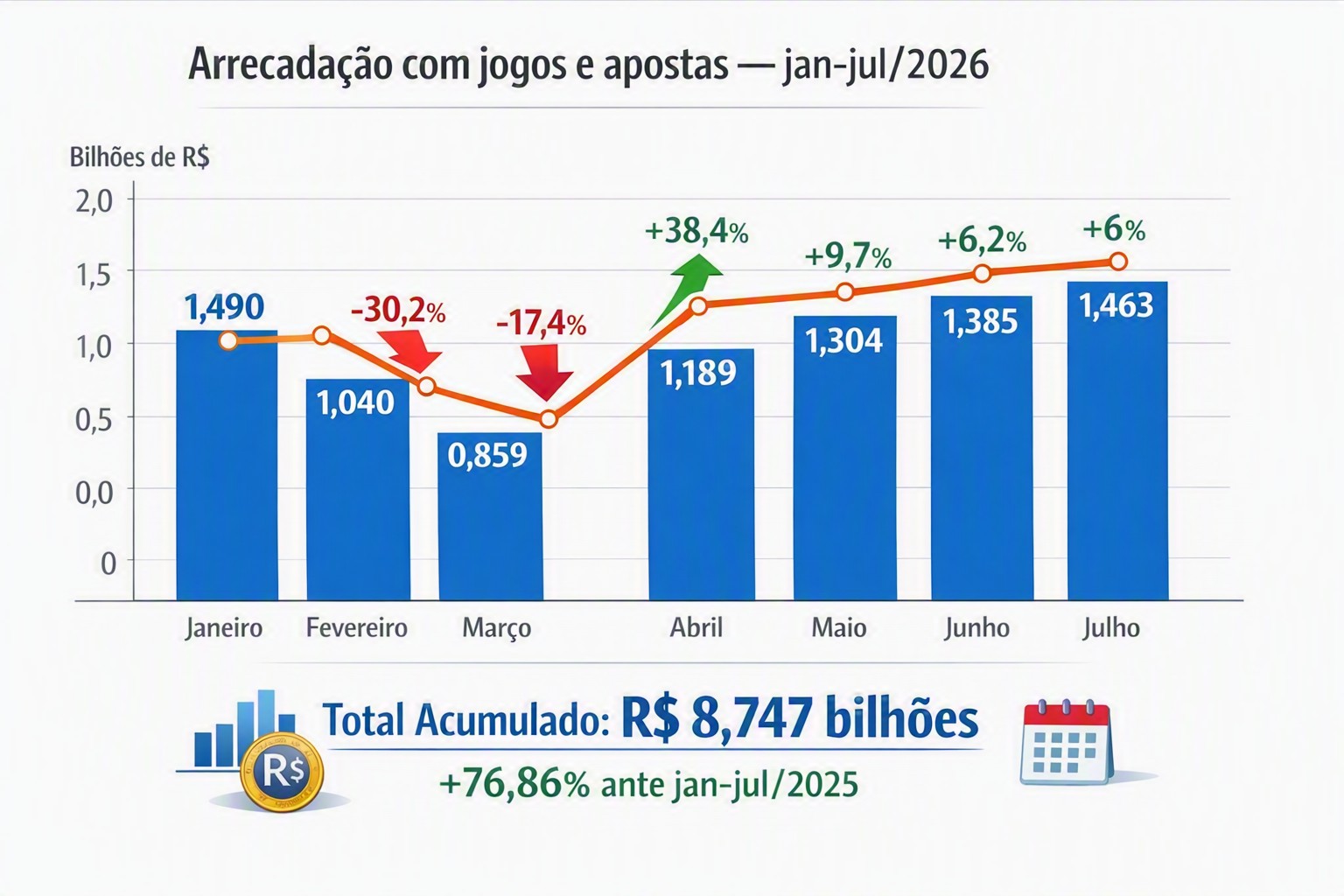
The Brazilian Federal Revenue Service collected R$ 8,747 billion in taxes on betting and gambling (including Caixa lotteries) between January and July 2026, a value 76,86% higher than that recorded in the same period of 2025, when the total was R$ 4,946 billion . The data is included in the revenue balance by economic division released by the agency this Tuesday (August 25).
In July alone, the gambling and betting sector collected R$ 1,463 billion , compared to R$ 1,385 billion in June — a 6% increase month-on-month.
This figure refers to the amounts collected by the Federal Revenue Service, including federal taxes such as Corporate Income Tax (IRPJ), Social Contribution on Net Profit (CSLL), PIS/Cofins, and Social Security Contributions. These resources are returned to society through public policies in various areas.
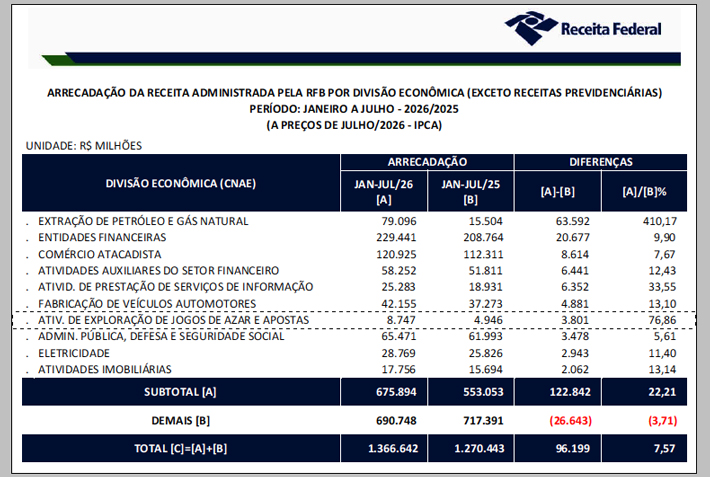
The figures are from the Monthly Analysis for July 2026, presented by tax auditors Claudemir Malaquias, head of the Center for Tax and Customs Studies, and Marcelo Gomide, coordinator of Forecasting and Analysis at the Federal Revenue Service.
Month by month: seasonality explains the fluctuations.
As in the first half of the year, the July data reinforces a clear seasonal pattern within the year: a sharp drop in February and March (Carnival period), followed by a steady recovery from April onwards, with July maintaining the pace of moderate increases from the previous three months.
Until March, betting was taxed at a rate of 12% on GGR (Gross Gaming Revenue), the gross revenue of betting houses after prize payments. The rate increased to 13% from March 26th, by Complementary Law No. 224/2025, after the ninety-day rule was met — a schedule that foresees further increases, to 14% in 2027 and 15% in 2028. This indicates that the growth in revenue from April onwards combines the effect of the higher rate with the effective recovery of betting volume, and not just the passing on of the tax.
World Cup ends without triggering an atypical surge.
July marked the end of the 2026 World Cup, with the final played on the 19th. Even so, the month's revenue grew 6% compared to June — a variation very close to that recorded in the months prior to the tournament (+9,7% in May, +6,2% in June) and lower than the 38,4% jump observed in April, when the championship had not even started.
This behavior reinforces the interpretation that BNLData had already been pointing out: the main sporting event of the year did not generate an "explosion" in betting volume. The growth observed during and after the World Cup is consistent with the seasonal recovery trajectory that had already been underway since April, coupled with the effect of the higher tax rate on GGR.
Towards R$16 billion in 2026
Throughout 2025, Brazil collected R$ 9,95 billion in taxes on betting and gambling (including Caixa lotteries), under the then-current rate of 12% on the GGR (Gross Revenue). With the R$ 8,747 billion already collected in the first seven months of 2026, the country is just a few months away from surpassing the total for the entire previous year—with five months still remaining until the end of the fiscal year.
Betting revenue has remained above R$1,4 billion per month since April, with the exception of March. If this performance continues until December, annual betting revenue could exceed R$16 billion in 2026 — more than 60% higher than the 2025 result.
While tax revenue rises, the agenda of restrictions advances.
While betting revenue increases and strengthens public coffers, the government is discussing measures that are detrimental to the sector: proposals for new tax increases, restrictions on the types of games allowed, and limitations on advertising. Such measures tend to produce the opposite effect to that intended, pushing some of the resources currently collected back into the illegal market.

