Each Portuguese player spent 257 euros on bets in 2018.

Diogo had a terrible day. As he explains to Expresso why, his voice rises in tone and his arms gesture forward, towards the computer screen. Diogo is nervous. He took a risk, bet his own money, played against dozens of people who did the same, and lost. But the explanations end, and Diogo stops looking upset, he smiles, his nerves are fake, he's not that affected. After all, it was "very little money thrown away". Yes, he can even say that "the day was terrible", but "of course I'm exaggerating".
Like almost 7% of the adult Portuguese population, Diogo is a fan of online betting and gambling. That day, he had played "more or less" three hours of online poker, but normally he sticks to an hour and a half. He lost 4 euros and some cents, but still had more than 10 euros left in his account on the site. Enough to "manage" the habit, especially since, for him, betting is just a hobby. For him and for "most" of his friends and acquaintances. He is 24 years old, in his first year of a master's degree at the University of Minho in Braga, far from his parents' house, he has to pay rent for his room and other expenses, and he receives a scholarship. In other words: he can't afford to "lose his head," to bet like there's no tomorrow on European football league and NBA (the North American basketball league) games. It would be "irresponsible" to do so, it's out of the question, and his group of friends shares the same philosophy. Of course, sometimes he feels like betting “100 or 200 euros at once” on a series of seemingly guaranteed games (the so-called multiple bet), but he always ends up resisting the risk. He rarely puts money into accounts — he risked around 80 euros in the last school year — and even more rarely does he make a profit. “Once I won 50 euros with a draw for the national team,” but the profit ended up being diluted in the following weeks.
The money Diogo has been gambling with contributes to the more than 2,4 billion euros that the Portuguese online gambling market generated in 2018. This figure comes from the report "Online Gambling in Portugal: The Best Bet for the National Regulatory System," produced for the Portuguese Association of Online Betting and Gaming (APAJO), which counted 1,18 million active accounts in Portugal last year (compared to 380 in 2017), meaning between 400 and 600 users; each player has, on average, two accounts simultaneously. Just like Diogo: one for sports betting and another for poker tournaments.
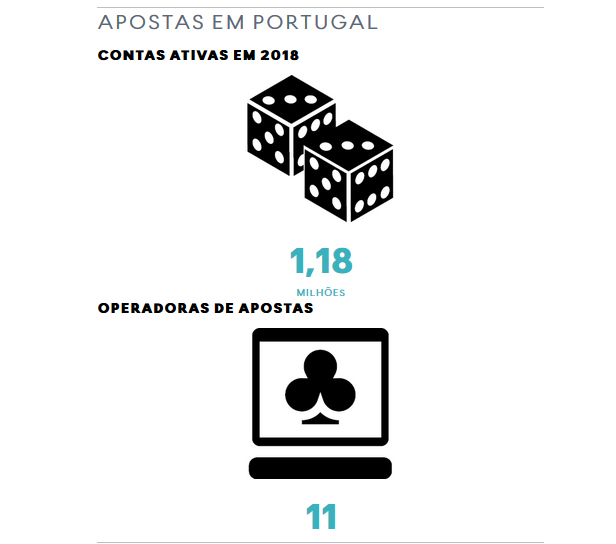
The sector was legalized in Portugal in 2015, following other European countries in licensing, and is regulated by the Gaming Regulation and Inspection Service (SRIJ), which oversees both sports betting and games of chance—such as "punto banco baccarat, French bank, blackjack/21, poker, American roulette, French roulette, slot machines, etc." Currently, there are 11 operators licensed to operate in the market: Betclic, Bet.pt, ESC Online, PokerStars, Casino Portugal, Casino Solverde, A Nossa Aposta, Placard, Luckia, 888, and Betano. In Portugal, football dominates sports betting (with almost 74% of the total); in virtual casinos with real money, slot machines attract the most people, accounting for 62% of the activity, and tournament poker represents only 5,3%, behind blackjack and French roulette. Of the more than 2,4 billion euros wagered in 2018, over 2 euros were due to casinos, and less than 400 million euros to sports. Compared to 2017, Portuguese people wagered 661 million euros more online, an increase of 37,3%.
Players, consumers
And who gambles? The SRIJ indicates that the biggest gamblers are citizens between 25 and 34 years old (38,8% of gamblers), followed by the age groups 18-24 (25,1%), 35-44 (23,3%) and 45-54 (8,9%). Only 2,8% of online gamblers are between 55 and 64 years old, and only 1% are over 65. These data do not surprise Tiago, 34, owner of a café in Braga, a few kilometers from Diogo's house, next to the University of Minho. His café is a haven for gamblers. Tiago almost never gambles, but he deals with the joys and frustrations of others every day. "Most of the customers come here to bet on Placard [a sports betting game managed by Santa Casa da Misericórdia], but they also bet on websites." They are mostly young adults, although it is also common to serve men up to their "early 50s". It's rare for older people to play. "Older people don't use the internet as much, it's normal." They stick to Euromillions and scratch cards. Braga is, in fact, the third district in the country where online gambling is most prevalent (it has 9,5% of all players), behind Porto (21,7%) and Lisbon (19,6%). These three districts account for more than half of Portuguese gamblers, and these gamblers are not prone to regrets: in 2018, only 2,7% suspended their account indefinitely or for a fixed period.
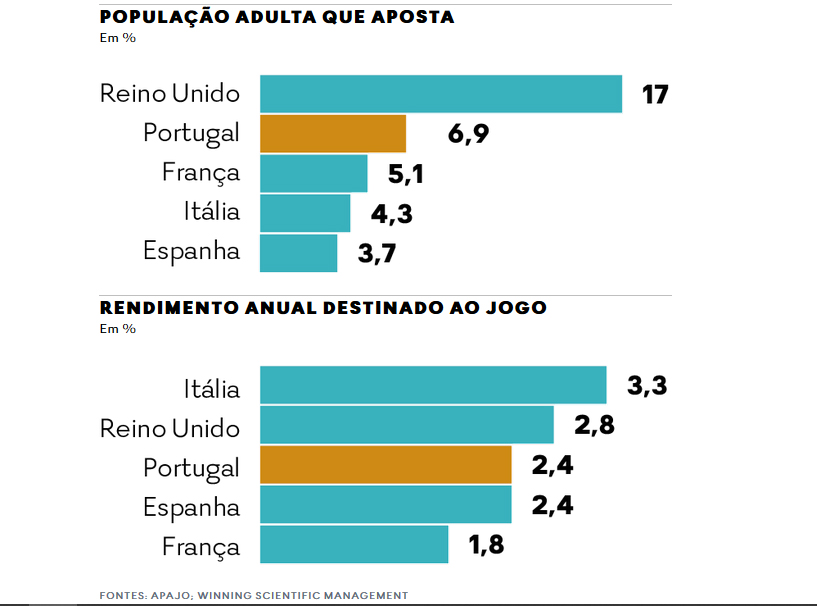
The report published by APAJO compared Portugal with four countries — France, Italy, Spain, and the United Kingdom; these five, along with Denmark, Poland, and Ireland, represent “about half of the gross revenue generated by the industry.” In the Portuguese case, 6,9% of adults play and bet online: this is the second highest penetration rate among the five countries analyzed, only behind the 17% of the United Kingdom, which has a fairly large domestic market, with more than 33 million accounts, almost 9 million players, and an average of 3,80 accounts per person in 2017.
After doing the calculations, both APAJO and SRIJ arrive at the same figures regarding the gross revenue of Portuguese operators, after all prizes have been paid to customers: 152 million euros. In other words, last year each player yielded slightly more than 257 euros to the bookmakers, the average amount each bettor lost to the operator. If you identify with this feeling of loss, know that in the United Kingdom—due to its gigantic market—each bettor gave up 714 euros. However, when these values are translated into a percentage of citizens' annual income, it's about the same: the Portuguese spent 2,4% of their budget, the British 2,8%. This doesn't mean that operators get away completely unpunished with consumers' unlucky money: the legalization of gambling brought the Online Gambling Tax (IEJO), which allowed the State to collect 66,5 million euros last year, 22,7% more than in 2017.
Transparency, protections
Last year, the SRIJ (Portuguese Gambling Regulatory Authority) detected and notified 338 illegal operators to cease their online activity, and 270 websites were blocked that, despite not having a license, continued to offer online betting to the public. In addition, “13 reports were filed with the Public Prosecutor's Office for the purpose of initiating the corresponding criminal proceedings.” However, this work by the regulator does not satisfy APAJO (Portuguese Association of Gambling Operators), representing “the majority of licensed operators,” such as Betclic, Bet.pt, and ESC Online. Although they conclude that “the market is functioning well” and that “consumers are adequately protected,” in line with what happens in other countries analyzed, they warn that there is a lack of protection for legal operators and, above all, a lack of “depth and transparency” in the information provided by the SRIJ. They want more complete information and a more comprehensive fight against unlicensed operators. In Portugal, there is no public “blacklist” of prohibited websites.
It's worth examining the conclusion that "consumers are adequately protected." Portugal and the other countries analyzed in the report published by APAJO require verifying the identity of each player and impose limitations on the amount that can be wagered and deposited (only France does not limit deposits). However, only Italy and the United Kingdom limit how much a person can lose to gambling. Diogo agrees with the measure and thinks Portugal should follow it, "because that way people would be more protected... from themselves." Tiago, based on the certainties and disappointments he hears every day in the café, says that "everyone knows what's best for themselves; as long as they are of legal age, they can bet as much as they want. The sites aren't anyone's parents, they don't have to worry about people's addictions." And the State, through the SRIJ, doesn't have one? Tiago repeats that it doesn't. He also disagrees with limitations on advertising by betting companies: in Portugal, there are limits on the content and space they can occupy, but in Italy "all advertising will be prohibited from June 14th", except for odds comparisons on television and the internet.
Four years after legalization, this complex world of guesses, probabilities, luck, and misfortune is definitively established in the lives of the Portuguese and is growing. For Diogo and his colleagues, it will never be more than a distraction with minimal risks. In Tiago's café, casual gamblers will continue to be the majority, with more slight losses than large gains. After all, "gambling is a business like any other. It's designed for losing money, not winning, isn't it? And almost everyone who says they win a lot of money... is lying." ( Expresso.PT – Tiago Soares, text and Liliana Gonçalves, infographic)