
How 'bet bookmakers' fuel a multi-million dollar illegal market and offer betting opportunities even to minors.

In the shadow of the legal sports betting market, there exists today in Brazil a universe of illegal betting that is the target of a Parliamentary Commission of Inquiry and that moves hundreds of millions of reais thanks to "bet bookies," reveals a report by BBC News Brazil.
A bookmaker is typically someone who sells tickets for events, such as concerts and sporting matches, and makes a profit from it. In the betting market, bookmakers act as intermediaries for illegal betting sites and are an alternative for those who are prohibited from betting through legal channels, such as minors.
Illegal betting sites rely on bookmakers to receive bets and pay out winnings, and these bookmakers receive a commission for each transaction. They also use social media to advertise their services and the best offers.
On Facebook, groups with tens of thousands of people offer illegal gambling throughout the day.
Bookmakers attract bettors by offering higher prizes than legal betting sites and prohibited bonuses.
On Instagram, pages with thousands of followers also offer these services. In some cases, they even use names similar to those of legally registered businesses.
Illegal betting sites run by bookmakers often offer, for example, a welcome bonus. Offering an initial amount of money to bettors is prohibited by law.
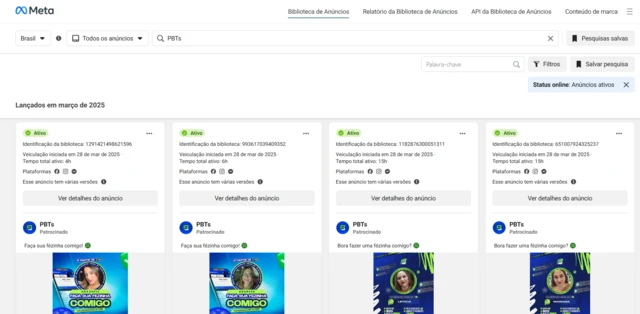
BBC News Brazil found hundreds of ads offering illegal gambling on platforms owned by Meta, the company that controls Facebook and Instagram.
In the company's advertising library, which provides access to advertising content promoted on its platforms, just one of these profiles, Cambistas 24 horas, had 110 ads running.
After the news outlet questioned Meta about it, the advertisements stopped appearing in the files.
In response, the company stated that "advertisers wishing to promote gambling or online games need to request written permission from Meta and provide proof that their activities are licensed by a regulator or established as legitimate in the territories where they wish to display such content."
Most of the time, social media serves as a lure for another digital environment where bets are actually placed through bookmakers, such as clandestine websites and messaging apps like WhatsApp and Telegram.
A recent survey by the Ministry of Justice of São Paulo (MJSP) showed that 10,5% of the teenagers interviewed gambled in the last year.
With restrictions placed on regulated betting sites, illegal betting operations and bookmakers become the only way for teenagers to continue gambling.
By law, in addition to minors, football coaches, players, referees, and members of regulatory bodies are prohibited from betting.
Companies also need to prevent individuals from compromising their income with gambling or from gambling addicts.
The government is also seeking to create a registry that will include those who are prohibited from gambling by court order.
In April, the government announced its intention to prohibit beneficiaries of the Bolsa Família and Benefício de Prestação Continuada (BPC) programs from gambling.
Betting houses also often restrict bets from customers when suspicious activity is observed, such as using a strategy known as "arbitrage," in which bets are placed at different bookmakers to profit from any outcome.
Since the regulated sports betting market began operating in Brazil on January 1st of this year, the more than 150 authorized betting houses have been generating between R$ 20 billion and R$ 30 billion every month, according to a recent estimate from the Central Bank.
The Undersecretary for Monitoring and Oversight at the Ministry of Finance, Fábio Macorin, says that the search for illegal ways to circumvent the restrictions imposed by the regulations was to be expected.
But he says this is causing him considerable concern because of the sums of money being moved clandestinely.
In just the first two months of 2025, Brazil recorded approximately R$ 350 million in illegal betting transactions, according to information released by the website Aposta Legal. The survey identified more than 30 million visits to these sites.
"The rules are made to protect consumers, but there are cases in which the restrictions can reinforce the illegal market," says Macorim.
The issue is not unique to Brazil. With fairly strict regulations applied to the sector for years, Argentina has seen a surge in the activity of so-called "cajeros," who perform the same function as money changers in the country.
The limitation on access to regulated websites goes beyond age restrictions. Betting sites can also only have clients in the region of the country where they are authorized to operate, for example.
In 2024, a survey by UNICEF, the United Nations fund for children and youth, showed that 8 out of every 10 young people in Argentina had placed a sports bet or knew someone who had done so during that year.
Of these, 30% said they used cashiers or intermediaries to place their bets.
Last September, the suicide of a 22-year-old who had started gambling at age 17 and spent US$140 (R$830) on gambling shocked Argentina.
“It’s something that’s completely normalized in the country, especially among men. The average age for starting to gamble is around 13 years old,” explains Lucía Fainboim, director of the consulting firm Bienestar Digital.
"There's a sense of control, since many think they know enough to win."
According to Fainboim, the role of cashier is usually welcome in Argentine society, as it often represents a way for families to earn extra income.
In addition to those who advertise on social media, many act as intermediaries for bets for people close to them who have some limitation in gambling legally.
According to the president of the National Association of Games and Lotteries (ANJL), Plínio Lemos Jorge, the strict regulations created by some countries may encourage illegal activity.
"If the requirements are too stringent, the illegal prevails over the legal, as in the cases of Portugal and Argentina," says Jorge.
Open space for blows.
In a group monitored for weeks by reporters, reports of scams were common, with bettors reporting losses in an environment with no guarantees.
After depositing the required sums to "validate the tickets," as the games are commonly called in this industry, the bettors were unable to receive their winnings.
In several cases, bettors claim that the betting sites required a deposit of at least R$100 before their funds could be withdrawn, but that even after the transfer, the amount remained withheld.
On Reclame Aqui (a Brazilian consumer complaint website), pages belonging to unregulated betting shops that advertise with money changers are accumulating complaints about non-payment.
A survey conducted by the technology company Idwall, in partnership with Opinion Box, reveals that 18% of Brazilian bettors have already been victims of some type of fraud on betting platforms, which corresponds to almost 10 million people.
"There is deception through various means, such as the promise of false gains," Jorge points out.
The president of ANJL states that non-payment of prizes has been happening very frequently, in addition to the fraudulent use of the image of legally registered businesses to attract potential victims.
"The legitimacy of regulated websites is among the biggest factors attracting illegal establishments," says Jorge.
On Instagram, the Bet365br page has 300 followers. The profile promotes a series of unregulated raffles and promises "commissions of up to 30%" for bookmakers who wish to connect with the company, which uses the name of the British company Bet365, licensed to operate in Brazil and one of the largest in the world in the sector.
In response to the report, the British company stated that it has no connection to the account disclosed in Brazil.
The role of influencers
There is great concern about profiles promoting illegal gambling. On social media, famous figures showcasing unregulated betting sites and exorbitant winnings are a constant occurrence.
This is being investigated in the Senate by the Parliamentary Commission of Inquiry (CPI) on Bets in the Senate.
In his testimony to the Commission, Delegate Lucimério Barros Campos showed that illegal betting houses and influencers lie on social media.
He was responsible for Operation Game Over in Alagoas, carried out based on complaints from people who had lost significant sums of money in betting houses.
The police officer explained that illegal betting sites use digital payment intermediaries, who receive bets from bettors via Pix (Brazil's instant payment system) and then forward the money to the betting sites.
In his testimony, he stated that the illegal gambling houses hire influencers and allow them to use fake accounts on the gambling app to simulate winning money from bets and publicize it to their followers.
Thus, according to the police officer, the influencer would earn money from the betting company for attracting more bettors, not by betting on the platform himself.
In Argentina, at the end of 2024, a major judicial operation charged 14 influencers for promoting cashier services.
“Influencers are very important, being the key to seduction. They appear successful and making money, which is very tempting,” says Fainboim.
According to Macorín, there needs to be an evolution towards standardizing the advertising of legalized establishments, since "many influencers are promoting illicit activities."
In their view, an improvement in the criteria regarding what is permitted and within the bounds of regulated gambling paves the way for betting advertisements to mitigate the promotion of illegal gambling.
Currently, a bill is being analyzed in the Chamber of Deputies that defines rules for digital influencers to advertise online betting and digital casinos. The proposal is that certification would be the responsibility of the Ministry of Finance and would include mandatory training on the risks of gambling.
Influencers who promote gambling without proper certification or without these warnings would be subject to fines ranging from R$10 to R$1 million.
With stricter regulations and enforcement on the subject, Lemos points out that influencers are more concerned about not promoting illegal gambling, but emphasizes that there is still a lot of misinformation circulating.
"They are easily deceived, including with the presentation of fake regularization licenses by the illegal houses," he says.
The idea is also that social media platforms that carry advertising or promotions for betting should require influencers to have valid certification.
Combat measures
The Lula government states that it is paying attention to the issue and is seeking to strengthen the fight against illegal betting.
Since the regulation came into effect, 177 cases have been opened against websites and profiles with irregularities, while approximately 11 clandestine website addresses have been taken down in the country.
According to Macorin, when the monitoring department detects any irregular activity on social media, it requests the removal of the profiles from Meta through an exclusive channel.
However, he points out that there is no specific monitoring by the company, which acts only on complaints.
Regarding fact-checking in more closed spaces, such as WhatsApp and Telegram groups, Macorin acknowledges that there are significant limitations due to the privacy of these platforms, since conversations take place in non-public environments.
In this way, legal action is limited, since regular oversight does not cover the possibility of infiltration in these cases.
Lemos advocates for greater identification of payment methods, with increased control over financial transfers. Furthermore, he believes that more cases of punishment for those who promote illegal betting could serve an educational purpose and discourage new individuals from doing the same.
"That way, people will understand that it's not a joke, that it's something serious and that it harms families," he says.