
Foreign-owned consortium wins Lotex auction with sole bid.
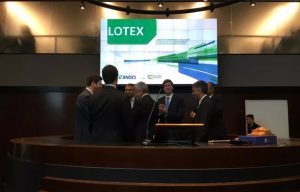
The Estrela Instantânea consortium, formed by the American company IGT and the Italian company SGI, won this Tuesday (22), with a single proposal, the auction for the concession of Lotex, the federal public service of Exclusive Instant Lottery.
Instant lottery, also known as scratch-off lottery, is a type of lottery where the player knows, the moment they scratch the card, whether they have won a prize or not.
The sole participant in the auction offered a payment proposal of R$ 96,969 million for the initial installment, just R$ 1 above the minimum required (R$ 96.968.123,51). The auction was held at B3 headquarters in São Paulo.
The total concession fee to be paid to the Federal Government in the coming years will be R$ 817,9 million, considering projected inflation. Of this total, 13% will be allocated to the National Public Security Fund. The consortium may make the payment in 8 annual installments, which will be adjusted for inflation (IPCA).
The consortium is formed by International Game Technology (IGT) and Scientific Game International (SGI). The first company is based in London but is controlled by an Italian group; the second company is from the United States. Together, the two currently hold 80% of the instant lottery market share worldwide, which is estimated at US$80 billion per year, according to Roberto Quattrini, a representative of the consortium.
Business potential
The consortium expects to earn around R$ 112 billion over the 15-year concession period. According to Roberto Quattrini, director of ITG in Brazil and representative of the consortium at the auction, in Italy, the two companies that operate the instant lottery, known here as "scratch-off tickets," earn R$ 45 billion annually.
In Brazil, this type of loan no longer exists; it was discontinued by Caixa Econômica Federal in March 2015. According to Quattrini, the maximum revenue the state-owned bank managed to generate from this product in the country was R$ 215 million per year.
Instant lottery tickets will be sold at lottery outlets across the country approximately six months after the contract is approved. That is, between June and July 2020.
The government attempted to auction off Lotex on two other occasions, without success. A first auction was scheduled for July of last year and another for May of this year, but neither received any bids from interested companies.
“This [auction], specifically, the Lotex auction, was a thorn in our side. Because we were stuck in the throat because we had failed,” said Wesley Cardia, secretary for the promotion and support of partnerships between federative entities of the PPI. “For us, it was a lump in our throat that today, finally, has been swallowed,” he added, noting that the program's auctions have been successful and have gained the confidence of investors.
The main change made in this bidding process compared to the previous model was the increase in the number of concession installments, which went from four to eight annual payments, according to Guilherme da Rocha Albuquerque, head of the privatization department at BNDES.
According to the terms of the tender, interested parties needed to prove they had raised R$ 560 million from such operations in other countries over the past 12 months, approximately half of the original amount of R$ 1,2 billion.
The minimum bid for the concession has also been reduced. In the first attempt to sell the concession in July, the government expected a minimum bid of R$ 1 billion. In the second auction attempt, the bid had already been reduced to R$ 642 million. In Tuesday's auction, the minimum bid was set at R$ 542,1 million.
The government avoided classifying the lack of competition in the auction as a problem. "In this deal, despite the lack of a premium, what's far more important than the concession fee is the revenue over time. It's a considerable amount for public coffers," the secretary stated.
According to him, even though the instant lottery sector is "relatively small" when compared to the oil and gas sector, opening the market should generate jobs and help in the resumption of economic growth. Lotex operated as a monopoly for 58 years.
Studies prepared by BNDES indicate a potential revenue of around R$ 6 billion starting in the fifth year of service operation. According to BNDES, the deal should generate R$ 19 billion in present value (i.e., without adjusting for inflation) for the government over the 15-year concession period. If taxes are included, the estimated amount reaches R$ 23,5 billion in present value.
The Secretary of Evaluation, Planning, Energy and Lottery, Alexandre Manoel, said he expects that, within 5 years, the consortium will be able to generate enough revenue to transfer between R$ 1,5 and R$ 2 billion annually to the government. This portion corresponds to the so-called "voluntary tax," which the operator must pay to the Federal Government.
By regulation, 65% of the revenue from instant lotteries must be returned to bettors in prizes. Another 18,3% is used to remunerate operators, and 16,7% corresponds to voluntary tax, resources that go into the public budget. (By Luísa Melo) G1 Economy)

