
Datafolha: 81% of Brazilians neither gamble nor associate with gamblers, but 78% support banning betting.
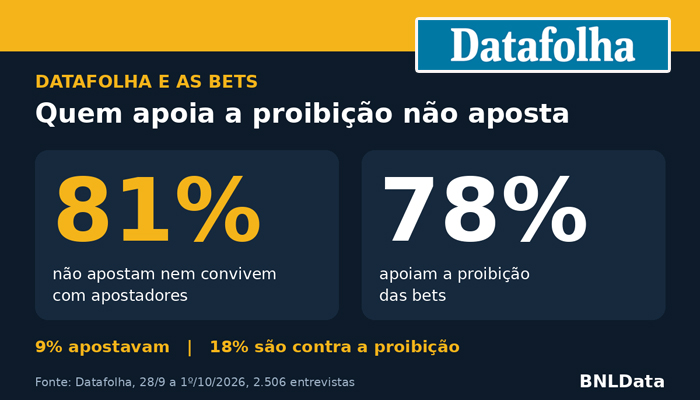
The Datafolha survey released this Thursday (1st) by Folha de S.Paulo was presented with a striking number: 78% of Brazilians say they are in favor of banning online betting and casinos, as determined by Provisional Measure No. 1.394/2026. The other data from the survey, published in two newspaper reports, tell a more complex story: ' Datafolha: 78% say they are in favor of banning betting, and 18% say they are against' and ' Datafolha: 18% say they used to bet online or had someone at home who did '.
The main finding is in the second report. According to Datafolha, 81% of those interviewed stated that they neither gambled nor had anyone in their household who gambled before the ban. Only 9% said they were gamblers (6% only the interviewee themselves and 3% them and another person in the household), and another 9% indicated only one family member.
The math is simple. Even if all respondents with someone gambling at home were in favor of the ban, at least 59 of the 78 percentage points of support would come from households with no contact with gambling. In other words, at least three out of four supporters of the measure are giving their opinion on a product they don't consume.
Rejection is double the number of bettors.
Another striking statistic: 18% oppose the ban, double the 9% who declared themselves gamblers. This indicates that resistance to the measure extends beyond those who gamble and reaches Brazilians who do not gamble but disagree with the prohibition of a regulated activity. Folha did not publish the correlation between opinion on the Provisional Measure and gambling habits, information that would allow for a precise measurement of this group.
The "increase" that is unsustainable
The report states that the data points to a "scenario of increase" in gamblers, comparing the current 18% with the 7% recorded in July. The questions, however, are different. In July, Datafolha measured who was gambling. Now, it added those who were gambling to those who had a gambler in their household.
In the correct comparison, the index went from 7% to 9%, a variation within the margin of error of two percentage points. Furthermore, the July survey polled voters aged 18 or older, while the current survey presents results for the 16-24 age group.
Those in debt are betting less than average.
Both reports remind readers that, in July, 6% of Brazilians who considered themselves indebted were gambling, a rate lower than the 7% of the total population. In the following paragraph, the texts claim that studies link these platforms to increased indebtedness. However, the institute's own data does not confirm this relationship.
Bolsa Família: data pointing to the illegal market.
Datafolha recorded that 31% of Bolsa Família beneficiaries gambled or had someone in their household who gambled, compared to 14% among non-beneficiaries. The number was presented as evidence of the reach of gambling among the poorest, but it reveals something else.
Beneficiaries of the program were prevented from betting on authorized platforms. By order of the Supreme Federal Court and regulation of the Prizes and Betting Secretariat of the Ministry of Finance, licensed operators were required to block the registration and betting of those individuals with CPF numbers (Brazilian taxpayer identification numbers).
The research did not ask where the bets were placed, and the index includes other household members who may not be beneficiaries. Even so, if the ban applied to the regulated market, bets placed by the beneficiaries themselves could only occur on illegal websites, which do not consult any government databases, do not pay taxes, and offer no protection to the player.
The data, therefore, does not measure the effect of regulated betting on the most vulnerable. It indicates the reach of the illegal market, which the prohibition does not affect and to which the public that previously bet with authorized companies tends to migrate.
The timing of the research
The provisional measure was issued on September 25th. The Datafolha poll was conducted between September 28th and October 1st, starting three days after the measure was issued, at the height of news coverage and the government's campaign on the subject, just days before the election.
The timing influences the responses. Respondents were asked about a habit that was already prohibited, which may inhibit those who gambled from disclosing their opinions. The question also doesn't specify a time period: it refers to betting "before the prohibition," without a date.
The first report mentions "maintaining public perception," and in the following sentence, it notes a 13-point increase in support for the ban compared to November 2024 (from 65% to 78%).
The survey interviewed 2.506 people in 152 municipalities and is registered with the TSE under number BR-08039/2026.

