
Owners of gambling stalls in Rio Preto advocate for legalization to emerge from the underground market.

"Only those who play win." The phrase is on the wall of a bar in Rio Preto, attached to the numbers and images of the 25 animals in the jogo do bicho (animal lottery). Bets are placed using machines or handwritten tickets, an older system used by elderly bookmakers averse to technology. "I don't know how to use the machine. You have to type in codes," said the owner of one bar.
Despite the prohibition, everything is done clandestinely and in broad daylight. This even includes the sale of virtual bingo cards – priced at R$ 0,50 – which broadcast live draws at scheduled times in bars and parties, displaying the winning numbers on televisions.
On the other side of the counter, bar owners are cheering and following the progress of the bill that promises to legalize gambling in the country. "If it were legalized, we wouldn't be afraid to sell and think that the police are going to burst through the door at any moment," said one bar owner interviewed by the newspaper on condition of anonymity.
In addition to the jogo do bicho (a type of illegal lottery) and bingo, the proposal includes the regulation of casinos and online gambling. The proposal has already been approved by the Chamber of Deputies and has been sent to the Senate for evaluation. If approved, it will be up to President Jair Bolsonaro (PL) to either sign or veto the bill, which is dividing opinions.
Currently, the Civil Police are responsible for monitoring and suppressing gambling. The report easily identified at least five locations – distributed throughout various parts of the city – where bets are placed and games are played with a loyal clientele. The bars receive a percentage of sales from both the illegal lottery game "jogo do bicho" and virtual bingo. Some bars even hold in-person bingo games with cash prizes on weekends.
The assistant delegate of the Rio Preto Regional Police Station, Alexandre Arid, who acted as coordinator of the Special Operations Group (GOE) in the fight against gambling in the city, states that there are ongoing police investigations to investigate alleged money laundering crimes that have been forwarded to the Specialized Division of Criminal Investigations (Deic).
“We have a monthly operation called 'Manthus'. It's carried out every month to combat these illegal games. It's a permanent operation that aims to have each police district carry out activities to combat this offense,” said Arid.
Among the negative aspects, besides money laundering, gambling can contribute to prostitution, drug trafficking, and increased addiction. "I don't have the technical capacity to assess the harm that gambling can cause in a citizen's life. As long as the law prohibiting gambling is in effect, we will comply with the law. If a law comes along and makes it a legal activity, we will stop monitoring it," stated the police chief.
Federal Deputy Geninho Zuliani (União Brasil) defended legalization on social media. “These are games that exist in Brazil today, but are not legalized in practice, generating revenue exceeding R$ 25 billion that could be taxed, improving health and education. Not to mention the people who work in these sectors without any regulation. Many without social security rights, working illegally. We have taken a great step; only Brazil and North Korea do not have these games legalized,” the congressman stated after voting on the bill in February.
Addiction is treatable.
The Rio Preto City Hall stated that psychological services in the municipal health network can assist people addicted to gambling. "The demand for treatment for this type of compulsion is very low in the network, but the treatments available are tailored to the severity of the condition and the needs of each patient – they can occur in Primary Care when dealing with less complex cases with less impact on the individual's functionality, or in Specialized Care, with more intensive attention, for cases of greater severity and impairment," the statement reads.
The Ministry of Health advises compulsive gamblers to seek professional help and share their difficulties with trusted individuals. Family and friend support is important in coping with psychological distress and in finding strategies for self-control. "This pathology is not monitored individually. I emphasize that the spontaneous or referred seeking of this type of problem is very low," the statement says. (RL)
Olympia is already receiving inquiries about a casino.

The City Hall of Olímpia has already received inquiries from investors about the implementation of a casino in the city, which is considered a tourist hub in the Rio Preto region. “Regarding gambling, we have already received inquiries from groups interested in the subject, studying Olímpia as a possible location, especially groups from abroad. I foresee that, if approved, Olímpia meets the conditions and, as a Tourist Resort, it cannot be left out,” stated Mayor Fernando Cunha (PSD) on Friday, the 18th.
Cunha, however, stated that he does not yet have a formed opinion on the approval of the bill regulating gambling in the country. “I believe that, initially, bingo halls and electronic gaming establishments would be made viable in a professional manner, with food courts and associated entertainment. Regarding casinos, I imagine that, being large-scale projects, they will be installed in municipalities such as capitals and even on the coast, since cities the size of Olímpia should be considered at a later stage,” Cunha stated.
According to the proposal, cities classified as tourist hubs or destinations will be allowed to install a casino, regardless of the population density of the state in which they are located. "The proposal defines these locations as those that possess regional identity, adequate infrastructure and supply of tourist services, a high density of tourists, and the title of natural heritage of humanity, in addition to having tourism as an important economic activity," states a note from the Federal Chamber.
The project also stipulates that a tourist casino cannot be located less than 100 kilometers away from any casino integrated into a leisure complex. (RL)
What does the project say?
It legalizes gambling, such as bingo, jogo do bicho (a type of lottery), betting, and casinos, requiring either permanent or temporary licenses.
casinos
They may be installed in resorts as part of an integrated leisure complex, which must contain at least 100 high-standard hotel rooms, meeting and event spaces, restaurants, bars, and shopping centers.
The physical space of the casino must be, at most, equal to 20% of the complex's built area, and electronic games, roulette, card games and other authorized modalities can be played.
Each economic group may hold only one concession per state, and accreditation will be done by public auction in technical and price terms.
In locations classified as tourist hubs or destinations, the installation of a casino will be permitted, regardless of the population density of the state in which they are located.
A tourist casino cannot be located less than 100 kilometers away from any casino integrated into a leisure complex.
There is the possibility of casinos on river vessels, with one for each river between 1,5 km and 2,5 km in length; two for each river between 2,5 km and 3,5 km in length; and three for each river longer than 3,5 km.
Bingo
Allowed only in bingo halls. Municipalities and the Federal District are permitted to operate bingo games in stadiums with a capacity exceeding 15 spectators.
The minimum area is 1,5 square meters, where up to 400 video bingo machines can be located. Slot machines will be prohibited.
According to the text, a maximum of one bingo hall will be accredited for every 150 inhabitants. Licensed locations will have a 25-year authorization, renewable for the same period.
Animal game
For the legalization of the jogo do bicho (animal lottery), the text requires that all records of the licensee, whether for bets or drawings, be computerized and accessible in real time (online) by the Federal Government, through the Audit and Control System (SAC).
The accreditation will be for a period of 25 years, renewable for an equal period if the requirements are met. There may be a maximum of one operator of this game for every 700 inhabitants of the State.
The redemption of prizes up to the Income Tax exemption limit will not require identification of the bettor.
All company records, whether from bets or drawings, must be computerized, with the possibility of real-time access by the Federal Government, for monitoring purposes.
online betting
The operation of online games will depend on specific regulations, which will be drawn up by the Ministry of Economy. This ministry will be responsible for formulating policies to organize the gaming market in general and overseeing the operation of these activities in the country.
Taxes
The bill creates Cide-Jogos, a tax with a fixed rate of 17% on betting operations.
It also establishes a 20% income tax rate on prizes exceeding R$ 10 – the income tax will be levied on the net profit, that is, the prize amount minus the cost of placing the bet.
The revenue will be distributed among the federal government, states, the Federal District, and municipalities.
What is the situation in Congress?
Bill 442/1991, reported by Representative Felipe Carreras (PSB-PE), was approved in the Chamber of Deputies with 246 votes in favor.
and 202 against.
It was forwarded to the Federal Senate, where it will also be put to a vote.
If approved, the bill goes to the President of the Republic, who can veto or approve it. (Source: Agência Câmara de Notícias)
Enforcement is a challenge.
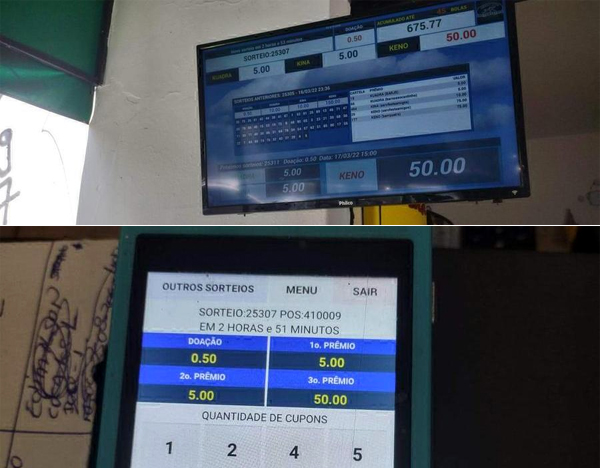
Monitoring gambling is one of the main challenges for the Civil Police. With the use of technology, it is becoming increasingly difficult to detect irregularities that constitute criminal offenses – as stipulated in article 50 of Decree-Law number 3.688/41. Generally, the courts convert convictions for operating gambling into community service, in addition to fines.
“Bingo and the jogo do bicho [a type of illegal lottery] have virtual versions. You have to access television, a server, you have to request judicial authorization. Technology has made it more difficult for investigations to be faster,” stated the assistant delegate of the Rio Preto Regional Police Station, Alexandre Arid. “But I am certain that the Civil Police are doing their job to curb these illegal gambling offenses. We uphold the law.”
In bars, for example, they have the illegal lottery machine. The police chief, however, stated that the challenge is to "attack the betting shop," where the game is managed, in order to reduce its incidence. "We identified and dismantled two betting shops. But it's like narcotics; on every corner there's a situation that makes our work difficult due to the large number of illegal gambling operations that exist today," said Arid. (RL)
Institute advocates for regulation.
The Brazilian Legal Gaming Institute advocates for the regulation of the sector, which has the potential to generate R$ 22 billion in taxes per year and formalize 450 jobs related to the jogo do bicho (illegal lottery) alone. The institute's president, Magno José Santos de Sousa, states that the legislation should encourage investments in the construction and implementation of casinos in resorts, bingo halls, jogo do bicho shops, and online sites.
"It will fuel the entire production chain of gambling games, including companies in IT, furniture, decoration, chips, betting slips, playing cards, electronic equipment, among others. It will also generate tax revenue for the Federal Government, States, Municipalities, and social projects through the payment of the CIDE-Jogos tax," he stated.
Sousa stated that the tourism sector will also benefit. “Besides keeping tourists in the destination for longer, the attraction is a decisive factor in choosing a tourist destination. A tourist will always opt for a destination that has a casino over one that doesn't,” he said. Other benefits include tax revenue, in addition to the economic impact on the production chain, which will lead to significant investments in the tourism, leisure, and cultural sectors. Furthermore, it will generate resources for the Embratur tourism agency so that it can promote Brazil abroad.
According to the institute's representative, if the bill is approved, the operation of games and betting will be permitted in physical or virtual establishments, provided that the interested party, a legal entity necessarily constituted as a public limited company with headquarters and administration in Brazil, obtains a license to operate as an operator. This operator must also have a minimum capital, depending on the segment in which it chooses to develop its activities. "To ensure the viability of its operation, operators must comply with the rules established for companies in general and in accordance with the regulatory acts issued by the Ministry of Economy," stated Sousa.
According to the institute, the Brazilian gaming market, with the legalization of all modalities, has the potential to gross R$ 74 billion (1% of the 2020 GDP of R$ 7,4 trillion) and generate approximately R$ 22 billion in tax revenue per year. "This amount does not include the concessions, estimated at over R$ 7 billion, in addition to investments and the economic impact of the production chain," stated the president of the entity.
The study by the Brazilian Legal Gaming Institute also estimates that the jogo do bicho (illegal lottery) alone would formalize around 450 jobs. "If we consider other modalities, formalizing the industry could provide around 650 direct jobs and 200 new positions, not counting the gaming production chain which could generate thousands more jobs," he stated. (RL)
Compulsion affects relationships.
Psychologist Mara Madureira warns that a person with a gambling addiction becomes obsessed with betting and strategies, compromising family, romantic, and even work relationships. They may resort to lying, borrowing money, and are unable to repay it or stop gambling.
"She ends up committing illegal acts such as embezzling money. The bets involve increasingly larger sums. The more she loses, the more she tries to recover what was lost. She shifts her real life concerns to worrying about gambling, as if it were a way of avoiding confronting the situation," said the psychologist.
According to Mara, a person will only be able to stop gambling if they undergo treatment involving medication or psychological counseling, or as a result of a traumatic event. "Something that can have a very large impact on their life. Either positive or negative," said the expert, comparing gambling to chemical dependency.
She states that addiction is dangerous because it causes the person to lose credibility, breaking family and social ties. “They may develop depression. If left untreated, it can lead to serious cases and, in extreme cases, suicide. They will destroy the family, who can't cope with the lies, the embezzlement, and the theft to gamble,” said the psychologist. (RL)
License to operate bingo halls
The proposal calls for the installation of one bingo hall for every 150 inhabitants per municipality. The license will be granted through a bidding process based on the highest proposed investment and the highest bid, with a minimum value equivalent to the paid-in capital. The paid-in capital will be R$ 10 million.
"Each establishment will be allowed to have 400 video bingo machines, and operation will be authorized in stadiums with a capacity of over 15 spectators," according to a study by the Legal Gaming Institute.
Regarding the jogo do bicho (illegal lottery), the license will also be granted through a bidding process based on the highest proposed investment and the highest bid to obtain the license, with a minimum value equivalent to the paid-in capital, with paid-in capital of R$ 10 million and a reserve of resources as a guarantee for payment. One license may be granted for every 700 inhabitants in each federative unit.
Slot machines were left out of the proposal approved by the Chamber of Deputies. The institute, however, argues that these machines should be included by the Senate in the final text of the law.
“These machines aren’t going to disappear overnight. If they aren’t legalized and regulated in small establishments, they could end up migrating to truly criminal structures like militias and prison organizations,” stated the president of the Legal Gaming Institute, Magno José Santos de Sousa. ( Diário da Região - Rodrigo Lima – Rio Preto – SP)

