
A study by Anbima contradicts the narrative of "widespread addiction" and does not call for a ban on betting.
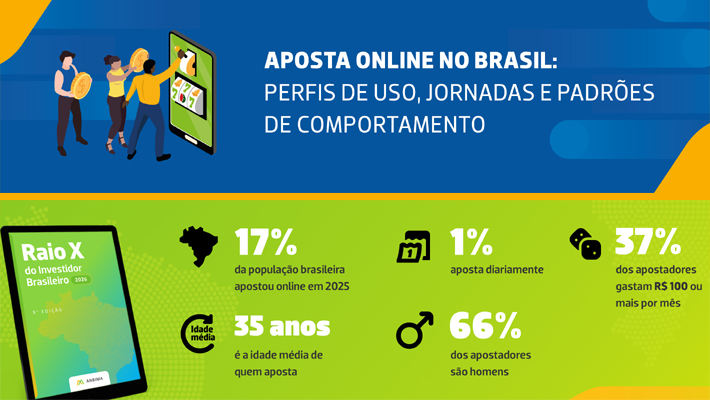
This week, Anbima released the study "Online Betting in Brazil: Usage Profiles, Journeys, and Behavioral Patterns," produced in partnership with the consulting firm Kyvo, based on in-depth interviews with 60 current and former bettors across the country's five regions. Valor has already reported on excerpts from the material, emphasizing the risks identified by the research. A complete reading of the report, however, reveals a series of findings that relativize the narrative that the expansion of betting equates to an epidemic of financial recklessness—and which may be of direct interest to the regulated sector. ( Download the report )
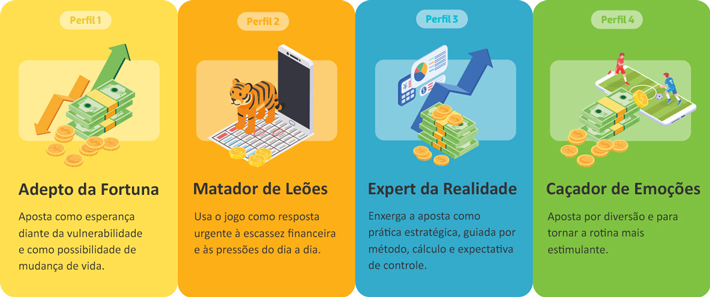
The research emerged after a growing number of Brazilians began declaring that they "invest" in bets during interviews conducted by Anbima on investment habits. The four profiles were named "Fortune Seeker," "Lion Slayer," "Reality Expert," and "Thrill Seeker."
The first two profiles are predominantly made up of women from social classes C, D, and E. The "Fortune Seeker" profile includes female gamblers who hope to get rich quickly through the platforms. The "Lion Slayer" profile, on the other hand, focuses on women facing greater financial difficulties, who resort to gambling to pay essential bills such as water, electricity, and rent.
The "Reality Expert" and "Thrill Seeker" profiles are mostly composed of young men from social classes A and B. The first group includes those who study games, develop strategies, and see betting as an alternative to the financial market. The second group includes those who got into betting through the influence of people close to them and treat the activity as a hobby to combat boredom.
Most gamblers show no warning signs.
The study itself, when contextualizing its findings with data from the 9th edition of the Brazilian Investor X-ray (2026), acknowledges that the practice is still mostly sporadic: 7% of Brazilians rarely gamble and only 1% do so daily. Of the total number of gamblers, the group classified as having a high level of propensity for addiction totals 11% — which, conversely, means that almost 9 out of 10 gamblers do not meet this risk criterion. The report itself explicitly acknowledges that, "although most gamblers do not show alarming signs," there is a significant contingent in a vulnerable situation — a formulation that recognizes the normality of the majority's behavior before pointing out the problem of a minority concentrated in specific groups (men, young people, class C).
Entertainment gains ground as a central motivation.
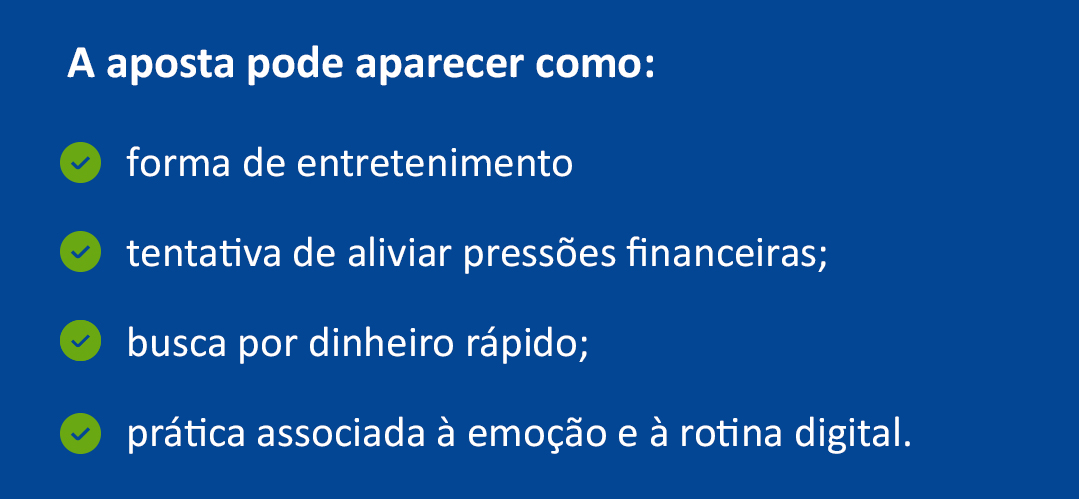
One of the most relevant findings for the sector is the growth of the recreational dimension of betting. According to the X-ray cited in the study, 32% of bettors already see the practice as a form of entertainment—a proportion that approaches the 39% who bet in search of quick gains. Kyvo's qualitative research details this behavior in the profile dubbed "Thrill Seeker": people with greater financial stability, planning ability, and resources available for leisure, who treat betting as a recreational activity associated with sporting events, with amounts separate from the essential budget and relatively stable limits over time. In practice, it is a description of healthy entertainment consumption—the opposite of the stereotype of the compulsive gambler.
Sports betting and online casino are not the same thing.
The report also makes a methodological distinction that reinforces arguments already defended by the regulated sector: not all betting modalities work the same way. Anbima differentiates sports betting — linked to events with a defined beginning and end, of more punctual use and associated with game monitoring and analysis — from continuous games, such as online casino and "tigrinho" (a type of Brazilian lottery game), which have an immediate and repetitive flow and tend to favor greater permanence. This technical distinction validates the argument that regulation, risk communication, and responsible gaming policies need to be differentiated by modality, and not treated as a single, homogeneous block generically called "bets".
The final recommendation is not to restrict, but to educate.
Perhaps the most significant point for public debate is what Anbima itself recommends at the end of the study. After mapping risks and vulnerabilities, the document does not propose prohibition, banning of additional advertising, or new regulatory barriers to platforms. The conclusion points to the strengthening of financial education programs, capable of helping the population differentiate between risk, probability, strategy, and the distinction between gambling and investment—recognizing that financial decisions “occur under time pressure, uncertainty, and continuous stimuli” throughout daily life, not just in gambling. This is a relevant editorial difference compared to discourses that treat the regulated market as the origin of the social problem of indebtedness.
Self-control exists — and people exercise it.
Another finding that was little explored in the initial report is the chapter on exit strategies from the practice. The study describes that bettors who reduce or stop using gambling adopt concrete self-regulation strategies: setting spending limits, withdrawing winnings, removing apps, blocking accounts, and restricting payment methods. Although the report frames this process as non-linear and subject to relapses, it also demonstrates that users have agency over their own behavior and use—albeit informally—the same control mechanisms (deposit limits, self-exclusion, blocking) that Brazilian regulation, under Law 14.790/2023, already requires of licensed platforms.

One caveat that cannot be left out.
It is worth noting that this study is qualitative research , based on 60 in-depth interviews—and not on a statistically representative survey of the population. Anbima is explicit about this in the methodology section: the objective was to understand the meanings and logic of decision-making, not to measure the frequency or volume of bets in a generalizable way. This does not invalidate the findings, but it recommends caution when extrapolating any of the numbers—including those favorable to the sector highlighted here—as a statistical portrait of the entire Brazilian bettor population.
What remains
The Anbima study, when read in its entirety, is more balanced than its initial reaction suggests. It acknowledges risks concentrated in specific groups, but also describes a majority of bettors who use the practice recreationally, within stable financial limits, with active self-control mechanisms—and concludes by recommending financial education, not repression of the regulated market. For the legislative debate, it represents a significant counterpoint to discourses that indiscriminately attribute the indebtedness of Brazilian families to betting.
https://www.anbima.com.br/data/files/51/96/FB/EB/E1AAF910DF3079F9BA2BA2A8/banner-donwload-jornada-do-apostador.jpg

