
Fabamaq: the Portuguese who make games for casinos worldwide.
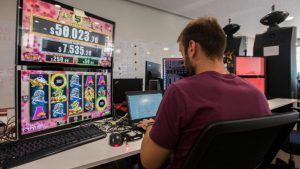
Anyone entering Fabamaq's new facilities in Campo Alegre might think the employees are playing cards on the computer instead of working, but that's not the case. Here, games aren't just for fun or a way to escape concentration; they're the core of everything done inside. Developing gaming software for casinos is the main business area of this nine-year-old startup. Among the three floors of the building, which opened in January, we find Sebastião Oliveira, head of the creative department and a company employee since day one. “I studied film in Covilhã, where I developed a lot of motion graphics, 2D animation, and special effects. I joined the team to bridge the gap between programming and the more artistic and visual aspects,” he explains in an interview with Observador.
At Fabamaq, they create traditional slot machine games, also known as land-based games, and online casino games, with electronic bingo or video bingo being their main specialty. The process begins with a product analysis team that visits trade shows in Las Vegas, England, or Macau and researches the market, identifying key needs and trends. After planning the game they will create, the technical aspects are developed, including several prototypes and mock-ups. Then the art department comes into play, composing the image and sound, and finally everything goes to the testing and quality control phase.
“Testing is a very important phase, to which we pay close attention, because it's what gives credibility to our games. If a machine malfunctions in a room, it can affect the product's image, and then that feeling spreads,” explains Sebastião Oliveira. Ideally, this process would only last a week, but there are launch cycles that can take six months.

In the creative area, Sebastião dedicates himself to designing the game in the most appealing way possible, working with various technologies. What does a good game need? "Involvement and attention to detail." According to the expert, his work is intuitive, and there are several feelings that must be conveyed in a game.
“We are in an industry where people don’t just play our games for fun, but their main goal is to make money. This evokes strong emotions in people; there’s a sense of risk, a sense of hope, an inherent danger, and a sense of luck and uncertainty.”
The decisions involve using a static image or animated content, choosing sounds or colors, and everything depends on the theme chosen for each game, whose construction process varies according to the objectives to be achieved. “The entire gaming industry revolves around themes that are created to attract players. Usually, the games have simple interactions, and the themes serve to further captivate people. There's a bingo game on ice and another in Egypt, for example. The scenarios of each theme serve as the basis for the color palette, the lettering, or for depicting the bonuses.”
Fabamaq develops the game software, but the machines are produced in the Philippines, so it's necessary to follow the entire process to try and visualize how the creations are adapted to each machine. “The goal is for the customer to have the most immersive experience possible. The machine and the game are part of the same set; the interaction between the two is essential,” emphasizes Sebastião Oliveira, adding that the machine influences and enhances each game created.
Obu Studios: the new segment of online games
In addition to more traditional slot machine games, the company ventured into the online casino gaming market in 2012, but felt the need for a team entirely dedicated to this function. Thus, last year, Fabamaq created Obu Studios, a unit exclusively dedicated to the virtual world. “We felt we weren’t 100% dedicated to this area, and it was a growth area where we could invest more,” explains Alexandre Gonçalves, head of the startup’s technical department, adding that although Fabamaq already developed online games, “we needed to take this step,” since the traditional market was already “established.”
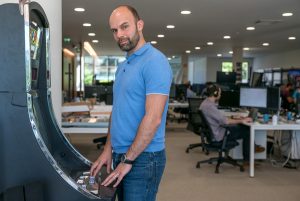
Obu Studios is located in the company's former headquarters in Boavista and employs around 20 people who work in a more "free" way, in an area where the product is defined from scratch and there are no intermediaries. While the artistic side remains largely unchanged, the same cannot be said of the more technical aspects. "Technology changes a lot in online games, what we do is maintain the content we are developing on the machines and, in a way, take advantage of it and adapt it for other devices," says Sebastião Oliveira.
Between bingo, slots, card games and roulette, in the online universe “there is much more variety”. “Almost like with car models, we always have four or five references that we are constantly working on and perfecting,” says Alexandre Gonçalves in an interview with Observador, adding that Fabamaq launches new games two to three times a year. Like Sebastião, Alexandre Gonçalves has been at Fabamaq since the beginning and still remembers the first game they marketed. “It was a bingo game with an Inka theme and it was distributed to Mexico. It wasn't a very evolved game, we didn't have enough know-how.”
One culture, one game
The Philippines, Mexico, Spain, and more recently Ireland are Fabamaq's main markets, with the Solverde Group being the only Portuguese recipient of the online games developed by the company. Adaptations are made to the games for each destination, as each culture requires different attention and sensitivity. “We've already made video bingo in Chinese, at fairs, to attract other markets, and it's not the type of game that's interesting except for Catholic cultures. The Philippines, from that point of view, fits very well because they have that Catholic connection and are an Asian country. Normally, Asian cultures are open to this type of game and technology,” explains Sebastião Oliveira.
The cultural issues of the various markets become "a real challenge".
“Something that might be perceived as positive in one place might not be so positive in another. For example, we created a game themed around Mayan culture, involving pyramids, a shower of coins, and a hand gesture of reverence. Now, the Mexican audience, who have ancestry from that culture, saw it as an insult, so we had to change everything. In Spain, the same game was never seen negatively.”
Fabamaq's focus over the past year has been on slot machine games, with plans to launch several new lines. "This is the area where we face the most challenges; production is much more demanding and the competition is also much greater," emphasizes Sebastião Oliveira. According to the creative director, the company is trying to compete with international giants. "We are trying to ensure that a company with 160 people, which isn't that large within the gaming industry, can market games alongside American giants that have five, six, or seven times our production capacity," he concludes.
In May of this year, the tech company moved from its rented office on Avenida da Boavista in Porto to new premises in the Campo Alegre area. The investment in the new 3.600 square meter space was €4,3 million. Without revealing specific figures, the company only states that its revenue grew by 43% between 2017 and 2018. (See more images on the Observador website – Maria Martinho – Photo: Ricardo Castelo – Portugal)

