
Federalism at stake: the regulatory battle of online betting.

My first classes at the Faculty of Law in Minas Gerais, in a small room at PUC (Pontifical Catholic University) Minas São Gabriel, in Belo Horizonte, addressed Brazilian federalism. Although the country, like the United States, is also a republic formed by autonomous entities, the origin of this federalism greatly impacts how we live in Brazil.
While in the North, the union of the American states gave rise to the nation – hence the name United States of America – in Brazil the process was reversed. We were born as a single entity, replacing the old Empire with the Republic. Since the imperial territory was already divided into provinces, the new form of government altered this structure little, although it came to be called federalism.
Legal sciences have borrowed the definitions of centripetal and centrifugal force from physics to define different federalisms in these environments. Countries like the USA have a centripetal federalism, meaning that the (peripheral) states tend to converge towards a greater concentration in the Union (center). On the other hand, Brazil has a centrifugal federalism, where the center (Union) would, over time, shift the force to the perimeter regions (states).
After so many years since I learned this, the online gaming and sports betting market in Brazil brings everything back to the surface when we observe the movement of state licenses. The purpose here is not to criticize the existing models, but rather to raise questions about the imbalance of power between state licenses and the federal license for operating betting.
The debate, which seemed confined to constitutional law textbooks, has now taken on practical and billion-dollar dimensions with the explosion of the online betting market. We have already seen similar situations in other disruptive and digital new markets, such as ride hailing and delivery.
On one hand, the Union, through the SPA (Secretariat of Prizes and Betting) of the Ministry of Finance, established a robust federal regulatory framework with Law 14.790 of 2023, which seeks to create a safe and transparent business environment that generates revenue for the country. The federal license, with a service price of R$ 30 million and a tax rate of 12% on monthly GGR (Gross Gaming Revenue), imposes a series of rigorous requirements in areas such as compliance, responsible gaming, prevention of money laundering, and data security.
On the other hand, supported by a 2020 decision by the STF (Supreme Federal Court) (ADPFs 492 and 493), which recognized the competence of the States to operate lottery services, federative entities such as Rio, Paraná, and Minas Gerais launched their own licenses, with significantly lower granting and taxation costs – there are state grants worth R$ 5 million and 5% on gross revenue – these licenses created a scenario of intense regulatory competition.
The discrepancy between the federal and state models is glaring and creates a dangerous competitive imbalance. While the federal license requires, for example, facial recognition of bettors, a financial reserve of R$ 5 million to guarantee prizes, and responsible gambling control tools such as time limits and self-exclusion, many state licenses are silent on these crucial points.
The table below, based on data released by IBJR (Brazilian Institute for Responsible Gaming), clearly illustrates this asymmetry:
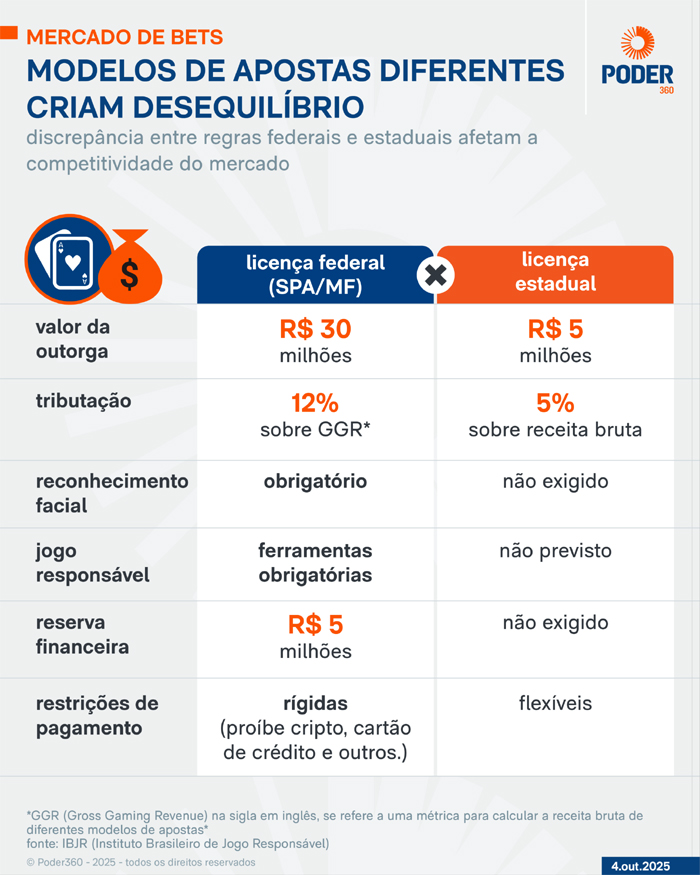
This “predatory competition,” as demonstrated by the IBJR, not only creates an unfair competitive advantage for licensed operators in the states, but also exposes bettors to greater risks, with fewer guarantees and protections. Furthermore, it weakens the fight against crimes such as money laundering and match-fixing, which federal regulations seek to curb more rigorously.
The core of the problem lies in the very nature of the internet. How can we guarantee that a licensed platform is only accessed by bettors located in that exact region? Imposing territorial limits on an essentially global service is a complex technical and legal challenge, which has been the main argument of those who defend the exclusive competence of the Union to authorize betting, as pointed out by several constitutional experts.
The Supreme Federal Court (STF) and the future of gambling in Brazil.
Amid this dispute, the Supreme Federal Court (STF) was once again called upon to rule. In a more recent decision, in September 2025 (ADI 7640), the Court declared unconstitutional provisions of Law 14.790 of 2023 that restricted the operation of economic groups in more than one state and the advertising of state lotteries nationwide. The unanimous decision reinforced the autonomy of the states and the principles of free enterprise, but, in practice, added another chapter to the complex regulatory saga, allowing state operators to gain even more strength to compete with the federal model.
We are therefore faced with a paradox: while Brazil seeks to consolidate itself as one of the largest regulated betting markets in the world, regulatory fragmentation and legal uncertainty threaten to undermine the entire effort.
The centrifugal force of our federalism, mentioned at the beginning of this article, seems to be acting with all its intensity, producing a scenario of uncertainty that does not benefit serious operators, the government, or, ultimately, the bettors themselves.
The question remains: will it be possible to find a balance that harmonizes the autonomy of the states with the need for a cohesive and secure national regulatory standard? Or will we witness a "fiscal and regulatory war" that could compromise the integrity and potential of one of the most promising markets today? The game is on the table, and the stakes are high for the future of Brazilian federalism in the digital environment. ( With information from Poder360 )

