
IBJR criticizes proposed new tax on betting and warns of growth in the illegal market.

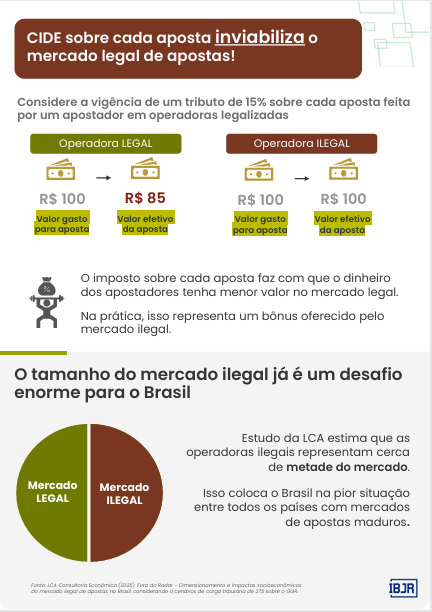
The Brazilian Institute for Responsible Gaming (IBJR) criticized the proposal by the National Confederation of Industry (CNI) to create a new tax called “CIDE-Bets”, with a rate of 15% on each bet in the regulated market. The statement was made this Tuesday (28), after the suggestion was released by the CNI. The IBJR, which represents the main sports betting companies in Brazil, considers that the measure would favor the clandestine market.
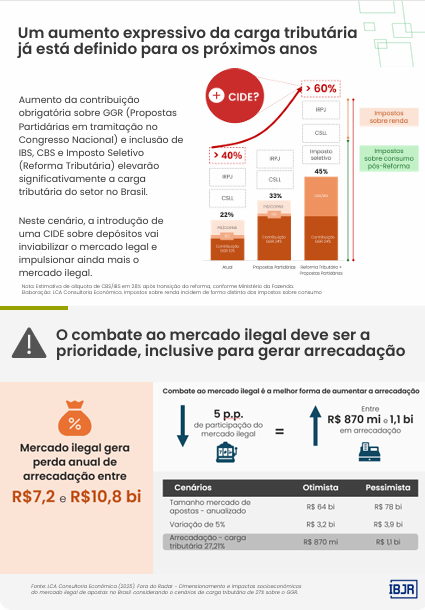
The betting sector already faces one of the highest tax burdens in the world, according to the entity. Regulated companies pay 12% on GGR (Gross Gaming Revenue), in addition to PIS/Cofins and ISS, raising the total taxation on consumption to approximately 25%. With the entry into force of the Tax Reform and the introduction of the Contribution on Goods and Services (CBS) and the Tax on Goods and Services (IBS), whose projected rate is 28%, the tax pressure on the sector is likely to increase even further.
Impact on the illegal market
The Brazilian Institute of Gambling (IBJR) disputes the estimated revenue of R$ 8,5 billion presented by the National Confederation of Industry. According to the betting industry entity, the new tax would only encourage the growth of the illegal market, which already represents about half of the volume of bets placed in the country.
A study by LCA Consultoria, cited by the Brazilian Institute for Responsible Gaming, indicates that reducing the illegal gambling market by just five percentage points could generate approximately R$ 1 billion in additional revenue per year for public coffers. Data from the Federal Revenue Service shows that regulated platforms collected R$ 6,85 billion in taxes up to September 2025, while the illegal market, which accounts for about 51% of bets in the country, represents an estimated loss of R$ 10,8 billion in revenue per year.
André Gelfi, director-advisor and one of the founders of IBJR, explained the negative effects of the proposal: “In practice, a 15% tax on each bet is equivalent to giving a reverse 15% bonus to the illegal market, an incentive created by the State itself, which would artificially increase the attractiveness of irregular platforms. It would be a reward for those who do not pay taxes and a punishment for those who comply with the law. The inflated projection of the CIDE-Bets tax is not supported by any realistic model of consumer behavior. By making the regulated market more expensive, revenue falls and crime grows.”
IBJR refutes the existence of any "tax benefit" for the sector. The organization emphasizes that it is an industry in its initial phase, trying to survive unfair competition from illegal operators.
Increasing the tax burden on regulated operators would reduce the tax base by causing bettors to migrate to illegal platforms. The clandestine companies, which do not pay taxes, would continue to operate outside the law.
The Brazilian Institute for Responsible Gaming stated that it will advocate for a balanced tax policy for the sector. According to the organization, the goal should be to strengthen the regulated market, protect consumers, and increase revenue by combating illegal operations.
The IBJR's concern gains even more relevance in light of Bill 5.076/2025, which proposes raising the GGR tax rate from 12% to 24%. The bill recently had its urgency request approved by the Finance and Taxation Committee of the Chamber of Deputies. If this proposal moves forward, combined with the Tax Reform, total taxation on consumption could reach 45,4%.
International experiences reinforce the Institute's position. In the Netherlands, the recent increase in taxes on betting led to a €200 million drop in revenue, while in Italy, excessive restrictions on advertising contributed to the expansion of illegal operations. The IBJR highlights that countries that have managed to reduce the illegal betting market have opted for tax moderation as a decisive factor in ensuring the competitiveness of licensed operators against unregulated ones.
The industry proposes a 15% tax on online betting (CIDE-Bets) to discourage the practice in Brazil.

