Gambling has been prohibited in Brazil for 85 years, and the country is repeating the same mistake with betting.
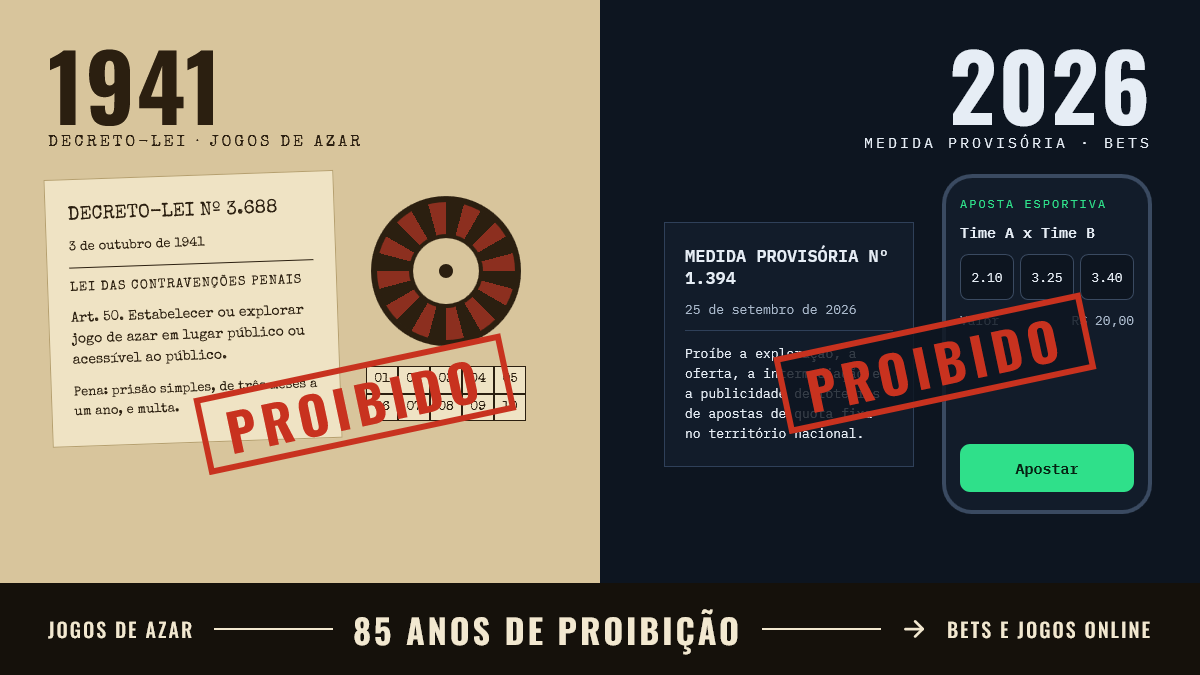
Decree-Law No. 3.688, the Criminal Offenses Law, turned 85 this Saturday (3). Signed by then President Getúlio Vargas in 1941, the law prohibited jogo do bicho and other forms of gambling in Brazil, classifying these practices as criminal offenses. This year's anniversary comes with an uncomfortable coincidence: eight days earlier, Provisional Measure No. 1.394, of September 25, 2026, prohibited the exploitation, offering, intermediation and advertising of fixed-odds betting throughout the national territory.
Three prohibitions, one same method.
The parallel begins with the form. In 1941, Vargas prohibited gambling by decree-law, without parliamentary debate. In 1946, Eurico Gaspar Dutra closed the casinos in the same way, with Decree-Law No. 9.215, ending overnight an activity that the State itself had legalized and regulated during the so-called "Golden Age" of casinos. In 2026, the instrument is the provisional measure, which comes into effect before the National Congress has a say.
Just like in 1946, the State is now prohibiting what it itself authorized. Fixed-odds betting was created by Law No. 13.756/2018 and regulated by Law No. 14.790/2023, and the prohibition came less than three years later. Companies paid a grant of R$ 30 million each to operate, and 85 were authorized in August, according to the Ministry of Finance. According to the text of the Provisional Measure, operators must take websites and applications offline ten days after publication, and federal, state, and district authorizations will expire on October 25.
The argument is also repeated. Dutra's decree invoked the "moral, legal, and religious tradition of the Brazilian people." In September, at the meeting that sealed the provisional measure, President Lula stated that it was necessary to "cut the evil at the root." The measure was issued nine days before the first round of elections.
What 85 years teach us
The 1941 ban did not end the jogo do bicho (animal lottery), which continues to operate throughout the country without oversight, taxes, or protection for bettors. Article 50 of the Law of Criminal Offenses provides for simple imprisonment of three months to one year and a fine for those who exploit gambling, a punishment that has never deterred its availability.
With betting, the starting point is worse. After 22 months of a regulated market, illegal offerings still account for more than 40% of bets. With the withdrawal of authorized operators, these sites become the only option for those who continue betting. The regulated market generated R$ 36,9 billion in gross revenue (GGR) in 2025 and R$ 20,07 billion in the first half of 2026, according to official data from the Treasury. This demand will not disappear with the publication of a provisional measure.
The government is betting on harsher penalties. Along with the provisional measure, it sent a bill to Congress that provides for a prison sentence of four to six years, in addition to a fine, for anyone who exploits or brokers fixed-odds betting. It's a shift from a minor offense to a crime, maintaining a logic that has failed since 1941.
“The Brazilian state should recognize the failure of this prohibitive model. Over the years, Brazil has become the world champion of unregulated gambling, and while the issue in the country is treated as a matter of custom, legislators in other countries consider it an economic activity that generates jobs and investments in social causes,” points out the president of the Legal Gambling Institute (IJL), Magnho José.

The two bans in the same minister's office
In the Supreme Federal Court, the two stories intersect. Minister Luiz Fux is the rapporteur for Extraordinary Appeal 966.177, with recognized general repercussion (Theme 924), which discusses whether the 1988 Constitution received the provision of the Law of Criminal Offenses that punishes the exploitation of gambling. The case remains without a scheduled judgment date. Fux was also designated, by prevention, as rapporteur for ADIs 8024, 8027, and 8028, filed against Provisional Measure 1.394. The National Association of Games and Lotteries (ANJL) and the Brazilian Institute of Responsible Gaming (IBJR) are among the entities that asked the STF to suspend the measure.
In Congress, the situation is equally contradictory. Bill 2234/22, which legalizes casinos in resorts, bingo halls, and the jogo do bicho (a type of illegal lottery), remains in the Senate, while Provisional Measure 1.394 needs to be analyzed by deputies and senators within the constitutional deadline to continue producing effects.
“It is well known that there is no record in any country in the world of a successful experience, from a social, economic and public safety point of view, among those that have opted for the prohibition of gambling or simply the removal of the State from the control of this activity. The only solution for this activity is the creation of a regulatory framework for gambling,” argues the president of the IJL.
After 85 years, Vargas's prohibition left behind a black market that no government has been able to shut down. Provisional Measure 1.394 initiates the same experiment with sports betting and online gaming, now on a digital scale.