Lula repeats promise to "end gambling" in Santa Catarina, but his generic statement contrasts with the government's own data on the sector.
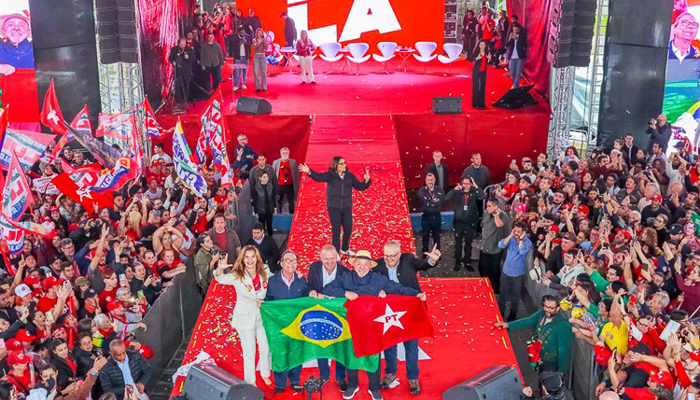
President Luiz Inácio Lula da Silva (PT) once again defended the end of betting in Brazil during campaign events in Florianópolis (SC) held this Saturday (19). Running for re-election, Lula announced that he intends to consult the Ministry of Finance and the Central Bank before any concrete measure against the sector — but did not detail the scope of the ban, the implementation schedule or which betting segments would be affected.
“I made a decision, if it depends on my will, I've already had some meetings, I'm going to talk to my people at the Treasury, I'm going to talk to my people at the Central Bank, but the truth is that I want to end the betting,” declared the president in Florianópolis, where he participated in a campaign event alongside allies running for office in Santa Catarina, such as the candidate for governor of the state, Gelson Merísio (PSB).
"I've been discussing this for two months."
On the same occasion, Lula stated that he had been discussing the issue "for two months" and linked the rise of gambling to household debt: "Gambling is leading many people into debt, and when a person is indebted because of gambling, they lie." The president also reacted to a joint statement published by football clubs the previous week, which warned of the risks of insolvency and legal uncertainty in case of a ban: "These people are lying, because the Brazilian national team won the championship without gambling. [...] What cannot happen is for poor people to spend money."
The government reiterates that no decision has been made.
Hours before Lula's speech in Florianópolis, the executive secretary of the Ministry of Finance, Dário Durigan, gave an interview to CNN Brasil in which he confirmed that the government is working on measures to tighten controls against gambling, but stressed that nothing is yet defined. "What do we have to do with this money that continues to undermine the purchasing power of families? We have to do more. That's why we continue discussing it; no decision has been made, but we continue discussing measures to tighten controls against gambling," said the minister.
Durigan also mentioned that the government is studying mechanisms for renegotiating old consumer debts—currently in banks' credit portfolios with low recovery prospects—but did not provide details about the proposal or clarify whether it would be linked to the discussion on debt refinancing or if it is a broader credit policy.
What the official figures show
According to the report released by the Secretariat of Prizes and Bets of the Ministry of Finance (SPA-MF) in January of this year, the gross revenue (GGR) of betting in the first year of the regulated market totaled R$ 37 billion in 2025 — equivalent to about 0,29% of Brazil's GDP, which closed the year at R$ 12,7 trillion, according to IBGE. This percentage is in line with the estimate of Santander bank, which, based on 2024 data (pre-regulation period), calculated that betting would have the potential to reduce the country's GDP by 0,2% to 0,3%.
SPA-MF's own financial report, released in January of this year, was presented by then-Secretary Regis Dudena as a milestone in regulatory transparency: the first year in which the State began systematically monitoring the sector, with data on oversight, revenue collection, and the profile of bettors—and not as a warning of a crisis.
Household debt: what the official data says
Regarding the diagnosis of household debt—used by Lula to justify the measure—the Consumer Indebtedness and Default Survey (PEIC) by the National Confederation of Commerce (CNC) paints a different picture: the historical record of indebted families in the country (more than 80% in 2026, according to the series that began in 2010) is mainly driven by credit cards, responsible for more than 85% of debt cases. The PEIC methodology itself—which considers credit cards, overdrafts, payroll loans, personal loans, store credit, and vehicle or real estate financing—does not treat betting as a separate type of debt, making it difficult to attribute the overall debt situation cited by the president solely to the betting sector. It is worth noting that SPA-MF regulations prohibit betting through credit card payments.
A speech without a proposal.
Two months after Lula stated he was discussing the issue internally, all that exists so far are declarations of intent, repeated in a series of campaign events, without a concrete public policy plan. Neither the president nor the Ministry of Finance has yet presented an estimate of the impact of a potential ban on federal revenue—in which the sector returned R$ 14,45 billion to the government and society (R$ 4,5 billion to legal beneficiaries and R$ 9,95 billion collected by the Federal Revenue Service, with federal taxes such as IRPJ, CSLL, PIS/Cofins and Social Security Contribution), in addition to billions in regulatory fees—on the more than 15,5 jobs generated by the regulated chain, or on the illegal market, which is expected to absorb the demand if the regulated market is eliminated without an equivalent oversight alternative.