
"The dragon was untamable": Attorney General's Office abandons in the Supreme Court the argument that the government itself defended in the public hearing of ADI 7721.
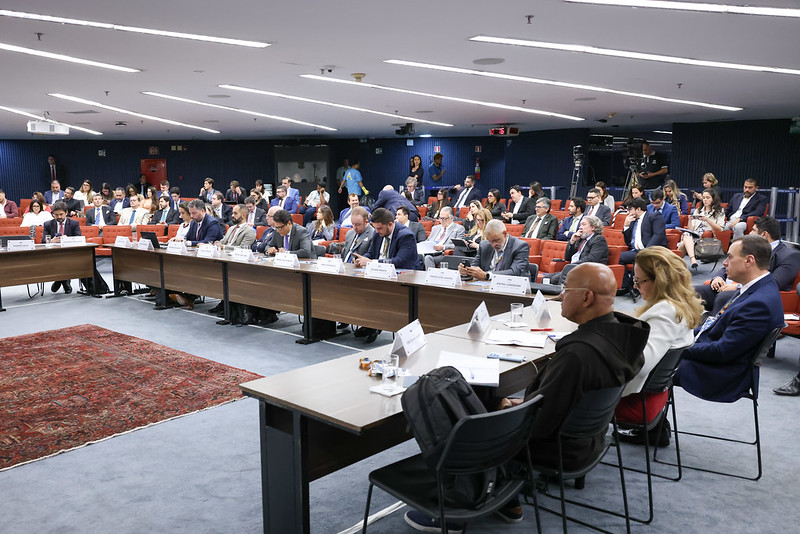
Brazil's Attorney General, Jorge Messias, asked the Supreme Federal Court to declare the legal framework for fixed-odds betting unconstitutional. The statement was signed at 16:22 pm on Friday (2) in ADI 7749, from the Attorney General's Office, one of six actions on the subject reported by Minister Luiz Fux. The text ends with a phrase that answers Messias himself: "The 'dragon' was untamable."
The image is from November 11, 2024. On that day, at the public hearing for ADI 7721, Messias told Fux: “I believe we are facing a dragon, and our challenge here is to try to tame it.” BNLData compared the official transcript of the hearing with the new document from the Attorney General's Office.
What did Messiah say in 2024?
In his speech, the Attorney General attributed the damage to the period without regulation, "from the Michel Temer government to the Jair Bolsonaro government," and presented Law 14.790/2023 as the Lula government's response. He asked for time.
“The regulation is recent and is still in the implementation phase. Its effects, therefore, need to be monitored continuously and carefully for a reasonable period,” he stated. The argument was that of progressive unconstitutionality: “Although Law No. 14.790 of 2023 may still be considered constitutional, the Attorney General's Office argues that the legislation is moving towards progressive unconstitutionality.”
What does Messiah say now?
The new document acknowledges the change. It recalls that, in ADI 7721, the Attorney General's Office considered the rule "still constitutional, subject to a process of progressive unconstitutionality," and states that the scenario is different: "The monitoring period deemed imperative has passed."
According to the Attorney General's Office (AGU), "the previous expectation that the weaknesses in the legal design could be filtered out was not confirmed in practice." The regime of the two laws "was extensively flawed."
The request covers articles 29 to 35 of Law 13.756/2018 and articles 1 to 21, 22 to 24, 25 to 40, 43 to 48 and 54 of Law 14.790/2023. In 2024, the Attorney General's Office (AGU) warned that overturning only the 2023 law would leave the activity operating under the 2018 law, "an even more serious scenario." The solution now is to request the repeal of both.
Three aspects of the play that deserve attention.
Wrong date
The Attorney General's Office (AGU) states that "the regulated market has been operational since 2024." The regulated market actually began on January 1, 2025, as the Treasury and the Attorney General's Office (PGFN) themselves stated to the Supreme Federal Court (STF) during the hearing. The "reasonable period" for monitoring was 21 months.
illegal market
The document acknowledges that the illegal market is “estimated to be between 41% and 51% of the total” and that it coexists with the regulated market in “equivalent dimensions.” It also notes that setting up an illegal platform costs around R$10 and that the crackdown “operated on the effects and not on the cause.” The statement does not explain how eliminating the authorized market would reduce the illegal one.
Caveats regarding the data
The Attorney General's Office (AGU) acknowledges that the SUS (Brazilian public healthcare system) service numbers "do not isolate cases resulting from fixed-odds betting" and that "betting should not be attributed exclusively as a cause" of indebtedness. Among the sources cited are studies by IEPS and economist Guilherme Klein, whose methodologies BNLData has already challenged.
The document, which responds to a ruling dated August 28, does not mention Provisional Measure 1.394/2026.
Farm: overturning the law would lead to illegality.
In 2024, Regis Dudena, then Secretary of Prizes and Betting, warned the Supreme Court against what the Attorney General's Office is requesting today.
“The demand for the service is real, and any declaration of unconstitutionality of the law will only direct Brazilians to an illegal, unsafe market with harmful effects such as fraud, money laundering, and the exploitation of gamblers,” he said. He concluded: “Regulation is the best means of state presence in the sector, and this presence will only be full, effective, and efficient if the constitutionality of Law No. 14.790 is recognized by this Supreme Court.”
Sports: "ending the law won't solve anything"
Giovanni Rocco Neto, the National Secretary for Sports Betting, followed the same line of reasoning: “Wanting to end the law that empowers the government to regulate this sector will not solve the problem. Without regulation, the illegal market will continue, and the problem, which is being confronted and contained by the strong hand of the State, will take on immeasurable proportions.”
PGFN and Coaf: a direct contradiction
Luciana Leal Brayner, from the Attorney General's Office of the National Treasury, an agency within the Attorney General's Office itself, stated that "the current state of affairs in Brazil did not stem from Law No. 14.790 of 2023, but rather from Law No. 13.756 of 2018."
Rafael Bezerra Ximenes de Vasconcelos, director of Supervision at COAF (Council for Financial Activities Control), assessed the law's anti-money laundering rules: "The legislative wording does not warrant any corrections." The Attorney General's Office (AGU) now argues that the rules "contained significant flaws" precisely in the area of money laundering prevention.
Social area: concern, but call for regulation.
The ministries responsible for social issues presented the most stark data, and none of them called for a ban.
⇒ Health: Sônia Barros highlighted the increase in healthcare services and reported that poorer families invest approximately 32% more than wealthier families. Luiz Henrique Martins dos Anjos, representing the legal consultancy, advocated for "stricter regulation."
⇒ Social Development: Clara Carolina de Sá stated that "there is no evidence in Brazil that beneficiaries of social programs are more susceptible to gambling" and expressed "the need for regulation of the issue."
⇒ Racial Equality: Ana Míria Carvalho pointed out the disproportionate impact on Black and mixed-race people and called for "careful regulation".
⇒ Human Rights: Minister Macaé Evaristo conditioned the declaration of unconstitutionality on the failure of the regulation, should the requirements "prove insufficient".
⇒ DPU: Leonardo Cardoso de Magalhães said that "we do not question the legality of the betting sector" and requested complementary measures.
Next step
Fux concentrates the six ADIs on the subject: 7721, 7723 and 7749, which question the legislation on fixed-odds betting and online games, and 8024, 8027 and 8028, distributed to him by prevention on Friday (2), which contest MP 1.394/2026. In ADI 7721, he gave the AGU 72 hours to comment on the provisional measure. It will be up to the government to explain, in the process in which it defended the law, why it now wants to see it overturned.
TRANSCRIPTS FROM THE 42ND PUBLIC HEARING

