The government that threatens to ban betting is the same one that projects billions in revenue from it in the 2027 budget.
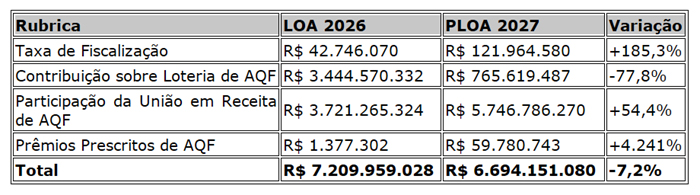
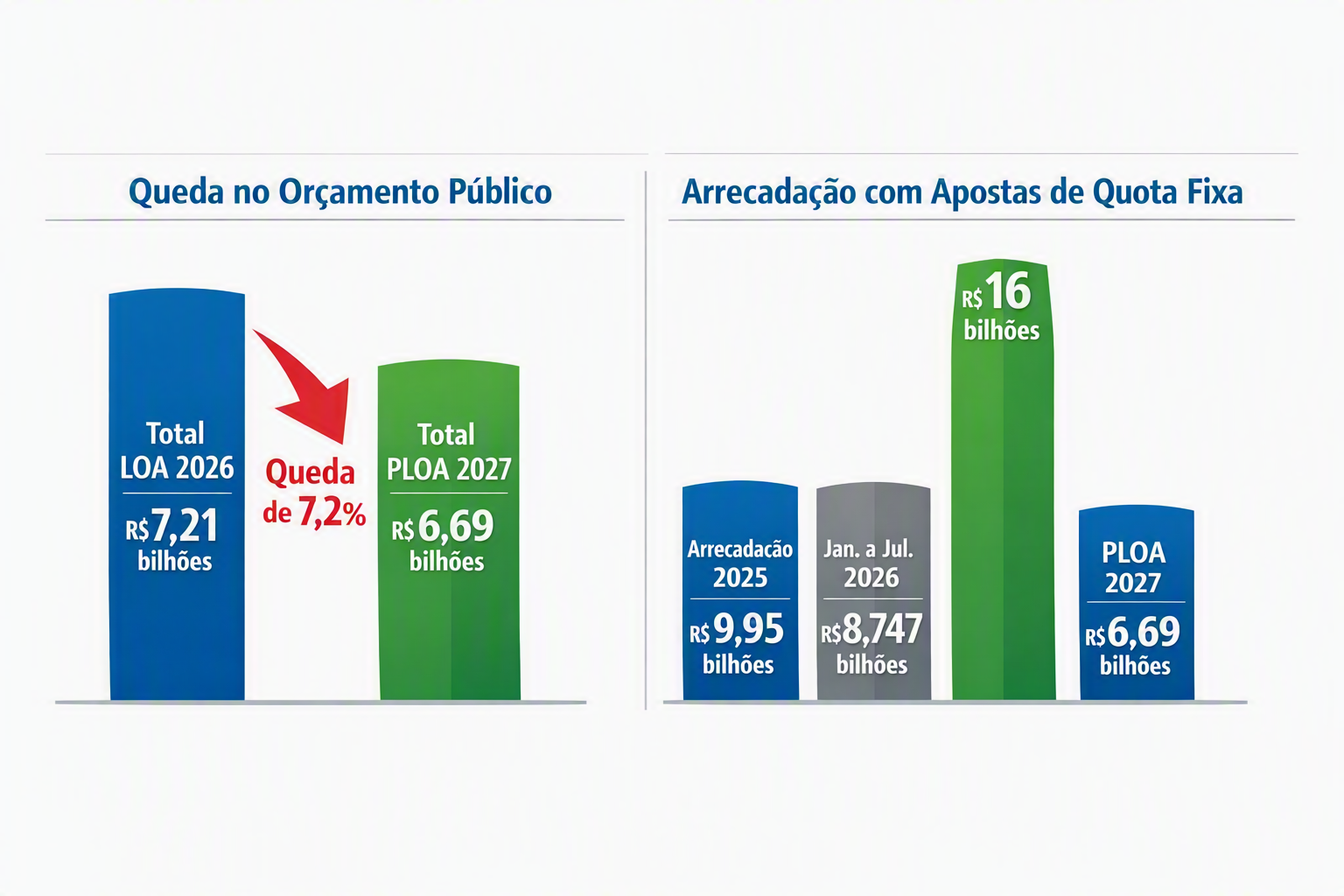
The 2027 Annual Budget Bill (PLOA), submitted to the National Congress on August 31st, projects a total of R$ 6,69 billion in the four specific budget lines linked to fixed-odds betting — a value 7,2% lower than that already approved in the 2026 Annual Budget Law (LOA) for these same lines. This decrease is noteworthy at a time when the regulated market has been registering revenue growth. But the data, analyzed line by line, reveals something more interesting than a simple underestimation: a specific betting line is being dissolved within the new Contribution on Goods and Services (CBS) — and this reduces the ability to track, in the Budget, how much the sector effectively contributes to public coffers.
The four categories, year by year.
BNLData cross-referenced the official data from the 2026 Budget Law (Volume I, Table “Revenue from the Fiscal and Social Security Budgets by Nature, Source of Resources and Sphere”) with that of the 2027 Draft Budget Law in the four budget items that explicitly identify fixed-odds betting:
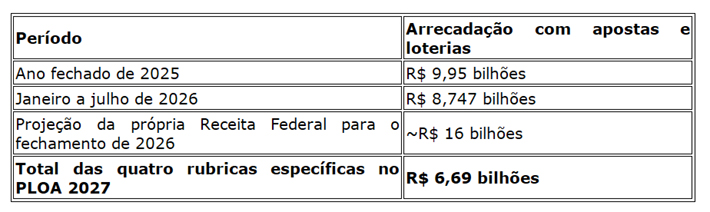
The result is noteworthy because it contradicts the actual revenue trend. According to the monthly reports from the Federal Revenue Service presented by tax auditors Claudemir Malaquias and Marcelo Gomide, the country collected R$ 9,95 billion in taxes on betting and lotteries throughout 2025. In the first seven months of 2026 alone, revenue already totaled R$ 8,747 billion — the Revenue Service auditors themselves project that the year should close near R$ 16 billion, which would be a record. Furthermore, the contribution rate on GGR (Gross Gaming Revenue) rises from 13% in 2026 to 14% in 2027, by virtue of Complementary Law No. 224/2025 — which should, in principle, push revenue upwards, not downwards.
The contradiction is clear: what the government is already collecting in 2026 and what it projects for 2027.
When compared to actual revenue figures, the 2027 PLOA (Proposed Budget Law) number becomes even more difficult to justify. According to the monthly reports from the Federal Revenue Service, presented by tax auditors Claudemir Malaquias and Marcelo Gomide:
Revenue in 2026 is growing at significant rates — 83,3% in the first half of the year compared to the same period in 2025 — well above inflation or GDP growth, a movement driven by the consolidation of the regulated market and the increase in the GGR tax rate (from 12% to 13% this year, and to 14% in 2027, by virtue of Complementary Law 224/2025). If this pace is confirmed, 2026 should close as the best year for revenue in the sector since regulation, breaking records.
Against this backdrop, the total of the 2027 Budget Bill for the four specific budget lines — R$ 6,69 billion — sounds contradictory: it falls short of what the Federal Government had already collected in the entire year of 2025 and represents less than half of the Federal Revenue Service's own estimate for the end of 2026. Even considering that the Federal Revenue Service's comparison base (aggregated taxes and contributions on "bets and lotteries") is not identical, line by line, to the four specific lines of the Budget, the difference in scale — more than R$ 9 billion between the projected end of 2026 and the total budgeted for 2027 — is not entirely explained by the accounting reclassification discussed above. A significant portion remains without a clear explanation, which reinforces the need for the Ministry of Finance to publicly detail the assumptions used to project the sector's revenue next year.
Where is the loophole: the AQF Lottery Contribution
The entire decrease in the total is concentrated in a single line item: the "Contribution on Fixed-Odds Lottery Betting" falls from R$ 3,44 billion (LOA 2026) to R$ 765,6 million (PLOA 2027) — a reduction of almost 78%. This contribution is equivalent in nature to the PIS/Cofins tax: it is levied on the revenue of the operators.
The most likely explanation is not a shrinking of the sector, but the timeline of the tax reform. Starting in 2027, the CBS (Contribution on Goods and Services) will come into effect, replacing PIS/Cofins (Social Integration Program/Contribution to Social Security Financing) in most of the economy — including, apparently, this specific contribution on betting. The text of the 2027 Budget Guidelines Bill (PLN No. 2/2026), which was processed in Congress, already anticipates this change: in Table XXVI (“Tax Expenditures — LDO 2027 Projections”), relating to the CBS, there is a specific line called “Prognostic Contests and Bets” , described as a “specific regime for the incidence of CBS on predictive contests, in physical or virtual media, including all lottery modalities, including fixed-odds betting”, based on articles 244 to 250 of Complementary Law No. 214/2025.
In other words, the money that currently appears under the heading "Contribution on AQF Lottery" will most likely not disappear—it will migrate into the CBS starting in 2027.
The problem: this migration makes the sector less traceable in the Budget.
Here's the point that interests the public debate. The CBS appears in the 2027 Budget Bill as a single, aggregated figure for the entire economy — R$ 636 billion — without a breakdown by sector. The Finance Minister himself, Dario Durigan, stated that the projection for the Selective Tax (the "sin tax," which also applies to betting) only considers the current IPI tax burden as a reference, since the specific rates per sector "have not yet been sent to Congress." The same applies to the CBS: the methodology for calculating the rates still depends on validation by the Federal Court of Accounts (TCU) and the Senate, with a deadline of December 15th.
This means that the specific portion of fixed-odds betting within the 2027 CBS — which replaces the old “AQF Lottery Contribution” — becomes invisible in the public budget. The line item that currently allows journalists, parliamentarians, and the Court of Auditors to track month by month how much the regulated sector contributes to federal coffers ceases to exist in isolation, dissolved within a number that mixes all sectors of the economy subject to the CBS.
What remains under the direct control of the government grows.
It is worth noting that not all comparisons point to less transparency. The item "Union Participation in Lottery Revenue from AQF" — which is not affected by the CBS transition, as it is a participation/royalty and not a contribution on revenue — increases by 54,4% in the 2027 PLOA, from R$ 3,72 billion to R$ 5,75 billion. It is the largest of the four items and the one that most closely reflects the real growth of the market. The Inspection Fee, in turn, more than triples (+185%), correcting a distortion that already existed in the previous budget: the 2026 LOA had budgeted only R$ 42,7 million for this fee, when the sector itself had already collected around R$ 95,5 million in 2025 alone — a concrete case of underestimation in an item that has no relation to the tax reform.
The secrecy doesn't stop at CBS: the selective tax rate for betting already exists, but it's being kept secret.
The loss of granularity is not limited to CBS. A report in the newspaper O Globo published this Monday (31) revealed that the Ministry of Finance has already internally defined the Selective Tax rate that will apply to bets from 2027 onwards — but decided to keep it secret, and may even change it before sending the specific bill or Provisional Measure to Congress. According to Minister Dario Durigan, the calibration strategy seeks a delicate balance: a percentage that is too low would make the charge irrelevant, but a percentage that is too high would have two undesirable effects from the government's point of view — it would strengthen the performance of the betting sector's lobby in Congress and push more operators into illegality, replicating the problem already observed when the taxation of cigarettes and beverages becomes uncalibrated.
The parallel that the government itself draws — between betting and products like cigarettes and alcoholic beverages, whose historically poorly calibrated taxation fuels the illegal market — reinforces the framing of betting within the logic of a "sin tax" that underlies the Selective Tax as a whole. But it also illustrates how two central pieces of the 2027 tax framework for the sector — the CBS share and the IS rate — reach Congress without the public, parliamentarians, or even the operators of the regulated market knowing, with precision, what the real tax burden will be starting in January.
What does this mean for the political debate?
The timing couldn't be more sensitive. While betting revenue is used as an argument for fiscal consolidation—the 2027 Budget Guidelines Law itself credits Complementary Law 224/2025, which increased betting revenue for social areas, with a relevant role in public accounts—and while expenses such as those of the National Public Security Fund (partially financed by betting) are shielded from budget cuts, the specific line item that allows measuring this contribution loses clarity precisely in the year in which the political "demonization" of the sector intensifies, with articulations surrounding a possible Direct Action of Unconstitutionality (ADI) by Lula against betting legislation and ADIs pending before the Supreme Federal Court (STF) under the rapporteurship of Minister Luiz Fux.
Therefore, it is not a matter of the government "hiding" revenue from betting companies — the technical explanation for the migration to the CBS (Contribution on Goods and Services) is consistent and verifiable. But the practical effect is a loss of granularity precisely in the information that would allow society to monitor, in isolation, the real fiscal burden of the sector — information currently used by both those who defend and those who attack the regulated market.
The other side
It is fair to note that the opacity of the CBS (Contribution on Goods and Services) is not a specific choice against betting companies: it equally affects dozens of other sectors of the economy that currently collect PIS/Cofins (Social Integration Program/Contribution to Social Security Financing) separately and will start collecting CBS in an aggregated manner. This is a side effect of the overall tax reform architecture, approved with broad support in Congress, and not a deliberate decision by the Ministry of Finance or the Ministry of Planning and Budget to reduce the specific visibility of the betting sector. Auditors from the Federal Revenue Service and the TCU (Federal Court of Accounts) can still, in theory, produce specific sectoral reports outside the Budget—as they already do today with the monthly revenue balances—even though the budget itself no longer allows for this automatic detailing.