Itaú denied Paula Lavigne's claims: the audiences were not empty.

"You can fool some of the people all of the time, and all of the people some of the time, but you cannot fool all of the people all of the time." This phrase, attributed to Abraham Lincoln, fits like a glove in the debate that led to the Bets Provisional Measure.
In a meeting convened by President Lula with artists to discuss betting, cultural producer Paula Lavigne stated that she has been promoting shows for 40 years and “has never seen anything like it”: the audiences were empty. The blame, in the narrative constructed from that point on, lay with the betting companies. A friend of First Lady Janja da Silva, Lavigne orchestrated the mobilization of artists against the sector that helped pave the way for Provisional Measure 1.394/2026.

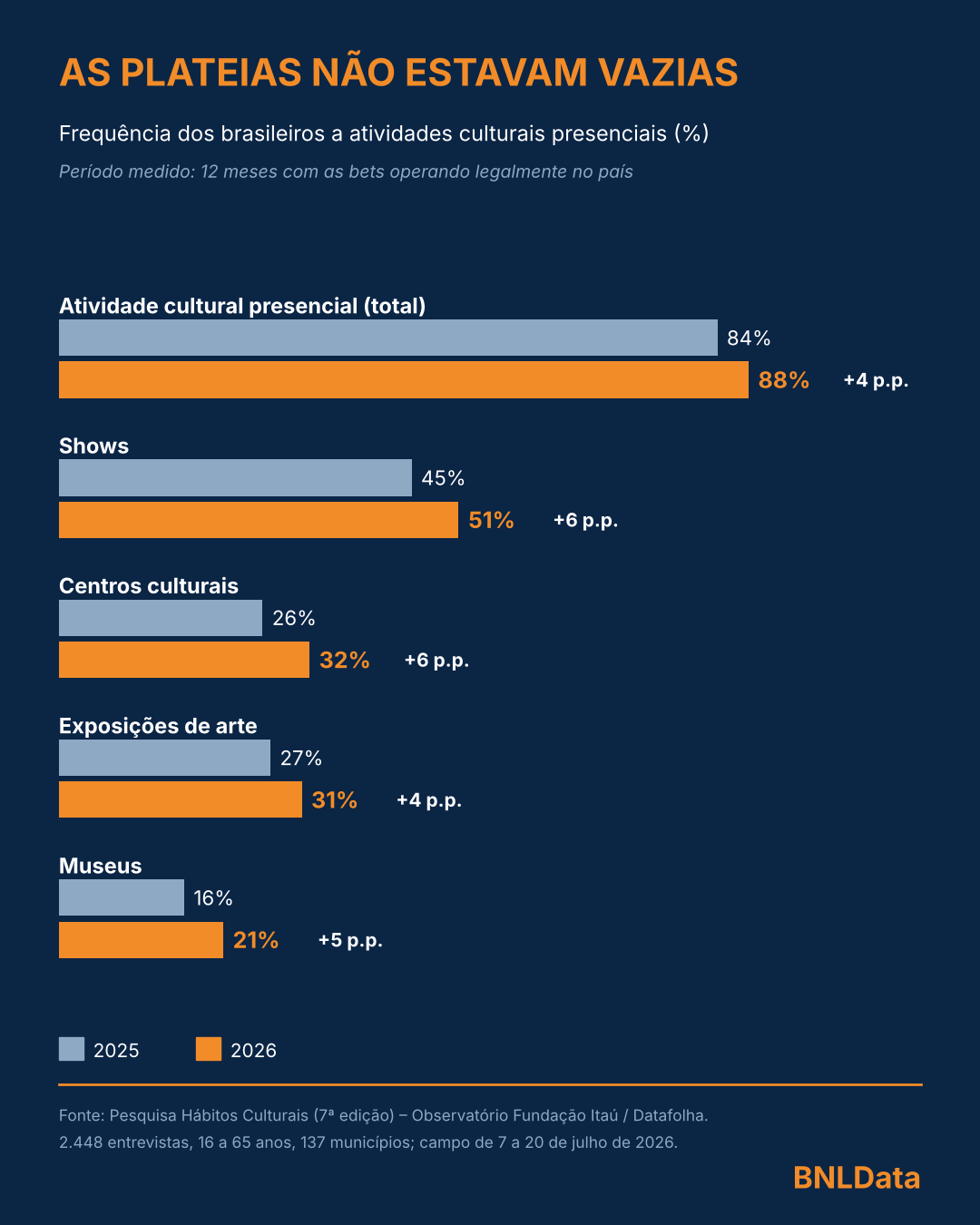
Now, the numbers have arrived. The seventh edition of the Cultural Habits survey, by the Itaú Foundation Observatory with Datafolha, released this Wednesday (14) and reported by O Globo, shows exactly the opposite. Attendance at shows grew from 45% to 51%. Cultural centers went from 26% to 32%, museums from 16% to 21% and art exhibitions from 27% to 31%. In total, 88% of Brazilians did at least one in-person cultural activity in the 12 months prior to the survey, compared to 84% in 2025.
The detail that dismantles the thesis: the fieldwork was conducted between July 7th and 20th, 2026. In other words, the 12 months measured correspond entirely to the period in which fixed-odds betting operated in a regulated manner, with operators authorized by the SPA/MF (Portuguese Securities Market Commission). If betting had emptied audiences, the effect would have been apparent precisely then. It wasn't. Audiences grew.
And what about the public's wallet? Research indicates that the percentage of those who spend up to R$100 per month on culture fell from 52% (2024) to 49% (2025) and 46% (2026) — a sign that spending on culture increased, not decreased.
The obstacles cited by Brazilians are different: lack of money (35%), fear of violence (30%), lack of time (23%), tiredness (21%), distance and overcrowding (19%), and lack of transportation (16%). Income inequality remains the major dividing factor: 97% of classes A and B attended some in-person activity, compared to 82% of classes D and E. No line in the survey attributes any blame for the low attendance to gambling.
The regulated sector was condemned based on a personal impression transformed into state truth. The narrative worked for a while—long enough to become a provisional measure, shut down companies, threaten thousands of jobs, and push gamblers into the illegal market. But, as the saying goes, you can't fool all the people all the time. Sooner or later, the data will come due.