
Research shows 70% in favor of banning betting, but 63% say the issue does not influence their vote.
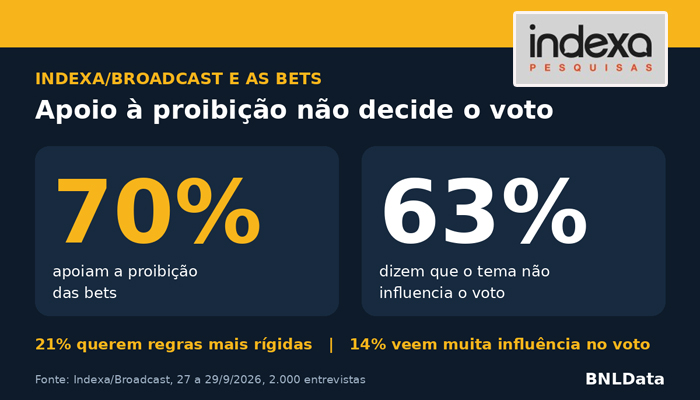
The ban on online betting has the support of 70% of Brazilian voters, according to an Indexa/Broadcast survey by Estadão released this Thursday (1st). The same survey, however, indicates that the issue has little weight on the ballot: 63% say that a presidential candidate's position on betting has no influence on their voting decision. Only 14% say that the influence is great, 9% see some and 12%, little.
The data puts the government's bet into perspective, which, on September 25th, announced Provisional Measure No. 1.394/2026 and made the ban one of the central themes of the final stretch of the campaign.
Stricter rules don't change the 68% vote.
The research did not measure, at least according to what was released, whether advocating for the ban increases the likelihood of voting for a candidate. The question asked dealt with "stricter rules" for the operation of betting. In this scenario, 68% responded that the position would not alter their choice. For 14%, it would greatly increase the likelihood of voting, and for 6%, slightly. Another 5% said it would decrease.
In addition to the 70% in favor of a ban, 21% advocate for continued legality of betting, but with stricter regulations than the current ones. Only 6% want the current rules to remain in place, and 1% prefers fewer restrictions. In other words, voters are demanding stricter measures, and one in five prefers the regulatory approach to prohibition.
Political context and timing of data collection.
The interviews were conducted between September 27 and 29, days after the announcement of the provisional measure and amidst President Lula's campaign against the sector. The breakdown by political profile shows the difference: 83% of those who identify as Lula supporters or PT members support the ban, compared to 67% of Bolsonaro supporters.
Support for the ban is higher among women (73%) than among men (66%), and among adults aged 25 to 34 (74%). The 35 to 44 age group has the lowest rate (63%). By region, the Northeast leads (75%) and the North has the lowest support (61%). Among those earning more than five minimum wages, the rate is 73%; the percentage for those earning up to two minimum wages was not reported in the publication.
Perception of indebtedness
According to 65% of those surveyed, gambling contributes significantly to household debt; 16% see little contribution and 17% see none. This number measures voter perception, not a causal relationship between gambling and debt.
The research also does not indicate whether respondents were presented with the effects of a ban, such as the migration of bettors to clandestine websites. As BNLData has already shown, the illegal market still accounts for more than 40% of bets in the country after 22 months of regulation. Estadão itself, when publishing the survey, points out that the United Kingdom, Germany, and Italy opted for limits, oversight, and rules to protect bettors, and not for a ban.
Exclusive
Indexa/Broadcast surveyed 2.000 voters by telephone. The margin of error is 2,2 percentage points, with a 95% confidence level. The survey is registered with the Superior Electoral Court under number BR-00698/2026.

