
Senate poll: Lula's allies are favored in seven states, and Bolsonaro's in four; see the numbers.
With one month to go before the elections, candidates supported by former president Luiz Inácio Lula da Silva (PT) are leading the Senate race in seven states, while names linked to President Jair Bolsonaro (PL) are ahead in four. A survey by GLOBO, based on the latest Ipec polls, also shows that in the remaining states there is a tie for the lead or a preference for candidates from parties that have not aligned themselves with the national polarization.
Since the pre-campaign, the Senate has been seen as a priority by both Lula and Bolsonaro in a future administration. The president, who managed to form a more consolidated majority in the Chamber of Deputies, mainly after supporting the election of Arthur Lira (PP-AL), found the Senate to be his Achilles' heel in his relationship with Congress.
This year, one-third of the House will be renewed, equivalent to 27 senators. Currently, the MDB (with 13 seats) and PSD (11) are the largest parties. In the next legislature, the trio of parties supporting Bolsonaro's candidacy (PL, PP, and Republicanos) will start with 11 senators.
For Lula, who is close to a large part of the MDB party, electing many allies is a chance to form a majority in the Senate, which is unlikely to happen in the Chamber, where he will need greater negotiation to win votes.
See the Senate election results by state — Photo: Art
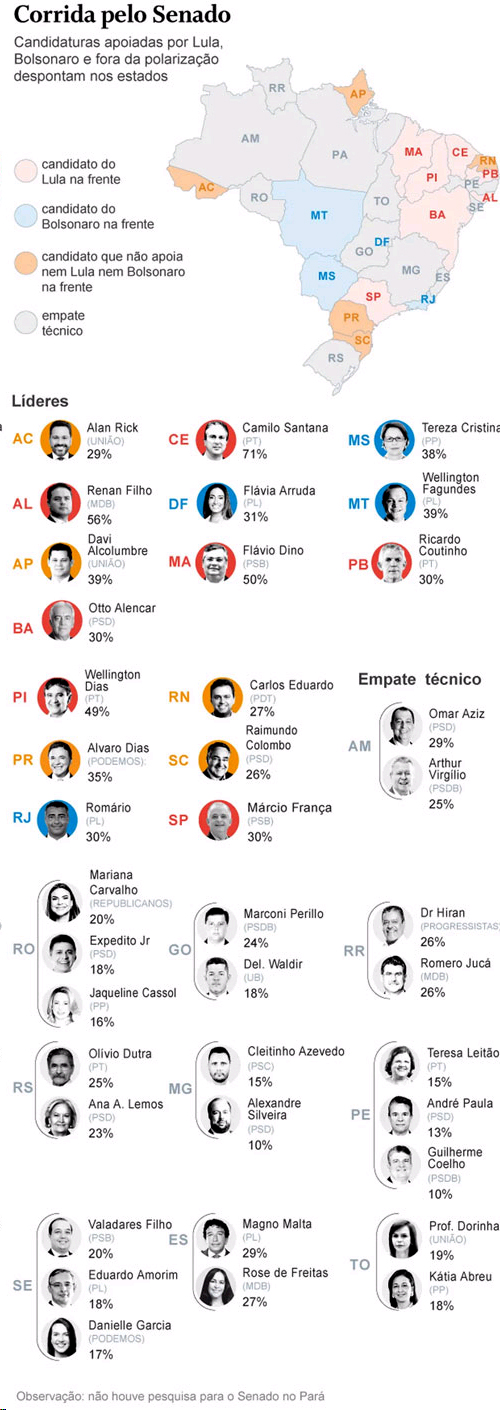
Following the geographic distribution of Lula's greatest strength in the presidential race, the Northeast is home to the favorite candidates for a Senate seat who are allies of the Workers' Party (PT). Of the seven Lula supporters leading the polls, six are from the region: Otto Alencar (BA), Camilo Santana (CE), Renan Filho (AL), Ricardo Coutinho (PB), Flávio Dino (MA), and Wellington Dias (PI). Rounding out the list is Márcio França, of the PSB party, in São Paulo.
The same is true for Bolsonaro, whose allies who are well-placed to be elected to the Senate are concentrated in the Central-West region, where the presidential candidate is doing well: Flávia Arruda (DF), Wellington Fagundes (MT), and Tereza Cristina (MS). In Rio, Romário, a senator for the PL, completes the picture.
In the state, the former player's path to reelection was made easier by the split on the left, which entered the election divided between Alessandro Molon (PSB) and André Ceciliano (PT).
"The image conveyed to the electorate is one of distrust. It was a brutal mistake, and there's no turning back now. Furthermore, Romário is already a senator and lives in the state that is the birthplace of Bolsonarism. He's taking advantage of the conservative vote," analyzes Eduardo Grin, a political scientist at the Getulio Vargas Foundation (FGV).
The same thing, with mixed signals, happened in São Paulo, where Márcio França benefited from the split in the Bolsonaro camp, which has former minister Marcos Pontes (PL) and state deputy Janaína Paschoal (PRTB) competing for votes.
In some states, Lula has a competitive ally, even if he isn't the outright frontrunner. This is the case in Amazonas, where Omar Aziz (PSD) is seeking reelection by campaigning on the president's image. He is technically tied with Arthur Virgílio (PSDB), who has avoided nationalization by focusing on local issues. In third place is Bolsonaro's candidate, Coronel Menezes (PL).
There are still states in a head-to-head situation, with polls showing a balance between Lula's and Bolsonaro's supporters. In Minas Gerais, Cleitinho Azevedo (PSC), supported by the president, scored 15%, technically tied within the margin of error with Alexandre Silveira (PSD), from Lula's coalition in the state. In Sergipe, Lula's candidate, Valadares Filho (PSB), is technically tied with 20%, and Bolsonaro's candidate, Eduardo Amorim, is technically tied with 18%.
In five states, the leading candidates in the polls are not supported by either Lula or Bolsonaro: Acre, Amapá, Paraná, Rio Grande do Norte and Santa Catarina.
Former Senate President Davi Alcolumbre (União Brasil) is running for reelection, leading the race in Amapá with 39%, without tying himself to the national race. In second place, Rayssa Furlan (MDB), whose party launched Simone Tebet for president, is also campaigning with a focus on state politics. The third-place finisher, Capi (PSB), is banking on Lula as a campaign manager to try to gain ground in the polls.
Split within Bolsonaro's camp
In Goiás, the poll leader, Marconi Perillo (PSDB), is staying away from the nationalization of the Senate race. He has 24% of the vote, in a technical tie with Delegate Waldir. A former Bolsonaro ally, the União Brasil candidate is also remaining neutral in the national race.
In the Federal District, there's a race between two candidates from the pro-Bolsonaro camp. Former minister Flávia Arruda (PL), who is leading the race, faces competition from fellow former minister Damares Alves (Republicans). With the support of First Lady Michelle Bolsonaro, Damares has so far achieved half the voting intentions of Flávia, who is affiliated with the president's party: 31% to 16%.
Other leading figures in the Bolsonaro government are facing difficulties. Former minister Rogério Marinho (PL) sees Carlos Eduardo (PDT) ahead in Rio Grande do Norte. In Rio Grande do Sul, Vice President Hamilton Mourão (Republicanos) is third, behind PT member Olívio Dutra and Ana Amélia (PSD). ( O Globo – Ana Flávia Pilar and Jan Niklas — São Paulo and Brasília)

