Presidential candidates defend vetoing betting laws, but fail to explain the R$ 12,2 billion fiscal gap, reveals Folha de S.Paulo.

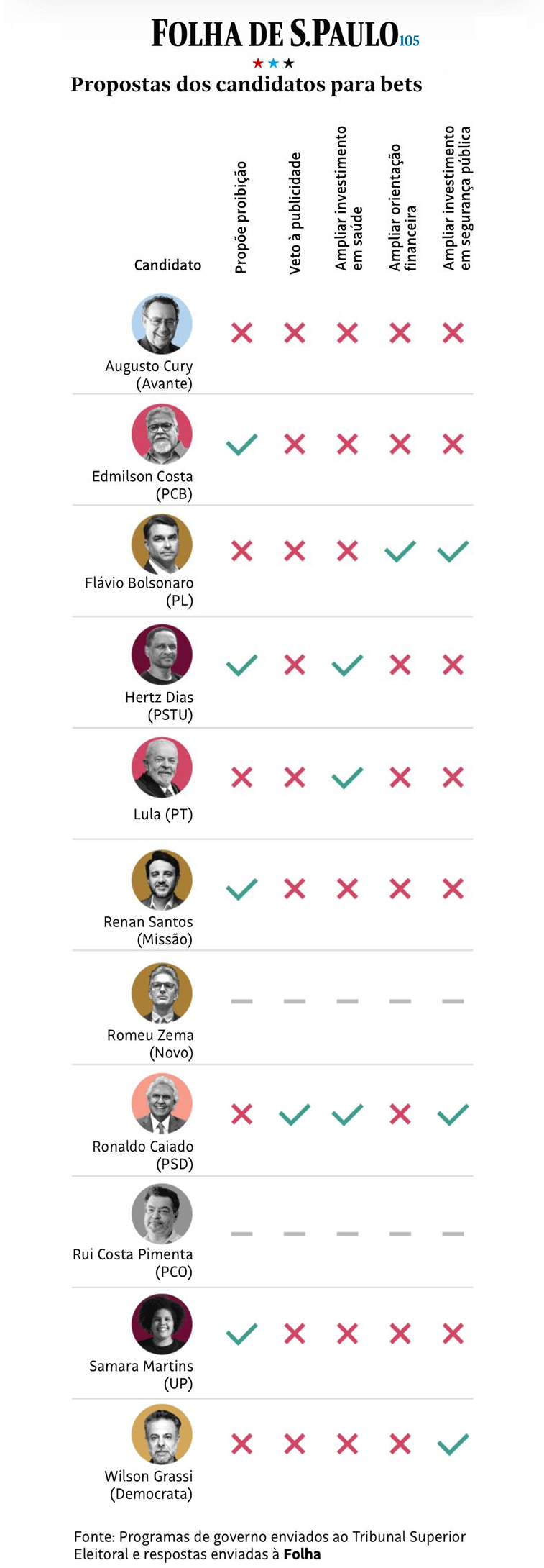
Four of the leading candidates for President of the Republic advocate for a total ban on sports betting platforms, known as bets, but none of them presents a plan to cover the fiscal gap created by the veto. The sector's revenue totaled R$ 12,2 billion in 2025.
The survey, published by Folha de S.Paulo this Wednesday (September 9th), mapped the proposals of all presidential candidates on the subject. Four other candidates did not include the issue in their government programs; two of them, however, released separate positions.
Proposals for a ban
Renan Santos (Missão), PSTU, PCB, and UP propose banning betting. Santos' campaign claims to favor a total ban, but does not detail how the government would recover the R$ 12,2 billion that the sector transferred to public coffers in taxes during the first year of the regulated market. PSTU and PCB go further; they also advocate the expropriation of company assets. UP classifies the activity as a crime against the popular economy.
Ronaldo Caiado's (PSD) candidacy doesn't go so far as to propose a veto on the operations, but promises to tighten the rules and prohibit advertising for betting in mass media and social networks. Caiado treats over-indebtedness as a public health issue. In a statement, the presidential candidate from Goiás claimed to have acted against the legalization of the sector when he was a senator; however, historical records show that Law No. 13.756 of 2018, which legalized fixed-odds betting, was approved with the support of all parties, including the then Democrats, of which Caiado was one of the leaders, in a symbolic vote in Congress.
Government and pro-regulation candidates
The campaign of Luiz Inácio Lula da Silva (PT), who is seeking re-election, advocates for improving existing controls. The proposal includes maintaining spending control mechanisms, monitoring household debt, and improving credit rules to prevent gambling-related debt. The program also foresees expanding mental health care for compulsive gamblers through the SUS (Brazilian public health system), a service with capacity for 100 people according to the Ministry of Health.
Last Tuesday (September 1st), however, Lula met with representatives of campaigns against gambling and promised to take "a more drastic decision" regarding the platforms. "I personally would put an end to betting; I think it's an evil of society," the president stated at the time, adding that he needed to hear all sides.
Flávio Bolsonaro (PL) voted in favor of regulating betting when he was a senator and prioritizes "combating indebtedness" in his proposal. The program foresees prohibiting the use of resources from social programs for betting, a measure already implemented by blocking beneficiaries of Bolsa Família and BPC (Continuous Benefit Payment). The campaign also proposes using the Caixa Econômica Federal network to offer financial education and credit to the population. "One of the main guidelines of the proposal is to attack what pushes families into debt, warning that online betting consumes the month's money even before it arrives home, eroding the income of the most vulnerable population," the campaign stated in a note.
Taxation and silence
Augusto Cury (Avante) advocates raising the taxation of betting platforms to over 50%. In an interview on TV Globo's Jornal Nacional, the candidate argued that the current 13% tax rate on platform revenue is lower than the estimated 18% tax on food. However, this comparison ignores the fact that operators also collect corporate income tax (IRPJ), social contribution on net profit (CSLL), social integration program (PIS), social security financing contribution (Cofins), and service tax (ISS); a calculation by the consulting firm LCA, commissioned by the two main entities in the sector, indicates a total tax burden of approximately 33% of revenue in 2026. Cury's campaign confirmed this position in a statement to the press.
Wilson Grassi (Democratic Party) proposes investigating betting companies for money laundering and redirecting the funds raised to public safety. Current legislation already allocates 13,6% of the social security contributions from betting companies to this area of government.
Romeu Zema (Novo), Renan Santos (Missão), and Rui Costa Pimenta (PCO) did not present proposals on betting in their government programs. The campaigns of Zema and Pimenta did not respond to attempts to contact them. Cury also did not include the topic in his program, but released his position in a statement and during a televised interview.
The regulated market
The sector was legalized in Brazil in 2018, during the Michel Temer administration, through Law No. 13.756, which authorized fixed-odds betting, a modality in which the bettor knows the prize value in advance based on the risk assumed. Between 2019 and 2024, the websites operated with licenses in tax havens, without reporting to the tax authorities; this model was the target of investigations by the Federal Revenue Service and the Public Prosecutor's Office.
Effective regulation, driven by the Lula government through a bill approved by Congress at the end of 2023, came into force in 2025 after a transition period. The regulated market allows the operation of 85 companies, each paying a grant of R$ 30 million. In the first year, the platforms received R$ 220,6 billion in deposits, paid R$ 183,7 billion in premiums, and recorded R$ 36,9 billion in revenue. The government received R$ 12,2 billion in taxes and R$ 4,43 billion in social security contributions, in addition to an inspection fee.
Today, 5 million CPF numbers (Brazilian taxpayer ID numbers) are blocked in the centralized betting management system, according to the most recent report from the Ministry of Finance. The regulation restricts access to individuals registered in the Desenrola program and beneficiaries of social programs; this latter restriction stems from a Supreme Federal Court decision contested by the current government.
A survey by More in Common/Ipsos-Ipec, conducted in July 2026, indicates that the issue has limited weight at the polls; 58% of Brazilian voters say they would not change their candidate based on their positions on betting, while 24% say they favor candidates who support limiting the platforms and 12% declare the opposite. The remaining 7% did not know how to answer.