
Raffle of police officers to maintain police station software sparks investigation in São Paulo.
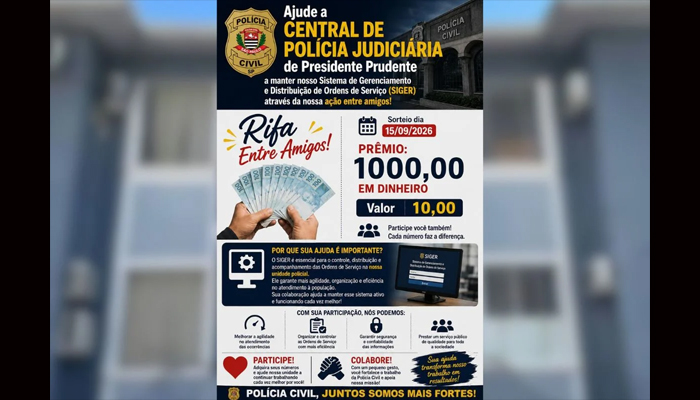
The police station didn't have the money to pay for the software. The solution found by police officers in western São Paulo was to sell raffle tickets among colleagues.
The initiative, called a "raffle among friends," offered a prize of R$ 1 to anyone who bought a raffle ticket for R$ 10. The money raised would be used to maintain the Service Order Management and Distribution System (SIGER), used by police stations in the Presidente Prudente region. The case was revealed by journalist Vinícius Segalla of DCM and investigated in detail by Metrópoles, with reporting by Ramiro Brites.
The Civil Police Internal Affairs Department has opened an internal investigation to look into the incident. According to the São Paulo State Public Security Secretariat (SSP-SP), the investigation may examine "possible violations of disciplinary rules."
The raffle that got out of control.
The numbers were sold in August, with the intention that the action would be restricted to people close to the police officers involved. However, the initiative spread through WhatsApp groups until it reached the top of the Civil Police, which ended the action.
A police officer even created an image using Artificial Intelligence to help with sales. It was this material that went beyond planned limits and accelerated the arrival of information to the corporation's high command.
According to the São Paulo State Public Security Secretariat (SSP-SP), SIGER had been acquired by the Presidente Prudente Regional Police Station in 2012 using public funds. The fact that a state-funded system needs informal financing to remain operational is precisely what has raised questions about the management of resources allocated to public security in São Paulo.
Fall in investments and dispute over numbers.
The raffle incident is not an isolated event. Since the fifth month of Governor Tarcísio de Freitas's administration, a parliamentary front in the Legislative Assembly of São Paulo (ALESP) has been denouncing what it classifies as the dismantling of the Civil Police. In the following years, union mobilizations of the Civil and Penitentiary Police took place; in 2025, two public events were held in the capital, one this Monday (February 11th) in defense of the Civil Police and another in November, bringing together the two corporations.
This year, the São Paulo Delegates Union took the debate to billboards scattered throughout cities in the interior of São Paulo state and to social media, making visible what it calls the deterioration of the security forces.
Investment data supports part of this narrative. Analysis of the São Paulo State Public Security Secretariat's (SSP-SP) investment budget, based on information available on the São Paulo State Finance Secretariat's website (Sefaz-SP), indicates a 41,48% reduction when comparing the first three years of João Doria's administration with the first three years of Tarcísio's administration.
The government disputes the interpretation. In a statement, the SSP-SP (São Paulo State Public Security Secretariat) stated that the number needs to be analyzed in conjunction with operating expenses and that, from this broader perspective, there was an increase of over 55%. However, the department did not specify whether the figure was adjusted for inflation. "The volume of resources allocated to public security services is much broader than the isolated analysis of a single item," the secretariat declared.
The risk of normalizing informal financing.
According to Fernando Capano, a specialist in Public Security and Military Law, professor of Criminal Law at the Padre Anchieta University Center (UniAnchieta) and of Constitutional Law at the Zumbi dos Palmares University, the episode points to a more serious problem than the raffle itself. "What cannot become normal is the informal financing of police activity itself," he stated.
Capano also identifies a weakness that goes beyond the financial aspect. "Systems used in Judicial Police activity cannot operate outside the technological governance and information security of the State," he added.
Concern for data is central. A police station's service order management system can handle information about investigations, victims, witnesses, suspects, and officers. According to Capano, it is necessary to know where the data is stored, who has access, whether there are authentication, encryption, and leak protection mechanisms, and whether the system has been approved by the state's information technology sectors.
The expert considered that the public purpose of the initiative does not, in itself, preclude any legal irregularities in the means employed; nor is it possible to anticipate individual liability based on what has been disclosed so far. The central issue, for him, is structural; if public servants needed to seek external resources to maintain a system essential to the unit's work, it is indispensable to investigate whether the State is adequately providing the material and technological means for the provision of the public service.

