
Senator uses betting commission of inquiry to question DataSenado survey.
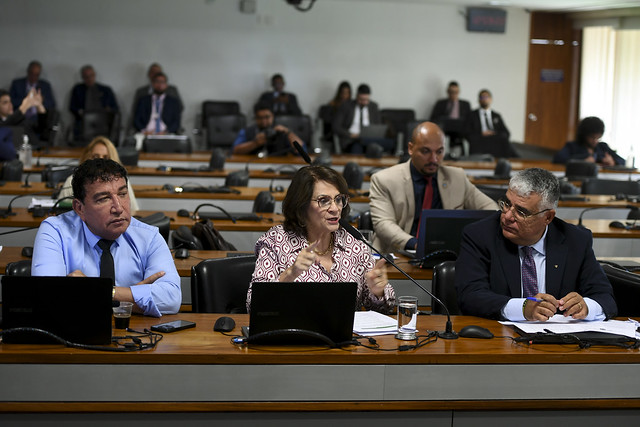
During the opening of the Betting CPI last Thursday (8), it was reported that Senator Eduardo Girão (NOVO-CE) would be a new member of the committee. The senator, who is against the legalization of gambling, seems to have joined the Betting CPI to criticize the possibility of legalizing gambling by the Senate plenary through the approval of PL 2234/22, using the commission as a platform for his positions against the legalization of gambling in Brazil.
Senator Eduardo Girão (NOVO-CE) presented data from a Datafolha Institute survey during a session at the Federal Senate Committee this Thursday (8). The survey, released at the end of 2024, indicates that 65% of the Brazilian population opposes the legalization of online betting, known as bets, and 71% support the prohibition of advertisements that promote this type of game.
During the meeting, Girão questioned the effectiveness of the sector's self-regulation in an interpellation to the president of the National Council for Advertising Self-Regulation – Conar. “I greatly respect Sergio Pompilio's opinion – he is very welcome here to this Commission – but I disagree. I think that self-regulation cannot confront this powerful lobby, because the objective is money,” stated Girão.
The congressman from Ceará pointed out a contradiction between data recently presented in the Plenary by Senator Irajá (PSD-TO), rapporteur of PL 2234/22. He mentioned that the congressman had cited a DataSenado survey indicating that 60% of the population would be in favor of legalizing casinos, bingo, and the jogo do bicho (a type of illegal lottery), while a previous survey showed the majority of Brazilians opposing this position. Girão questioned the credibility of the recent DataSenado survey, implying that the Institute's surveys are only reliable when the results are favorable to its opinion and political orientation.
It is worth noting that the DataSenado survey, conducted between February 21 and March 1, 2025, interviewed 5.039 citizens by telephone, selected through stratified random sampling of the Brazilian population aged 16 or older. The survey, which had an average margin of error of 1,72 percentage points, confirmed that 60% of respondents are in favor of legalizing gambling, while 34% declared themselves against it.
In the same session, the NOVO senator acknowledged Senator Magno Malta's influence on the debate about gambling in Brazil. Girão attributed part of the credit to Malta for the fact that bingo and casinos have not yet been legalized in the country, highlighting his views on the impacts of gambling expressed about two decades ago. During the meeting, Girão was accompanied by other senators opposed to the legalization of gambling, such as Magno Malta himself (PL-ES) and Damares Alves (Republicanos-DF).
The debate gained relevance in the context of the possible legalization of other forms of gambling. The parliamentarian questioned Senator Izalci Lucas, who was presiding over the session, about whether he was aware of the significant public rejection of gambling advertisements, as indicated by the Folha newspaper's research.
A study by the Locomotiva Institute, also cited by Girão, demonstrates the influence of advertising on gamblers' behavior. The data reveals that 68% of Brazilians who gamble were influenced by advertisements, app ads, sports betting websites, influencers, or team sponsorships. Without citing the source of the research, the parliamentarian commented that in Ceará, the rejection of gambling reaches 86% of the population.
The parliamentarian questioned the initiatives of the Ministries of Finance and Sports in controlling online betting advertising in the media. He also inquired about the role of CONAR (Brazilian Advertising Self-Regulation Council) in regulating these advertisements.
Girão reported that the Federal Senate is expected to deliberate in the coming weeks on restrictions to gambling advertising. The senator stated that he intends to fight for "maximum restrictions" on advertising for these games, although his personal position is for a total ban on the advertisements.
The discussion included the participation of other parliamentarians, such as Senator Soraya Thronicke (Podemos-MS), who followed the presentation of data on popular rejection of gambling advertisements in Brazil. Furthermore, the rapporteur of the Betting CPI advocated for a total ban on gambling advertisements.
It is important to highlight that, according to research by DataSenado, three out of four Brazilians consider the current ban on gambling and casinos to be ineffective. Only 25% of the population believes that the ban reduces the supply of these illegal games "significantly," while 70% are divided between those who believe it reduces "not at all" (29%), reduces "a little" (21%), or "moderately" (20%). Furthermore, 58% of Brazilians believe that legalizing gambling and casinos would increase tax revenue, and 44% believe it would generate more jobs in the country.

