
Victory for the illegals: the consequences of Lula's electioneering decision to ban gambling.
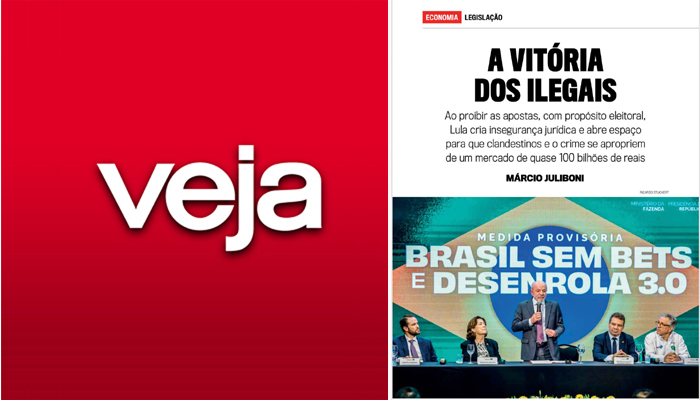
President Luiz Inácio Lula da Silva banned online sports betting in Brazil through Provisional Measure No. 1.394, signed on Tuesday (September 25). The decision reverses the regulation of the sector implemented in 2023 and hands over a market of almost 100 billion reais to organized crime, according to an analysis published this Friday (October 2) by VEJA magazine in issue No. 3015.
The measure directly affects licensed companies that operated under rules established by the federal government itself. Since 2023, betting companies were required to pay a fee of 30 million reais for a five-year license, maintain headquarters in Brazil, require biometric registration of players, and prohibit betting by minors. With the Provisional Measure, these legal operators lose the legal basis to operate without any provision for reimbursement of investments made.
Market handed over to illegals
Data from the consulting firm LCA shows that, in 2025, online betting generated up to 97 billion reais in the country. In that year, illegal operators accounted for 44% of that volume, equivalent to 43 billion reais. The projection for 2026, before the Provisional Measure, was a reduction in the criminal share to 41 billion reais, with the total market reaching 100 billion reais. With the prohibition, illegal operators will now compete for the entirety of that value.
In the first weekend after the measure was signed, 4.700 illegal websites were created in Brazil. The immediate reaction illustrates the risk pointed out by experts and industry representatives. “Banning betting is a mistake,” stated Bernardo Itri, vice-president of the São Paulo Football Federation. “The measure will inevitably push bettors into the illegal market.”
International experience reinforces this diagnosis. In recent years, the Philippines, Cambodia, Laos, and Myanmar have banned platforms that operated legally. The result has been to transform Southeast Asia into the region with the highest concentration of illegal betting in the world, according to the UNODC, the UN agency dedicated to combating organized crime. China has banned gambling since 1949 and, in 2020, banned betting on foreign websites. Even so, the Chinese spend $145 billion a year on bets hosted in neighboring countries, an amount greater than the $91 billion moved by the country's official lottery. "I don't know of any country that has been successful in banning online betting ," said David Forrest, professor of economics at the University of Liverpool and expert on gambling.
Organized crime and operations by the Public Prosecutor's Office
The link between illegal betting and organized crime in Brazil was already documented before the Provisional Measure. In the twelve months ending in August 2026, the Public Prosecutor's Office carried out ten major operations against illegal gambling. Six of them investigated connections between irregular platforms and organized crime.
In May, Operation Fake Las Vegas dismantled a PCC scheme that resulted in the freezing of 5,3 billion reais. Operation Misfortune, launched a year earlier, dismantled a network of fifteen digital influencers with over 30 million followers who promoted illegal online casinos run by the PCC and Comando Vermelho; authorities estimate that the scheme moved 4 billion reais. Meanwhile, Operation Lucky Tale, launched in June in Rio Grande do Norte and Pernambuco, is investigating the irregular accreditation of betting websites by municipalities in a scheme that moved 50 billion reais.
Illegal websites are also used for money laundering from drug trafficking and robberies. The funds pass through fintech companies and investment funds responsible for concealing criminal assets. The scale of this globalized illegal business is even greater; by 2025, irregular platforms were projected to generate $5,9 trillion in revenue worldwide, according to Gaming Compliance International, an American consulting firm specializing in the sector.
Economic and legal impacts
The ban has direct economic consequences. LCA estimates that, if the veto is upheld, up to 73 billion reais will not be collected over the next four years. The sector sustains 15.000 direct and indirect jobs. The fees paid by betting companies to the government total 2,5 billion reais; the refusal to reimburse them is expected to generate a wave of lawsuits.
Sponsorship of football is another area of loss. From 2018 to 2025, the annual spending of betting companies on clubs in the Brazilian Championship's Série A jumped from 295 million reais to 1,2 billion. Clubs like Flamengo and Corinthians publicly protested against the abrupt end of this revenue. "The teams will spend months negotiating new sponsorship contracts," said Fabiana Bentes, president of the Instituto Sou do Esporte.
In the legal field, the National Association of Games and Lotteries (ANJL) filed a precautionary request with the Supreme Federal Court to suspend the effects of Provisional Measure 1.394. The central argument is the lack of urgency justifying the use of the instrument. ANJL claims that the measure is "riddled with unconstitutionalities and serious omissions" and does not provide for the treatment of sponsorship contracts in force or compensation for investments made. The alternative of resorting to state licenses is also blocked; Article 2 of the Provisional Measure explicitly prohibits "the operation of fixed-odds betting lotteries in the States and the Federal District." "As the Provisional Measure was drafted, resorting to the states is unfeasible," stated Bernardo Freire, ANJL's lawyer.
Processing in Congress
In the legislative sphere, the provisional measure has a 120-day deadline for voting. However, the process faces obstacles. The first step would be to establish a joint committee of deputies and senators to expedite the analysis, something that is likely to be postponed due to the electoral calendar. The election results should also influence the willingness of the government and the opposition to negotiate the issue. "Parliamentarians and the government are likely to drag this matter out until after the elections," stated Vitor Oliveira, political scientist and partner at the consulting firm Pulso Público.
When work resumes, Congress will still have the approval of the Budget and the analysis of presidential vetoes on its agenda. The most likely scenario, according to political assessments, is that the government and Parliament will negotiate adjustments to the text of the Provisional Measure, such as stricter restrictions on advertising and greater protection for bettors, without overturning the measure entirely. "Educational campaigns should accompany the crackdown on illegal gambling," stated Steve Greenfield, professor of sports law at the University of Westminster.

