
Caixa adopts refund policy for Quina de São João promotional kit, angering lottery agents.
Promotional material that didn't arrive, insufficient funding, and rules released the week of the draw. This was the scenario faced by lottery business owners for the Quina de São João draw, the second largest special lottery contest in the mid-year calendar.
The Quina de São João draw with an estimated prize of R$ 260 million will take place on Sunday (28), at 14 pm, at CTN – Centro de Tradições Nordestinas de SP.
The Brazilian Federal Savings Bank (Caixa Econômica Federal) broke with a well-established practice: that of producing and distributing promotional kits for special lottery draws in advance. Without the materials in hand, lottery retailers had to bear the costs of their own promotion, and the reimbursement promised by the institution arrived late and in amounts that the group considers insufficient.
The statement that arrived late
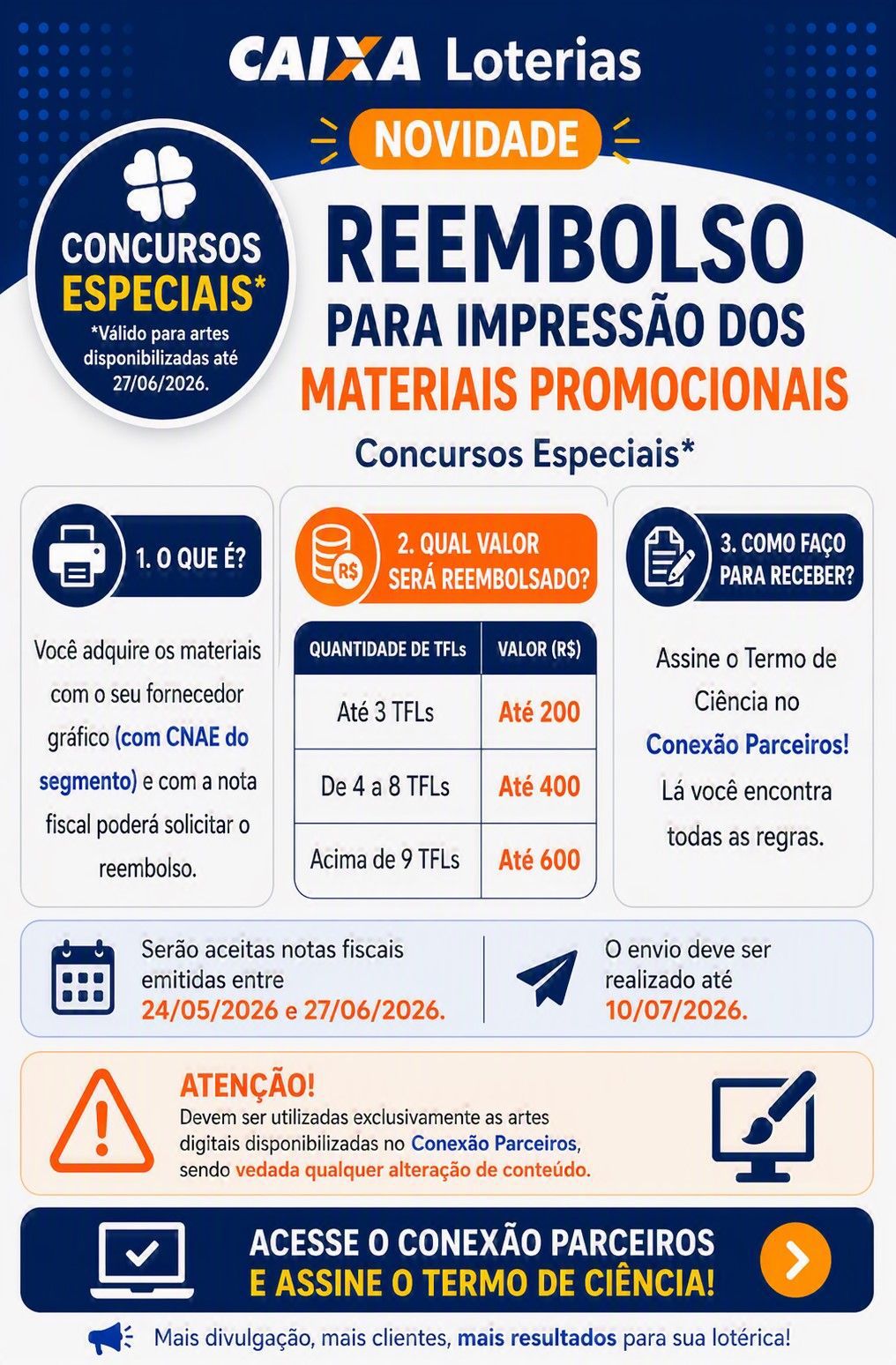
Caixa downplayed the situation through a statement (CE GENOL 0003/2026) sent to the lottery network to authorize what it called "decentralized production of promotional material for the special contests in June." In the adopted model, each business owner chooses their own supplier, based on digital artwork available on the Conexão Parceiros portal, with any content alteration prohibited. After presentation of an invoice, reimbursement would occur within 15 business days from confirmation of document validation.
The problem lies in the timing: the rules were released the week of the Quina de São João lottery draw itself. Many lottery retailers had already purchased the materials without requesting an invoice, precisely the document required to receive reimbursement.
The values defined by Caixa are based on the number of Lottery Financial Terminals (TFL) per lottery unit (UL):
⇒ Up to 3 TFL: reimbursement limit of R$ 200,00;
⇒ From 4 to 8 TFL: limit of R$ 400,00;
⇒ 9 TFL or more: limit of R$600,00.
For this category, these amounts are insufficient to cover the actual costs of banners, stickers, and flags. The complaint is especially acute in smaller establishments, where the limit of R$ 200 per unit does not even come close to covering the cost of a minimum visual campaign.
The Quina de São João lottery was not an isolated case.
The lack of promotional material had already caused friction before. On Lottery Agents' Day, celebrated on May 26th, business owners across the country registered complaints in WhatsApp groups and at public demonstrations about the lack of kits for the Quina de São João lottery. The same situation had occurred with the Mega 30 Years, a special draw held to commemorate the 30th anniversary of Mega-Sena; banners and signs were also not delivered on that occasion.
The category points to a breach of contractual obligations. According to the contract with Caixa Econômica Federal (a Brazilian bank), the institution is responsible for providing promotional material for Caixa Lotteries, including equipment, systems, and supplies, such as rolls of paper, betting slips, and office materials. The interruption in the physical delivery of promotional kits for special draws is seen by lottery operators as a violation of this agreement.
A state union leader, during the Lottery Workers' Day demonstrations, publicly stated that Caixa (the Brazilian bank) did not have an active promotional contract at the time, since the bidding process for this type of service had ended without immediate renewal. Without a contracted agency, the institution would not have been able to produce and send the material.
Contract worth R$ 265 million and fund of R$ 247 million.
The argument of unavailability of resources took on new dimensions with information published later. On Wednesday (June 11), the Official Gazette of the Union published an extract of a contract signed between Caixa and the company Promova Co Promoções, Eventos e Serviços Ltda., for the provision of "promotional marketing services for planning and creative conceptualization; creation of promotional materials; production and logistics of promotional actions and events of all kinds". The value: R$ 265 million for a period of 12 months.
In parallel, Caixa manages the Lottery Development Fund (FDL), created by Ministry of Finance Decree No. 130/1981 with the objective of ensuring that part of the lottery revenue is allocated to technological development, modernization, and promotion of the lottery business. The FDL's projected revenue for 2026 exceeds R$ 247 million. For lottery operators, the existence of these resources makes it even more difficult to justify the absence of promotional material in special draws.
Exception or new standard?
The Caixa's statement frames the decentralized reimbursement model as an "exceptional" measure. For business owners, this expression suggests that the practice will not be repeated in future special draws, now that the institution has a contracted marketing agency. The lingering question among the sector is whether the reimbursement of expenses related to the Quina de São João lottery represents an isolated case of crisis management or the beginning of a broader change in how Caixa handles the cost of promotional materials for the network. The institution has not yet provided an answer to this question.

