Debate on banning betting intensifies after Fux's decision.
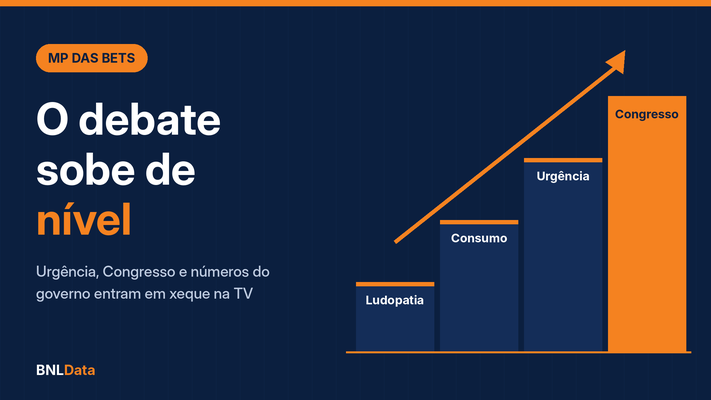
The public debate surrounding President Lula's provisional measure banning gambling in Brazil is beginning to shift. After Supreme Court Justice Luiz Fux suspended all legal actions regarding the ban until the Court rules on the case, the discussion has moved beyond simply "to ban or not to ban." Now, it involves more fundamental questions: whether there was truly an urgent need to issue a provisional measure, whether the ban solves the problem of compulsive gambling, and whether there is already a basis to say that the money previously spent on gambling has returned to household consumption.
Four analyses on television and the internet, later edited and posted on Instagram, show this shift. They present arguments that BNLData has been raising for months and that are now also being made by journalists and political scientists outside the sector.
Fux prefers a solution from Congress.
In UOL News, journalist Cézar Feitoza reported on the behind-the-scenes workings in Fux's office. According to him, at last week's public hearing at the Supreme Court, the minister was objective: he said that bets "admittedly do harm," but that the Supreme Court's job will be to analyze whether the government acted correctly in signing the provisional measure "on the eve of the first round of elections" and whether the constitutional requirements were met, starting with urgency.
Feitoza also said that the Supreme Court could modulate the terms, setting deadlines both for the betting sites to resume operations and for them to cease their activities. Aides to the minister, interviewed by the journalist, affirm that Fux continues to prefer a legislative solution, in which Congress analyzes the provisional measure and decides whether or not to maintain the prohibition.
The problem, according to Feitoza, is that congressional leaders are sending signals to the Supreme Court in the opposite direction. The tendency would be to let the provisional measure expire due to lack of a vote. "There is currently indecision in Minister Luiz Fux's office about what to do," he summarized. The question is whether it's worthwhile to wait for Congress or take the case directly to the full Supreme Court.
Prohibition drives addiction underground.
Also on UOL News, political scientist Mano Ferreira criticized what he called the "prohibitionist avalanche in public debate." According to him, believing that prohibition eliminates the problem "is a huge mistake."
“What ends up happening is a migration of pathological behavior from the formal environment to the informal environment. And then it becomes, sometimes, even more difficult to locate the behavior and where this person is,” he stated. According to Ferreira, the compulsive gambler doesn't cease to be “a slave to their illness” just because gambling has been pushed underground.
The political scientist cited a survey by Unifesp (Federal University of São Paulo) that estimates that 7,3% of the Brazilian population has a propensity for gambling addiction, "a frightening number that demands serious public policy." He then compared this number to that of alcohol: 11,9% of Brazilians have risky behavior associated with drinking. "I believe that no one will think that prohibiting alcohol is the best way to deal with this social problem," he said.
Increased sales would be seen as government propaganda.
On the program "Acorda Metrópoles," from the website Metrópoles , the political scientist questioned another piece of the official discourse: the idea that, with the ban on betting, supermarkets are already making more profit.
“I think it’s very premature for you to state that in that way. How can you make that calculation so quickly?” he questioned. For him, a possible return of money from betting to consumption is “a medium- to long-term trend,” and “we have to wait.” And he went further: in his assessment, the narrative that sales have grown is part of the government's propaganda to justify the provisional measure.
BNLData had already challenged this claim when the Brazilian Association of Supermarkets (ABRAS) attributed the increase in supermarket consumption to the ban on bets.
The political scientist also pointed out that gambling is deeply rooted in the country, with the jogo do bicho (animal lottery) and Caixa lotteries like Mega-Sena, and that the betting lobby extends to football clubs, many of which are sponsored by betting companies. Therefore, he said he understood Fux's position in requesting more time: "One cannot make such an untimely decision, which could have other kinds of consequences." He also criticized the rush to resolve important issues at the end of the legislative year, "at the last minute," which "hinders good debate."
Lula throws the decision into the lap of Congress.
In another analysis by Metrópoles, Gabriel Buss assesses that, by returning to the topic in his national radio and television address, the president transferred responsibility for the future of the ban to Congress. "The final word will be given by the National Congress," he stated. According to him, Lula is preparing his speech for a possible defeat of the provisional measure: "Look, I did my part, Congress, unfortunately, overturned this measure."
Buss points out that the Legislature has already tried to deliberate more decisively on betting, without success, and cites the Betting CPI (Parliamentary Commission of Inquiry), which ended without an approved report. In his view, this is a sign of the strength of the sector's lobby in Congress.
The analyst observes that the scenario changed with Lula's reelection. Previously, many parliamentarians were betting on Flávio Bolsonaro's victory, and the provisional measure would simply expire. Now, the discussion among party leaders has been left for the final stretch of the legislative year, competing for space with the budget. "Last-minute discussions can bring both positive and negative surprises," he said. Buss does not rule out that Congress will amend the provisional measure to make the prohibition more flexible, although he acknowledges that the proposal is not yet on the table.
The game continues.
All four analyses arrive at the same conclusion, which BNLData has been advocating: a provisional measure will not end gambling. The real discussion is about how to regulate, monitor, and care for those who become ill.
Now that the decision rests with the Supreme Court and Congress, the debate moves beyond the logic of propaganda and begins to address urgency, data, and public health.