
A David vs. Goliath tie in the Mega-Sena lottery: how a R$6 ticket and a R$232 ticket won the same prize.

Since we're talking about essentially miraculous luck, a biblical metaphor is fitting, with only the outcome changed: the 3.010th Mega-Sena lottery draw was a duel between David and Goliath, resulting in an improbable tie between the rivals.
On one side, a simple bet in Rio de Janeiro, with just 6 numbers, costing a mere R$ 6. On the other, a group bet of 20 numbers (the maximum allowed by the Lottery), organized by a group from Fortaleza that spent R$ 232.560,00. Both won the same prize: more than R$ 168 million each.
The math makes the imbalance between the forces vying for the fortune even more evident. See below:
Let's review two key concepts:
Arrangement : used when the order of the factors matters and there can be no repetition.
For example: the World Cup podium will have one team in 1st place, one in 2nd, and another in 3rd. It's clear that everything changes depending on whether Brazil is in 1st place (sixth title!) or in 2nd place (runner-up).
We have the following possibilities: firstly, all 48 participating teams. Secondly, 47 (one will already be in first place). Thirdly, 46 (one in first place and another in second).
To find the number of possible podium finishes, you need to multiply 48 × 47 × 46 = 103.776.
There's a formula for that. It reads "arrangement of 48 [total number], 3 by 3 [number of little houses]":

Result: 103.776 different possible podium finishes.
But Mega-Sena doesn't work according to that logic: the order in which the numbers appear doesn't matter much, as you will understand below.
⇒ What does that exclamation mark mean? It's the factorial symbol. The factorial of a number represents its multiplication by all positive integers smaller than it, down to 1. Example: 3! = 3 × 2 × 1 = 6. Or 5! = 5 x 4 x 3 x 2 x 1 = 120. The “48!”, therefore, means 48 × 47 × 46 × 45… down to 1.
Factorials appear in formulas to help us count all the possibilities without having to write out gigantic multiplication problems.
⇒ Combination: the order of the "draw" doesn't matter. There is also no repetition.
Here, yes, it's the case of Mega-Sena: the numbers drawn in this contest were 03 – 30 – 33 – 35 – 45 – 47. It doesn't matter which was the first, second, or sixth ball drawn from the urn. And, of course, a number that has come up once doesn't return to the pile, meaning it won't be repeated.
Let's look at the formula for the following combination, in the context of the David and Goliath contest.
David : the R$6 bet
The "weaker" young man, without much experience in battles, represented by a gambler from Rio, risked that, by "guessing" 6 numbers, he would correctly guess the 6 numbers drawn by Caixa Econômica Federal.
What is the probability of success? There are 6 blanks to be filled: __ __ __ __ __ __.
We have 60 possibilities in the first, 59 in the second, 58 in the third… So far, everything is the same as the arrangement explained above. But we need to eliminate the sequences that contain the same numbers, such as 03 – 30 – 33 – 35 – 45 – 47 and 30 – 03 – 33 – 45 – 35 – 47.
The formula for this is:
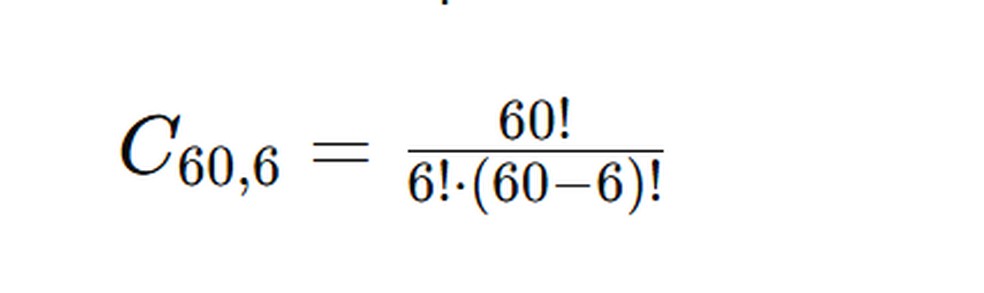
Solving the calculation, we arrive at 50.063.860. In percentage terms, this means an approximate chance of 0,000001998% (about 1 in 50 million).
⇒ Goliath: the R$ 232.560,00 bet
Let's take the case of Goliath, the much stronger fighter. He chose to spend more to increase his chances of winning. He made 20 predictions.
In other words, the combination here was:
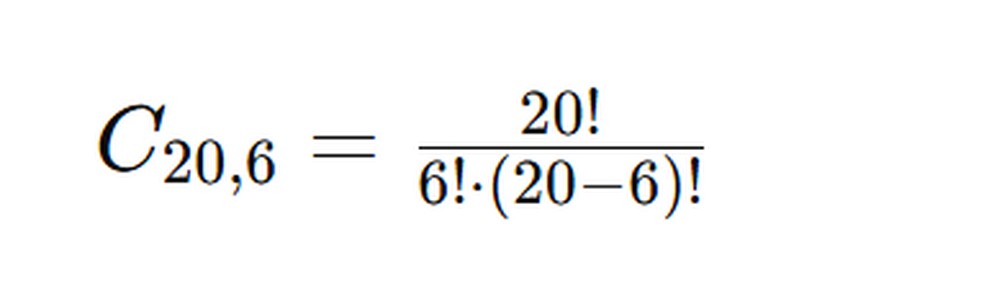
Result: 38.760.
In other words: 38.760 chances out of 50.063.860. This equates to 1 chance in 1.292.
Note that there is no discount for more ambitious bettors. The probability increases in direct proportion to the investment.
In percentage terms, the comparison between David and Goliath looks like this:
David : 0,000001998% chance of being correct.
⇒ Goliath: 0,0774% chance of success
Even with a huge disadvantage in the odds, the single bet ended up with the same prize as the group bet. In short: Mega-Sena doesn't defy mathematics. It only shows that what is unlikely can also happen (we are all waiting for our turn). ( With information from g1 Education Editorial Staff )