
The government collected more revenue from betting than the companies themselves earned.
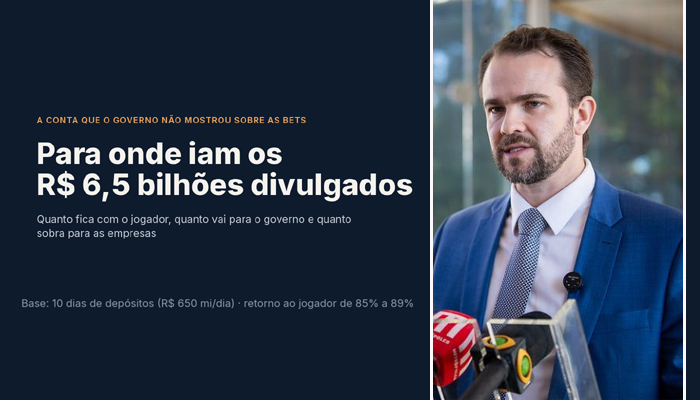
Finance Minister Dario Durigan reiterated on Tuesday (6), when presenting the balance of the ban on fixed-odds betting, that between R$ 600 million and R$ 650 million per day were leaving people's savings for betting and that this money is now going to families. In ten days, the amount reaches R$ 6,5 billion, a value comparable to 8 million basic food baskets. The complete account, however, shows a different picture: deposits are cash inflows, not losses, and most of it returns to the bettor himself.
FactCheck: What the minister said and what the number measures.
The statement: R$ 650 million per day “was leaving people’s savings” for betting houses. On Friday (2), the amount cited by the minister himself was R$ 600 million.
The data comes from information from the Central Bank regarding transfers to betting site accounts. The number therefore measures what entered the platforms, without deducting what returned to bettors in winnings and withdrawals.
What the official data shows: what the operators keep is the GGR, the gross gaming revenue. According to data from the Treasury itself, obtained by BNLData via the Access to Information Law, the GGR totaled R$ 36,9 billion in 2025 and R$ 20,07 billion in the first half of 2026. This is equivalent to approximately R$ 101 million per day in 2025 and R$ 111 million per day this year, approximately one-sixth of the value presented by the minister.
What the minister's own report reveals: 86,2 million accounts had balances between R$0,01 and R$0,99, and 1% of bettors, about 200 people, concentrated 80% of the R$1,325 billion pending restitution. The picture is of a predominantly recreational audience, with residual amounts on the platforms, and not of families with their savings trapped in betting houses.
Conclusion: the statement is misleading. The minister treats the volume of deposits as if it were a loss for families, when most of that money was returned to the bettors.
Where did each R$100 go?
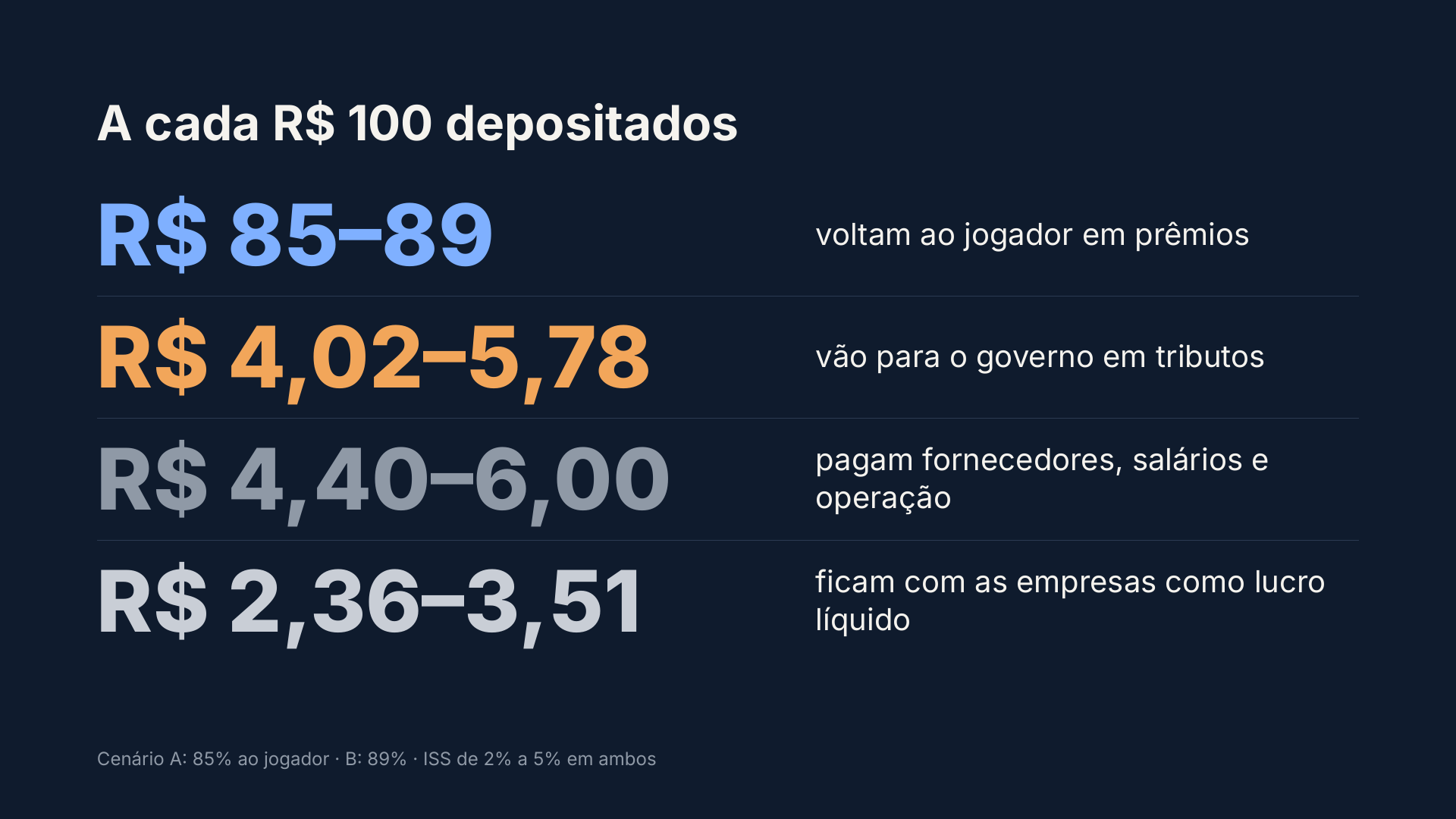
Considering a return to player between 85% and 89%, between R$ 5,53 billion and R$ 5,79 billion of the R$ 6,5 billion returned in prizes. The GGR (Gross Guaranteed Rewards) ranged between R$ 715 million and R$ 975 million, or 11% to 15% of the total. The table below shows the destination of each R$ 100 deposited:
What the government collected
The GGR is subject to a 13% contribution, ISS (from 2% to 5%, depending on the municipality), PIS (1,65%) and Cofins (7,6%). In a scenario with an 85% return to the player, these taxes total between R$ 236,4 million and R$ 265,7 million. In an 89% scenario, they range from R$ 173,4 million to R$ 194,8 million.
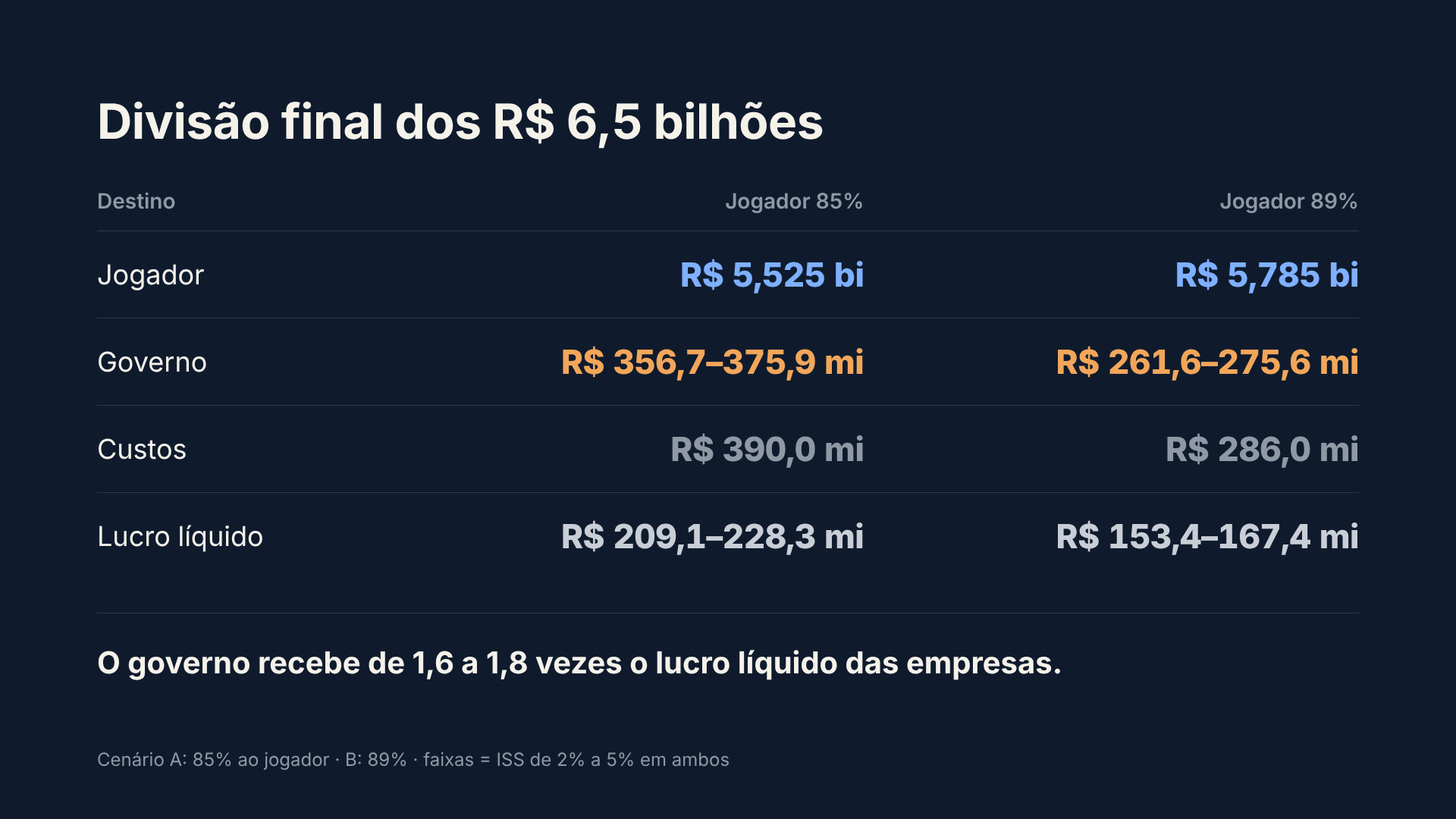
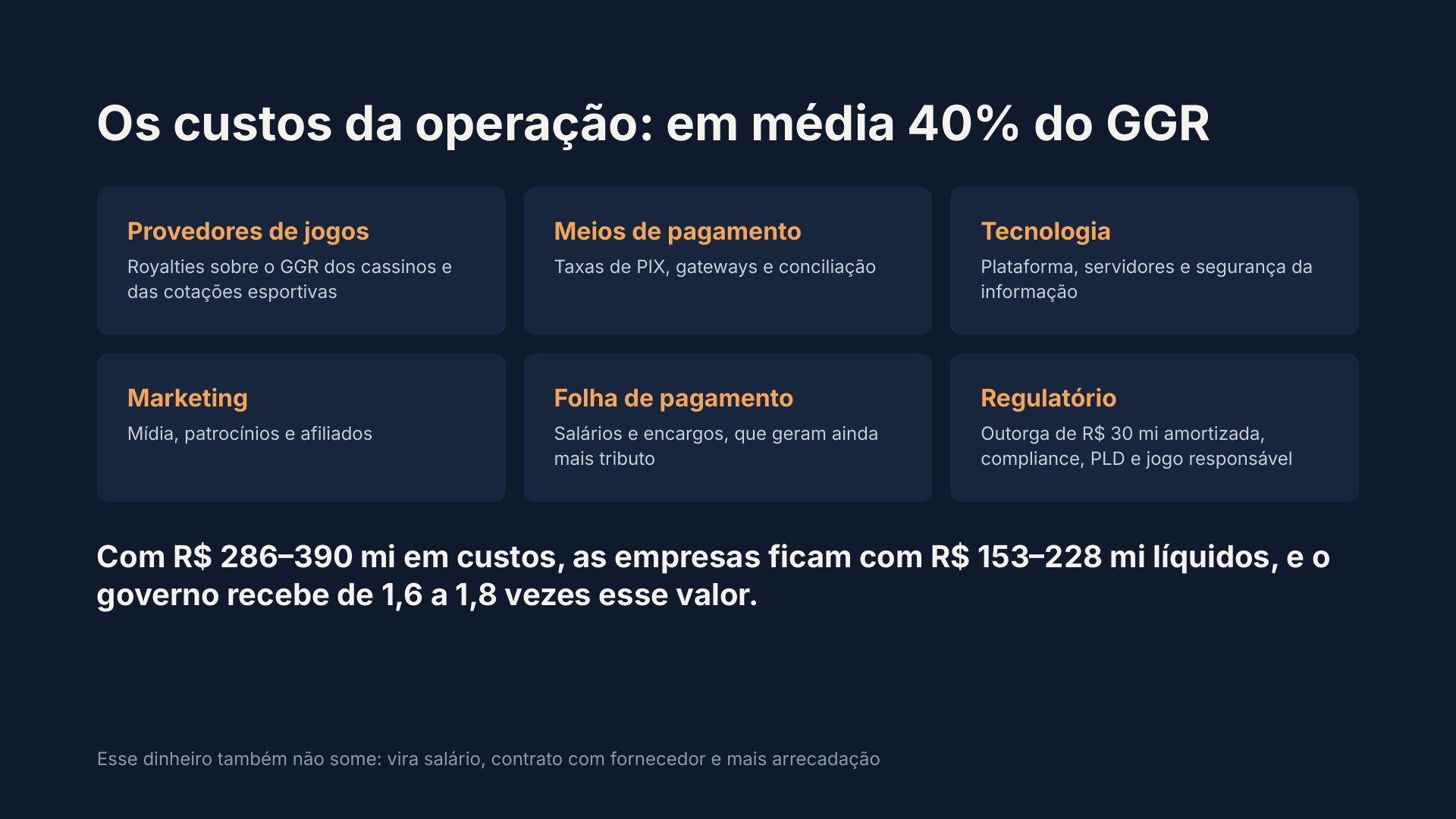
Next come the operational costs, averaging 40% of the GGR (from R$ 286 million to R$ 390 million), and the IRPJ and CSLL on profit, which add from R$ 80,8 million to R$ 120,3 million to the revenue. In the end, the government received between R$ 261,6 million and R$ 375,9 million on the same R$ 6,5 billion.
The government was earning more than the companies.
The net profit of the operators ranges between R$ 153,4 million and R$ 228,3 million, equivalent to 2,36% to 3,51% of deposits. In all scenarios, the government received 1,6 to 1,8 times the companies' net profit.
The “8 million basic food baskets”, divided
Applying the same rule, of R$ 812,50 per basket, the breakdown is as follows:
Between 6,8 and 7,1 million baskets were already being returned to the bettor in prizes.
⇒ Between 322 and 463 is equivalent to what went to the government.
Between 352 and 480 were used to pay suppliers, salaries, and operations.
⇒ The net profit of the companies ranged from 189 to 281.
The costs don't disappear either.
The 40% of GGR consumed by operations remunerates game providers, payment processors, technology companies, marketing agencies, payroll, and regulatory obligations. This money becomes salaries, supplier contracts, and more revenue.
Context
In June, Durigan himself assessed that a potential ban on betting could be harmful by stimulating and expanding the illicit market. With Provisional Measure 1.394, along with the companies' profits, the taxes, jobs, and contracts that this revenue sustained disappear. The measure still needs to be approved by Congress and is the subject of legal actions in the Supreme Federal Court (STF), under the rapporteurship of Minister Luiz Fux.

