
Jogo do bicho: how it works, why it's illegal, and what the legalization bill says.
The jogo do bicho (animal game) remains present in Brazilian culture and generates a lot of money in the country despite being classified as illegal since 1941, through the Law of Criminal Offenses. The Brazilian Legal Gaming Institute (IJL) estimates that, in 2024 alone, revenue reached R$ 12 billion in more than 350 points of sale – a number that easily surpasses the 12.600 lottery outlets of Caixa Econômica Federal.
Even though it's outside the law, the jogo do bicho (animal game) remains popular and operates almost like an informal business, raising questions about why the practice is prohibited and the real effects of legalization, like federal lotteries.
This article from E-Investidor reports on how experts assess the issue.
Before understanding how the jogo do bicho (animal lottery) works, the reader should know that there are figures who control the bets, such as the banker, the bookmaker, and the scorer. Thus, it functions almost like a real company, where there is a boss, a manager, and an employee. See each of the roles below:
⇒ Banker: responsible for financing the game and assuming the financial risks. He owns the operation in a given area, collects the bets, and is responsible for paying the prizes to the winners.
⇒ Manager or bookmaker: manages one or more betting shops and coordinates the flow of bets in that region. He supervises the bookmakers and ensures that everything works according to the system.
⇒ Bookmaker, bookie, or recorder: records bets, usually in notebooks, ledgers, or even electronic systems. This is the person who deals directly with the public, acting as the link between the bettor and the game's structure.
Despite the names, in everyday life, the three are almost always referred to as bookmakers.
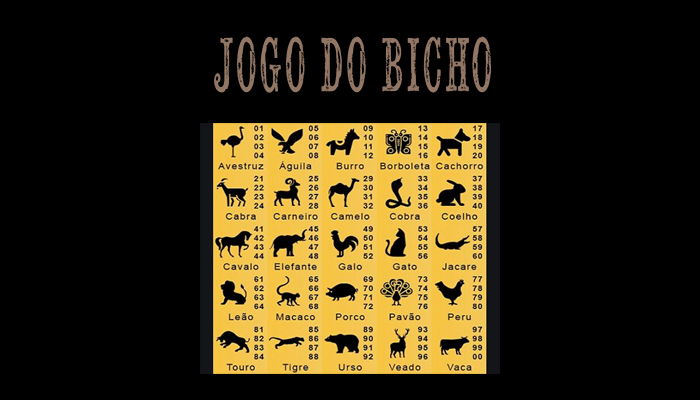
But it is only possible to play using a list of numbers represented by 25 animals, with each animal corresponding to four tens. From the ostrich (01,02,03,04) to the cow (97,98,99,00), they add up to 100 tens.
See all the groups in the animal lottery game separated by animals.
| Group | Animal | Dozens |
|---|---|---|
| 01 | Ostrich | 01 - 02 - 03 - 04 |
| 02 | Eagle | 05 - 06 - 07 - 08 |
| 03 | Donkey | 09 - 10 - 11 - 12 |
| 04 | Butterfly | 13 - 14 - 15 - 16 |
| 05 | Dog | 17 - 18 - 19 - 20 |
| 06 | Goat | 21 - 22 - 23 - 24 |
| 07 | Sheep | 25 - 26 - 27 - 28 |
| 08 | camel | 29 - 30 - 31 - 32 |
| 09 | Cobra | 33 - 34 - 35 - 36 |
| 10 | Rabbit | 37 - 38 - 39 - 40 |
| 11 | Horse | 41 - 42 - 43 - 44 |
| 12 | Elephant | 45 - 46 - 47 - 48 |
| 13 | Gallic | 49 - 50 - 51 - 52 |
| 14 | Cat | 53 - 54 - 55 - 56 |
| 15 | Jacaré | 57 - 58 - 59 - 60 |
| 16 | Lion | 61 - 62 - 63 - 64 |
| 17 | Monkey | 65 - 66 - 67 - 68 |
| 18 | Pork | 69 - 70 - 71 - 72 |
| 19 | Pavão | 73 - 74 - 75 - 76 |
| 20 | Peru | 77 - 78 - 79 - 80 |
| 21 | Taurus | 81 - 82 - 83 - 84 |
| 22 | Tigre | 85 - 86 - 87 - 88 |
| 23 | Urso | 89 - 90 - 91 - 92 |
| 24 | Stag | 93 - 94 - 95 - 96 |
| 25 | Cow | 97 - 98 - 99 - 00 |
What are the possible bets in the jogo do bicho (animal lottery)?
From the list, simply choose one of the animals or bet on specific numbers. For example, when betting on the sheep, the player is automatically choosing the numbers 25, 26, 27, and 28 — and wins if one of these is drawn. To bet on an exact number, simply choose the desired number, regardless of the animal it is associated with.
It is also possible to bet on a hundred. In this case, the player chooses a ten from an animal and adds a number in front. Let's suppose someone wants to bet on the ten 99, which belongs to the cow, and puts the number 2 before it. Thus, they form the hundred 299. If the number 3299 comes up in the draw, for example, the player wins, since the last three digits correspond to the chosen hundred.
Finally, it's possible to bet on a complete four-digit number. The logic works the same as for the three-digit number: the player chooses the last two digits – which must belong to one of the animals – and adds two more numbers in front, forming a four-digit number. Thus, if they bet on the four-digit number 3299, they only win if that exact number is drawn.
After that, the bettor must wait for the draw, which can be carried out either by the game organizers or through the numbers drawn in federal lotteries. Just like in lotteries, the prize varies according to the probability of winning; that is, the higher the value, the lower the chance of winning. Furthermore, the prize is multiplied by the bet amount, regardless of the value.
Are lotteries, jogo do bicho (illegal lottery), and bets investments?
Even though they are popular – and seen by many as a way to get rich – both the jogo do bicho (animal game) and lotteries are considered games of chance, as they depend exclusively on luck and chance, in addition to sharing the so-called "risk factor". Despite the return being quite high for the lucky winners, according to investment specialist Virgílio Lage, jogo do bicho, lotteries, and even bets are not reliable as a source of extra income – although they are risky in different ways.
“They all carry a very high risk, but with some differences. Caixa's official lotteries are legalized, supervised, pay prizes according to the rules, and allocate part of the revenue to areas such as health, education, and security,” explains the expert about lotteries.
Regarding online betting and the famous "tigrinho" (little tiger) lottery, Virgílio states that there is a risk of total loss, in addition to the threat of match-fixing.
The illegal lottery game known as "jogo do bicho," on the other hand, is not subject to any regulation or oversight. "The bettor has no one to turn to if they are wronged. There is also the risk of indirect involvement with criminal organizations, which is the scenario with the greatest operational risk today," assesses the expert.
Will the jogo do bicho (animal game) be legalized like lotteries?
In 2022, Bill No. 2.234/2022 began its legislative process in Congress with the aim of regulating the jogo do bicho (a type of illegal lottery), as well as casinos, bingo halls, slot machines, and online betting, through concessions, oversight, tax payments, and measures to mitigate social impacts. However, to date, the proposal remains unresolved. A vote scheduled in the Senate for July 8, 2025, has been postponed indefinitely.
Both Lage and Franchescoly Carnevale, a civil lawyer, acknowledge that the potential legalization foreseen in the bill could generate both positive and negative consequences. Regarding the jogo do bicho (illegal lottery), the lawyer mentions that the bill's text provides for the creation of accredited companies in each city of 700 inhabitants to legally operate this type of gambling – in addition to the creation of two new taxes.
These would be: the Gaming and Betting Inspection Fee (Tafija), paid every three months, in the amount of R$ 20 for operators of the jogo do bicho (illegal lottery); and the Contribution for Intervention in the Economic Domain levied on the commercialization of games and bets (Cide-Jogos), which would have a rate of up to 17% on gross revenue – that is, the difference between the value of bets and prizes paid from all initiatives in the sector.
"Part of the resources would also have to be allocated to actions to prevent gambling addiction, in health, public safety, animal protection, student financing, actions in areas impacted by natural disasters, and the National Fund for Children and Adolescents (FNCA)," he adds.
Gamblers will also be financially affected by legalization, as they will have to pay 20% income tax on winnings exceeding R$10. The full proposal is publicly available on the Senate website for anyone who wishes to consult it.
According to the House, estimates by Irajá Abreu (PSD-TO), rapporteur of the legalization proposal, indicate that the activities could generate investments of R$ 100 billion and create approximately 1,5 million direct and indirect jobs. Potential revenue reaches R$ 22 billion per year.
What are the social risks of legalizing the jogo do bicho (illegal lottery)?
Despite the economic activity, Lage is primarily concerned about the risks of legalizing gambling – including the jogo do bicho (a type of illegal lottery) – to the financial health of Brazilians. “In theory, legalizing jogo do bicho could bring benefits, as it could generate tax revenue, formal jobs, and reduce crime associated with illegal gambling. But, on the other hand, there are studies that show social risks, such as gambling addiction, increased financial vulnerability, and chronic indebtedness for many families, which often outweigh the tax gains,” he explains.
The expert adds that if gambling is truly regulated, a robust law would be necessary, with controls, audits, prevention campaigns, and support programs for addicts, as is the case in other countries where casinos, for example, are legal.
Canevale agrees with Lage's thinking, but goes a little further: for him, the prohibition is the result of social and cultural prejudice. "It's a popular practice, rooted in communities, but still treated with stigma, as if it were something lesser or marginal. Meanwhile, other forms of gambling, such as lotteries and online games, are legalized and even encouraged by the State itself, which shows a clear contradiction."
The lawyer also comments that if the jogo do bicho (an illegal lottery game), which currently moves billions in money in secret, were legalized, the risk of its link to organized crime would decrease substantially.

