Lula promises security, but he took almost R$ 1 billion a year from the police's budget.

The president who makes public safety a campaign banner is the same one who cut one of the sector's funding sources. By prohibiting fixed-odds betting, Provisional Measure 1.394, of September 25, revoked articles 29 to 35 of Law 13.756/2018, precisely those that allocated part of the betting revenue to the National Public Security Fund (FNSP), the Federal Police, and border monitoring.
Spreadsheets from the Treasury Management System, obtained by BNLData and reported by the Secretariat of Prizes and Bets of the Ministry of Finance (SPA-MF) via the Access to Information Law, show the size of the cut. Between February 2025 and June 2026, bets yielded R$ 912,5 million to public security: R$ 553,1 million in 2025 and R$ 359,4 million in the first half of this year alone.
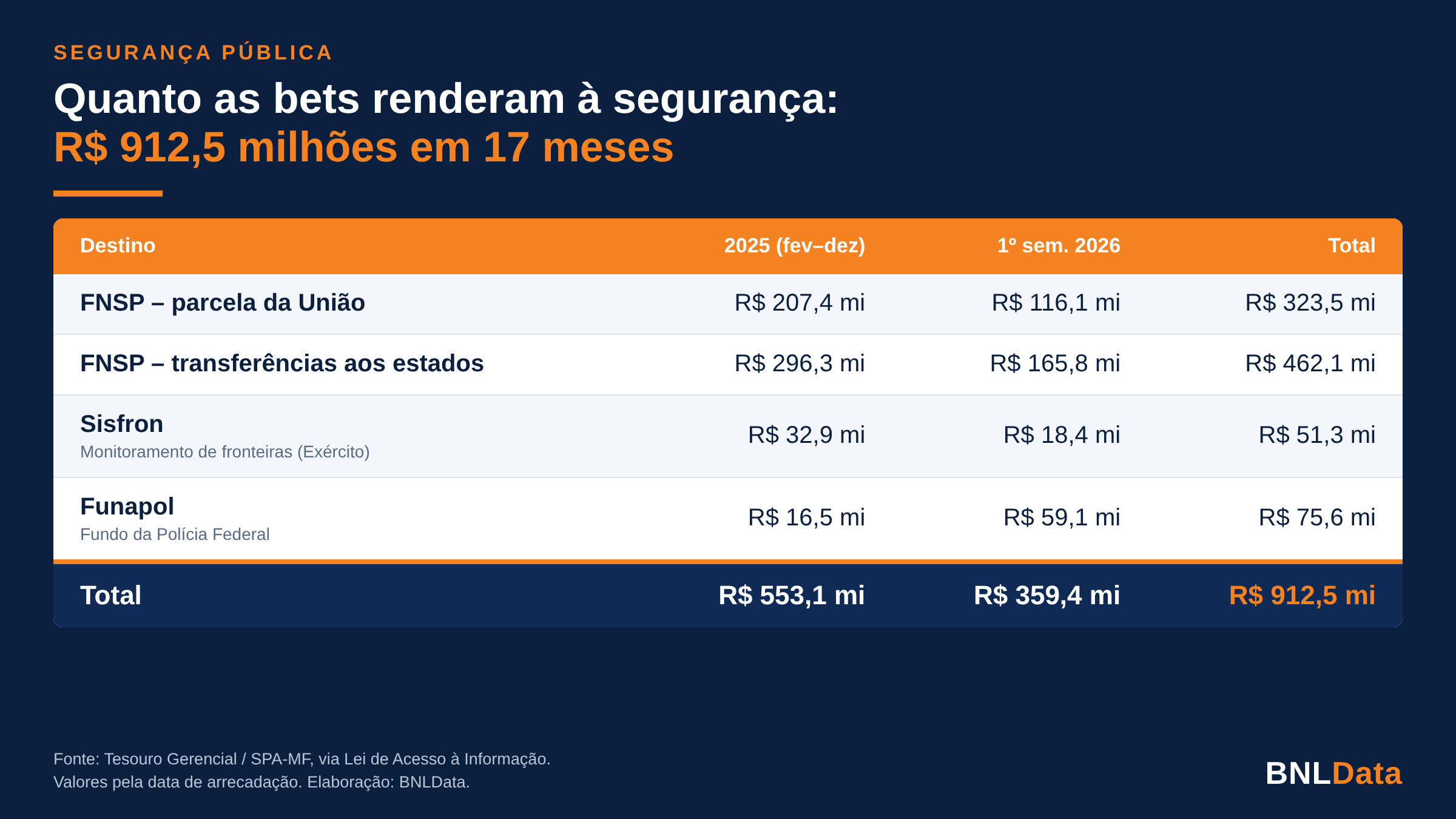
The cuts don't stay in Brasília. More than half of what went into the National Public Security Fund (FNSP), R$ 462,1 million during that period, was transferred to the states. This money is used to buy vehicles, equipment, and technology for military and civil police, firefighters, forensic experts, and municipal guards. By law, the fund also reserves at least 6% for combating violence against women, including ankle monitors for aggressors, and 10% to 15% for housing and quality of life for police officers.
The contradiction of Funapol
The most symbolic case is that of the Federal Police. On July 30th, Lula signed the law allocating 1% of the revenue from betting to Funapol in 2026, a percentage that would reach 3% from 2028 onwards. At the ceremony, the Minister of Justice stated that everyone deserves health, infrastructure, and dignity.
The spreadsheets show the effect of the new rule, in force since April by provisional measure: the fund, which received about R$ 1,5 million per month, began receiving R$ 26,9 million in May and R$ 26,0 million in June. Fifty-seven days after the sanction, the same president eliminated the funding source.
At the rate seen in May and June, public security received approximately R$ 75 million per month from betting. According to BNLData's estimate, this equates to roughly R$ 900 million per year that is lost.
The government was already taking 30%.
The data reveals another problem. The SPA-MF Periodic Panorama records that, in 2025, the legal allocations of bets totaled R$ 614,4 million for public security and R$ 25,1 million for Funapol. However, only R$ 553,1 million reached the coffers of these agencies.
The main explanation lies in the Union Revenue Disconnection (DRU). Spreadsheets show that the Treasury retained 30% of the federal share of the FNSP, Sisfron, and Funapol, an amount that went to "unrestricted Union resources." According to BNLData's calculations, approximately R$ 110 million earmarked for security had a different destination in 2025. In other words, before the source was eliminated, the government was already failing to deliver everything the law promised.
PEC without backing
The inconsistency extends to the government's main proposal for the sector. The Public Security Amendment, which arrived in the Senate in July, allocates 10% of the revenue from betting to the National Public Security Fund (FNSP) and the Penitentiary Fund in 2026, reaching 30% in 2028. With the prohibition, the amendment promises to redistribute revenue that the government itself eliminated.
Meanwhile, the gambling doesn't disappear: it migrates to the illegal market, which doesn't collect a single cent for the police. The government still hasn't explained where the money will come from to replace what it took from security.