An average of 12 polls shows Flávio with 51,1% and Lula with 48,9% on the eve of the second round.
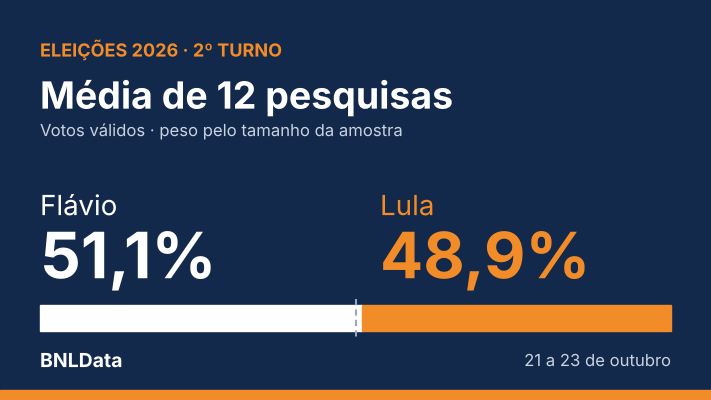
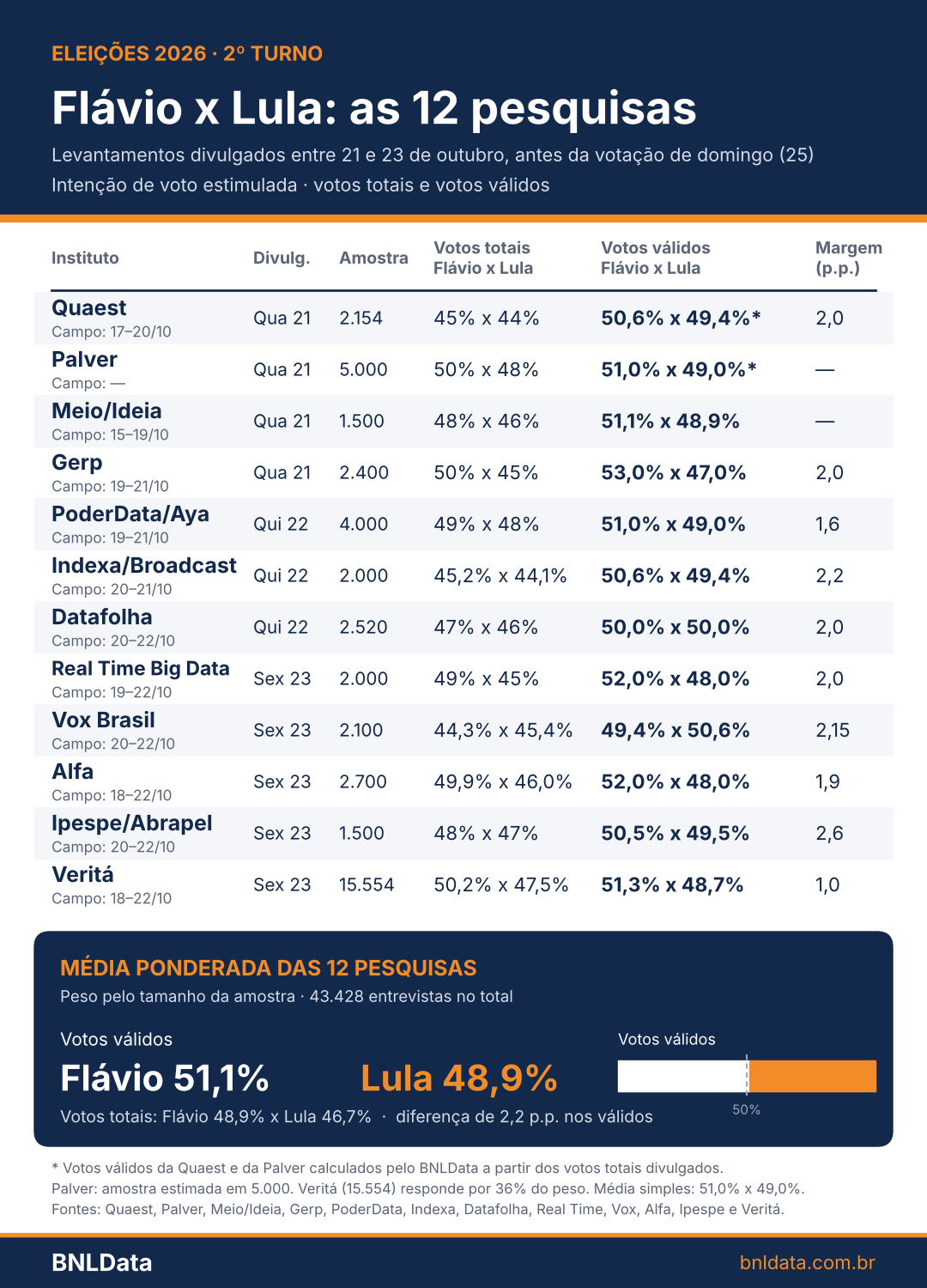
Twelve institutes released national polls for the 2nd round of the presidential election between Wednesday (21) and Friday (23). BNLData aggregated all of them and calculated the weighted average by sample size, totaling 43.428 interviews. Senator Flávio Bolsonaro (PL) has 51,1% of valid votes and President Lula (PT), 48,9%. In total votes, the score is 48,9% to 46,7%.
Veritá, with 15.554 interviews, alone accounts for 36% of the weighted average. Even so, the result remains practically unchanged when all surveys are weighted equally: the simple average gives 51% to 49%.
Flávio appears numerically ahead in valid votes in ten of the twelve surveys. The two candidates are tied with 50% in the Datafolha poll, and Lula leads only in the Vox Brasil poll, with 50,6% against 49,4%. The senator's biggest advantage is in the Gerp poll, 53% to 47%. This is the only poll in which the institute itself classifies the difference as statistically significant. In the others, the candidates are in a technical tie.
What the first round teaches us
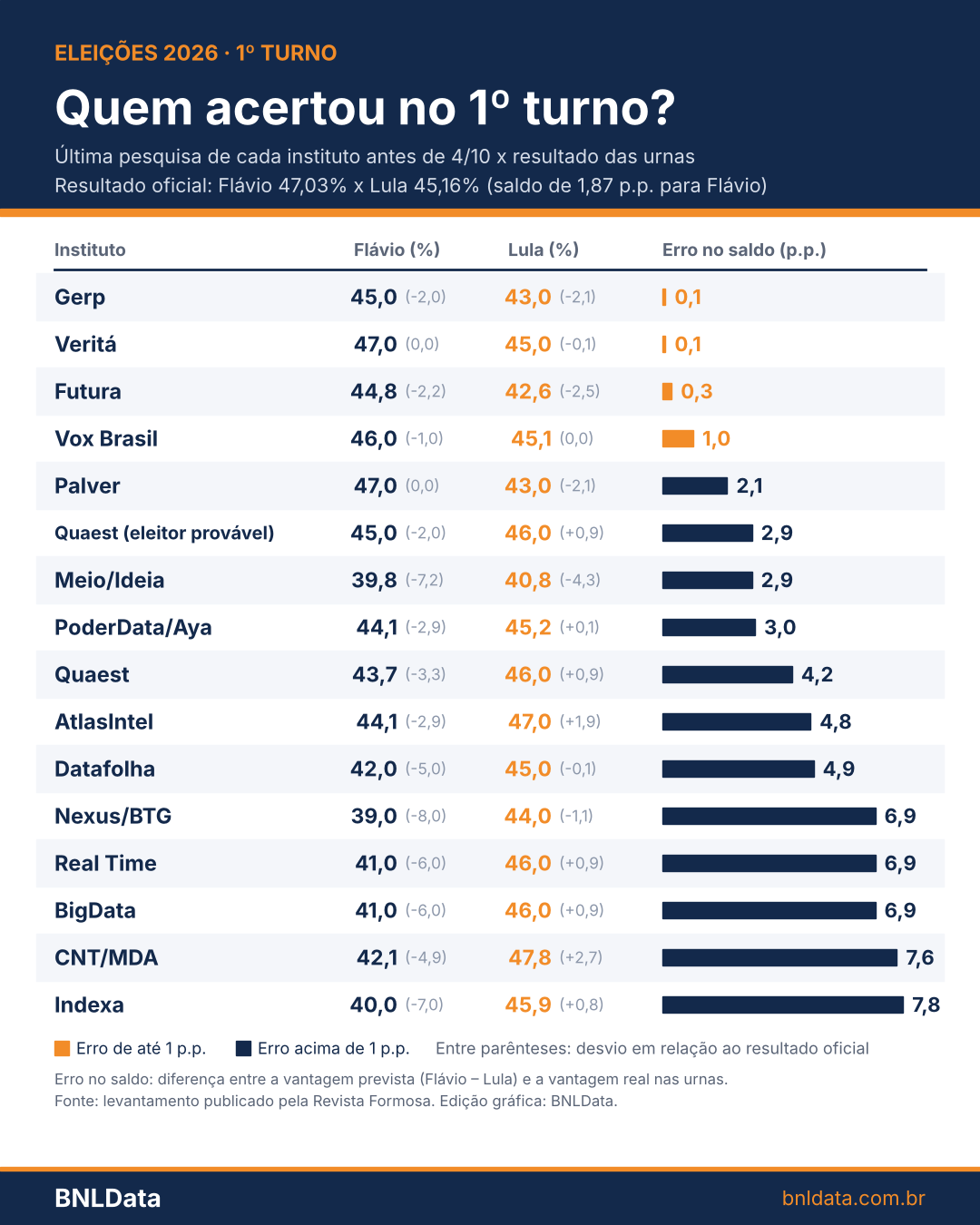
On October 4th, Flávio finished with 47,03% of the valid votes and Lula with 45,16%. The difference was 1,87 points in favor of the senator. A survey on the performance of the polling institutes, which circulated after the election, shows a pattern: none overestimated Flávio. All underestimated him or were correct.
The most accurate polls in their assessment of the difference between the two candidates were Gerp, Veritá, and Futura, with an error of up to 0,3 points, and Vox Brasil, with an error of 1 point. Palver, Meio/Ideia, Quaest, and PoderData/Aya were off by between 2 and 4 points. Datafolha, Real Time Big Data, and Indexa were off by between 4,9 and 7,8 points, consistently underestimating the senator.
The three most accurate polling institutes from October 4th, which returned to the field this week, do not reach a common conclusion. Gerp shows Flávio 6 points ahead, Veritá gives the senator 2,6 points, and Vox Brasil gives Lula 1,2 points. The average of the three gives Flávio 51,2%, practically the same number as the overall average.
The picture repeats itself when the polling institutes are grouped by their performance in the first round. Those with moderate error (Palver, Meio/Ideia, PoderData/Aya and Quaest) give Flávio, on average, 50,9% of the valid votes. Those with high error (Datafolha, Real Time Big Data and Indexa) also give 50,9%. Regardless of the reliability scale, Flávio appears between 50,9% and 51,3%.
Correction exercise
A simple calculation involves adding to the current results of each poll the amount by which the institute underestimated Flávio on October 4th.
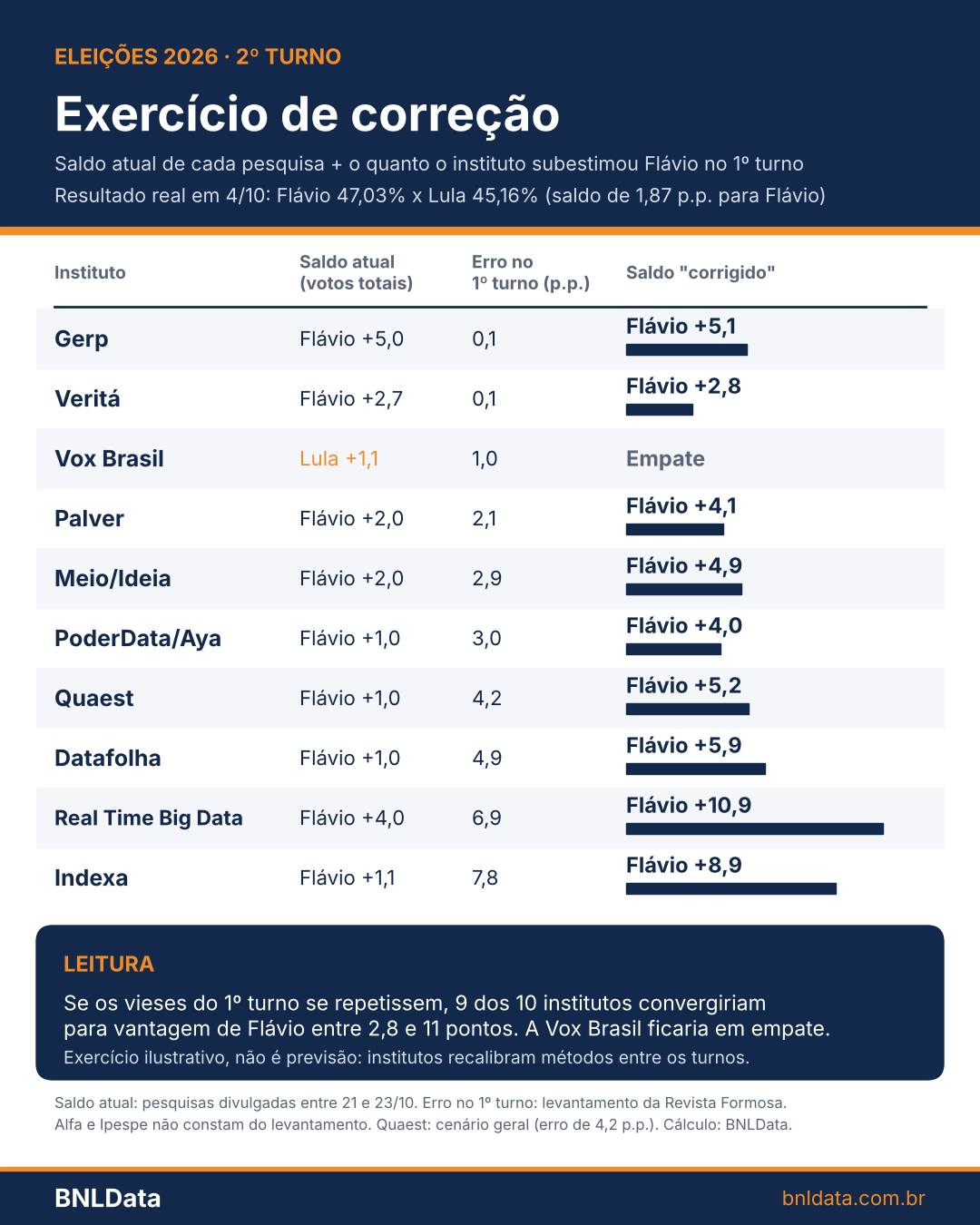
If the biases of October 4th were to repeat themselves, nine of the ten institutes included in the survey would converge on a lead for Flávio between 2,8 and 11 points. The exception would be Vox Brasil, which would show a tie. Alfa and Ipespe do not appear in the first-round performance survey.
The calculation has clear limitations and should not be interpreted as a prediction. Institutes that make significant errors usually revise their methodology before the next round. Palver, for example, reported that it began calibrating the sample using the official results of the first round by region. The second round also has its own dynamics, with vote transfers, changes in voter turnout, and fewer undecided voters. The fact that the survey on the accuracy of the first round mixes total and valid votes without detailing the criteria used also weighs against the calculation.
A snapshot of the final stretch.
The picture for the week is a technical tie, with a bias favoring Flávio Bolsonaro. The weighted average, most institutes and the senator's recent history of underestimation point in the same direction. The margin, however, remains too small to anticipate the result. This Saturday (24), the day before the 2nd round, the polls from AtlasIntel, Quaest, Datafolha, Paraná Pesquisas, Nexus, Palver and MDA will be released.