The betting law has already cost 3,5 jobs, and layoffs are expected to reach 5,6 in 90 days, according to partial data from an ANJL survey.
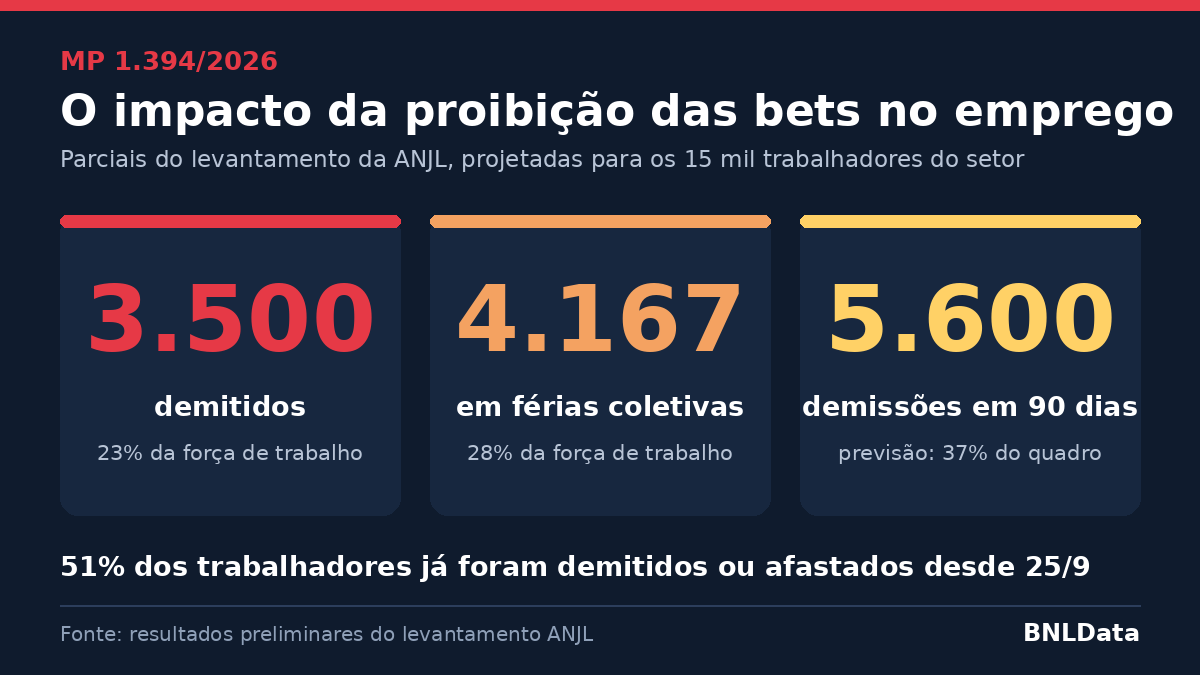
The first figures from the survey by the National Association of Games and Lotteries (ANJL) on the effects of Provisional Measure No. 1.394/2026 on the labor market show the extent of the damage caused by the ban on fixed-odds betting in the country. Partial data obtained by BNLData indicate that 23% of the entire workforce has already been laid off, 28% are on collective leave, and the forecast is that layoffs will reach 37% of the workforce within 90 days.
Projected for the entire market, which employs approximately 15 people, the percentages correspond to roughly 3.500 workers laid off and 4.167 on collective leave. In three months, the total number of layoffs is expected to reach 5.600, meaning an additional 2,1 jobs eliminated on top of those already lost.
Including both those laid off and those furloughed, 51% of the sector's workforce, or more than 7,6 people, have already lost their jobs or been placed on collective leave in less than two weeks since the measure came into effect.
"That's more people than a large multinational corporation," summarized a market source who is following the data consolidation.
How is the survey conducted?
The survey was launched by ANJL to measure, with real numbers, the effects of the Provisional Measure on direct and indirect jobs. The form is intended for both operators and service providers in the sector and should be completed by HR representatives or management with access to the company's figures. Operators were also instructed to forward it to impacted suppliers and partners.
Dismissals and terminations that occurred from September 25, 2026, the date the measure was announced by the government, are considered “due to the Provisional Measure”. The deadline for submitting responses ends this Wednesday (7).
“We need real numbers to gauge the effects of the measure on workers and companies that depend on the activity,” says the president of ANJL, Plínio Jorge, in the statement sent to operators. According to the organization, the data will be consolidated and released exclusively in an aggregated and anonymous form.
The numbers could still grow.
The results are preliminary and are likely to change as responses are consolidated. The trend is upward, since the supply chain includes payment methods, technology, customer service, compliance, marketing, agencies, affiliates, and media outlets—segments that directly depend on the activity and whose figures are still being compiled.
Collective vacations, in turn, serve as a holding pattern. Companies are awaiting a decision from the Supreme Federal Court, where lawsuits against the Provisional Measure are being processed under the rapporteurship of Minister Luiz Fux, and from the National Congress, which needs to vote on the measure. Without a reversal, some of these 4.167 workers are likely to swell the ranks of those laid off.
The data that was left out of the balance sheet.
The impact on employment was not mentioned in the government's official presentations on the ban. These are formal jobs, created in a market regulated by Lula's own government, by companies that paid a grant and complied with the requirements of the Prizes and Betting Secretariat of the Ministry of Finance. In 22 months of regulation, the sector structured teams in Brazil precisely because the law began to require a local presence.
Each of these numbers represents a family. And the survey comes amid the election campaign, after the president's own campaign assessed that the ban on betting harmed the first-round results.
The question remains: would these people and their families vote for Lula's reelection?