Native Americans played with bone dice 12 years ago, study reveals.
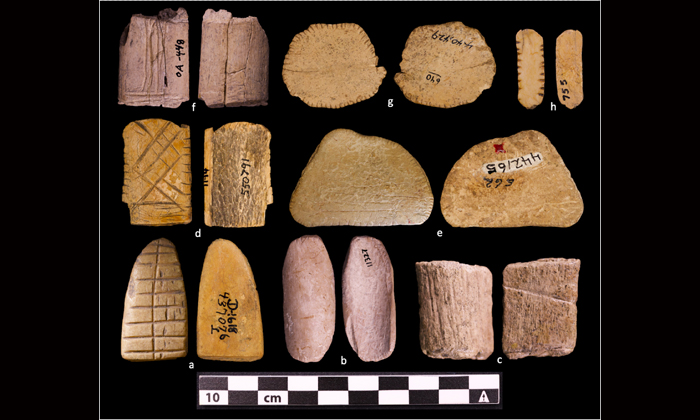
Colorado State University released a study that identifies the practice of gambling among Native Americans at the end of the last ice age. Archaeologist Robert Madden cataloged more than 600 artifacts that functioned as binary dice at 57 sites from the Folsom period. The research was published this Thursday (2) in the journal American Antiquity.
The objects analyzed date back between 12.800 and 12.200 years. They were found in regions that today correspond to the states of Wyoming, Colorado, and New Mexico. As reported by Galileu Magazine, the discovery represents a significant milestone in understanding the cultural practices of Native American peoples, revealing sophisticated aspects of their social interactions in remote periods of prehistory.
Bone artifacts generated random results.
The identified data are worked bone fragments with two distinct faces. These specimens were small, flat or slightly rounded, often oval. The faces showed differentiation through markings or surface treatments.
The objects' operation produced a binary result, similar to a "heads or tails" system. When used together, they allowed for scoring systems based on the number of specific faces that were facing upwards.
The cataloging encompassed different cultures and ways of life throughout North American prehistory. The geographical distribution of the findings highlights the breadth of this cultural practice among hunter-gatherer groups.
The methodology allowed for a reinterpretation of known materials.
Madden developed a specific test applied to hundreds of previously cataloged artifacts. This method made it possible to recognize patterns that had not been identified by generations of archaeologists.
“In most cases, these objects had already been excavated and published,” the expert notes. “What was lacking was not the evidence, but rather a clear and comprehensive pattern across the continent to recognize what we were analyzing.”
The lack of an adequate interpretive framework prevented an understanding of the function of these artifacts. The new methodological approach allowed for a reinterpretation of already known materials from a different perspective.
Timeline pushes back the origin of games by 6,5 years.
The previously accepted chronology placed the emergence of these practices around 5,5 years ago. The new evidence pushes this origin back at least 12 years.
The study demonstrates that the use of these objects formed a continuous cultural tradition. This practice spanned millennia, from the Upper Pleistocene to periods after European contact.
“Historians traditionally treat dice and probability as Old World innovations,” Madden said in a statement. “But what our archaeological record shows is that ancient Native American groups were deliberately creating objects designed to produce random outcomes and using those outcomes in structured games long before.”
Games functioned as social technologies.
Gambling played important social roles beyond entertainment. “Gambling created neutral, rule-governed spaces for ancient Native Americans,” Madden reports. “It allowed people from different groups to interact, exchange goods and information, form alliances, and cope with uncertainty.”
More recent ethnographic accounts corroborate this interpretation, as highlighted by Scientific American magazine . European observers described the games as collective events, often noisy, with complex rules and strong community engagement.
Regarding the characteristics of the artifacts, the archaeologist points out: “They are simple and elegant tools, but they are also undeniably functional. They are not casual byproducts of working with bones. They were made to generate random results.”
Discovery impacts the history of probability.
The discovery has repercussions that extend beyond the archaeological field. Historically, dice games are recognized as humanity's first systematic contact with the concept of chance. This practice represents a precursor to the development of probability theory and statistics.
“These findings don’t claim that Ice Age hunter-gatherers were applying formal probability theory,” Madden cautions. “But they were intentionally creating, observing, and building upon random outcomes in repeatable, rule-governed ways that took advantage of probabilistic regularities, such as the law of large numbers.”