
The numbers don't add up: a GCI study in Lauro Jardim's column attempts to erase what regulation has achieved.
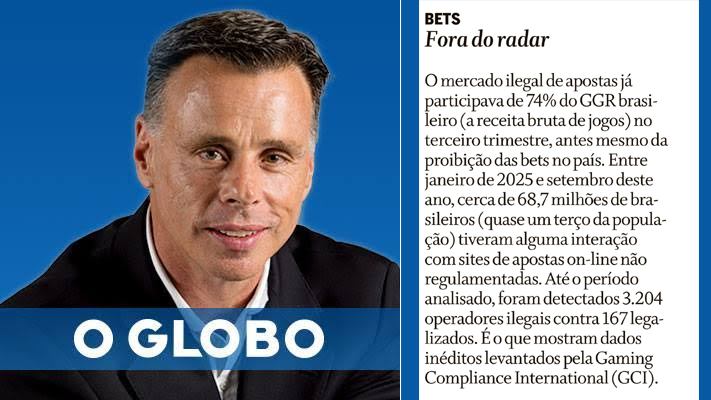
Lauro Jardim's column in O Globo published a note on Sunday (15) titled "Off the radar". According to the text, the illegal betting market already accounted for 74% of Brazilian GGR (gross gaming revenue) in the third quarter, "even before the ban on bets". The note also states that 68,7 million Brazilians "had some interaction" with unregulated sites between January 2025 and September 2026, and that there were 3.204 illegal operators against 167 legalized ones. The data is from Gaming Compliance International (GCI), presented as unpublished.
The phrase "even before the ban" reveals the note's intention: to support the argument that regulation did not remove illegal operators and that, therefore, Provisional Measure 1.394 did not take anything away from anyone. The benchmark figures for the Brazilian market tell a different story.
What do the benchmark estimates say?
H2 Gambling Capital, one of the leading data consultancies in the sector worldwide, cross-referenced three sources to measure the Brazilian market: research with bettors, transactions via Pix from the Central Bank, and online traffic. The result: approximately R$ 15 billion in GGR (Gambling Risk Management) per year circulated outside the regulated market, about 30% of the total. In the review conducted after the Provisional Measure, the consultancy calculated that 30% of the market was already offshore before the prohibition, about R$ 17 billion, and that the illegal volume could rise to R$ 42 billion.
Research by LCA Consultores with the Locomotiva Institute, commissioned by IBJR, points in the same direction: the illegal market fell from 41% to 51% in 2025 to 38% to 44% in the first half of 2026.
In summary:
⇒ H2 Gambling Capital: approximately 30% is illegal, meaning 70% is channeled into the regulated market.
⇒ LCA/Locomotiva: 38% to 44% illegal in the first half of 2026, with a downward trend.
⇒ GCI: 74% illegal in the 3rd quarter of 2026
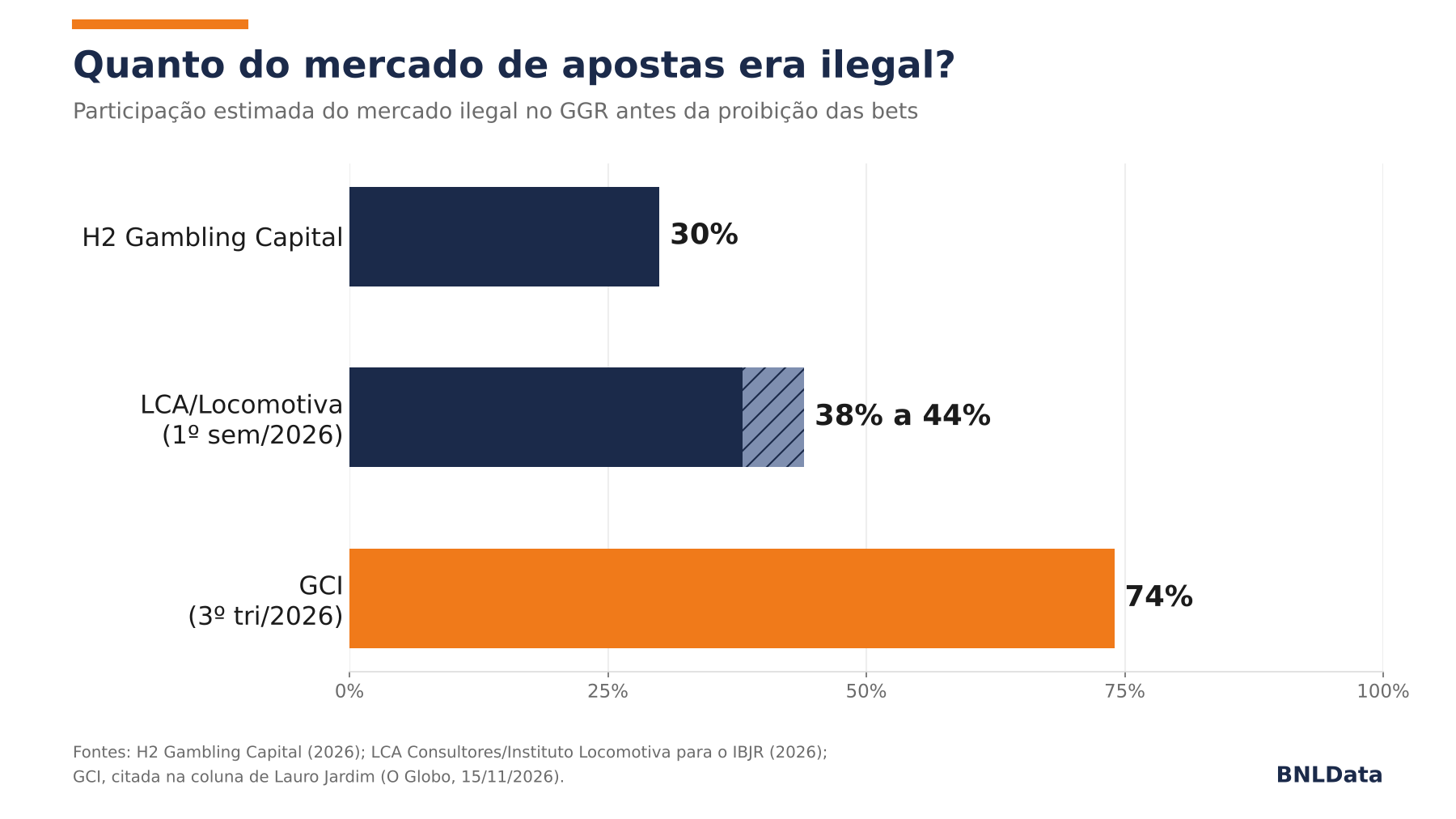
Based on the two benchmark estimates, the regulated market captured the majority of bets in less than two years of operation. For an activity that was prohibited for 85 years, this is a significant result.
The account that doesn't add up
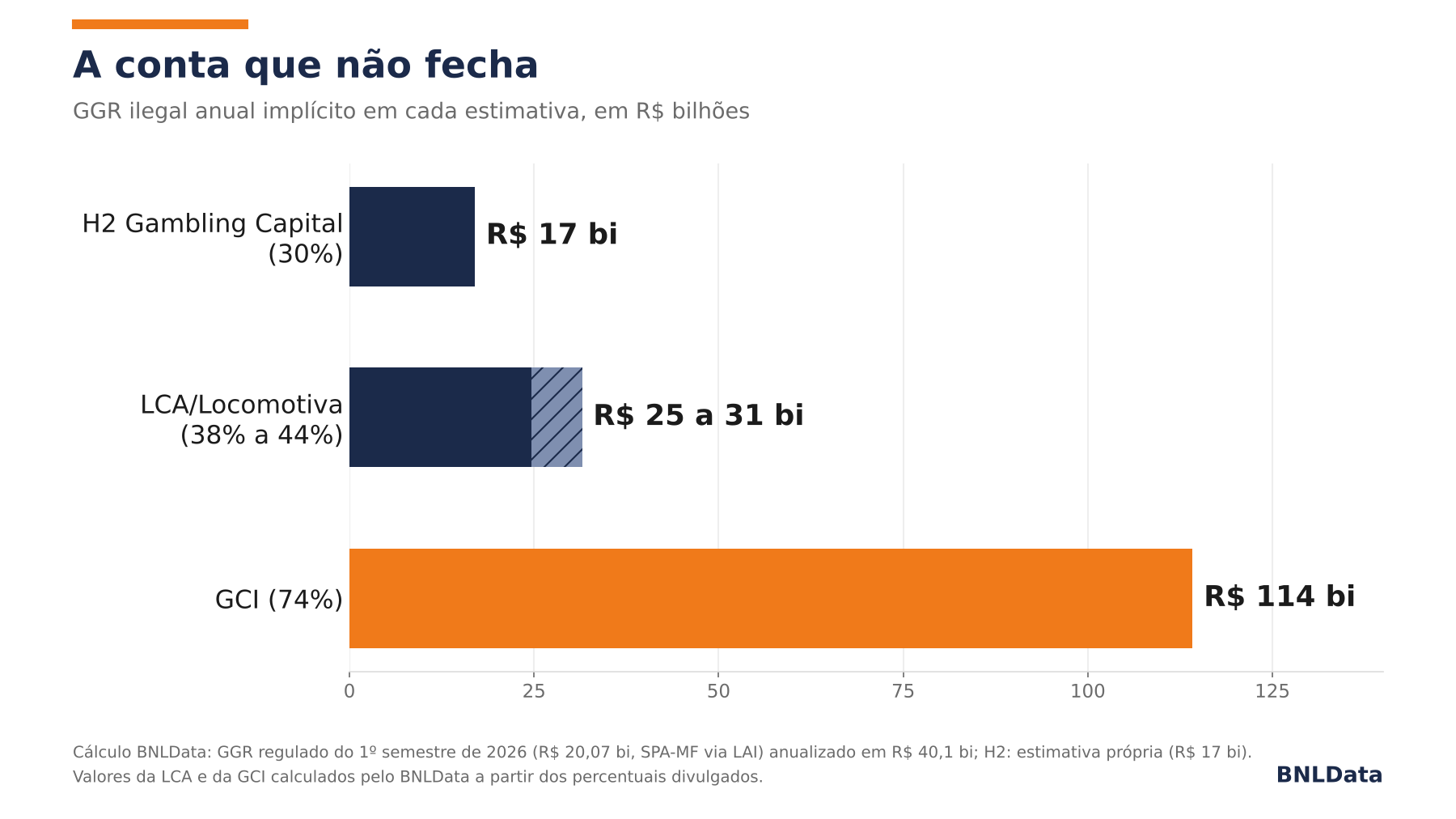
According to official SPA-MF data, obtained by BNLData via LAI, the regulated market had a gross revenue of R$ 20,07 billion in the first half of 2026, approximately R$ 40 billion annually. If this value corresponded to only 26% of the market, as stated by GCI, the illegal sector would have moved around R$ 114 billion per year, or R$ 28,5 billion per quarter.
It's six to seven times what H2 estimates. No known data on payments, revenue, or traffic in Brazil supports that figure.
The other numbers on the note also have problems:
⇒ 68,7 million "interactions": Interaction is not gambling. In GCI reports, the metric measures how much of the gaming content a consumer encounters comes from licensed or unlicensed sources. Seeing an advertisement on a pirated stream can count as interaction. For comparison: 25,2 million unique CPF holders gambled in the regulated market in 2025, according to SPA.
⇒ 167 licensed operators: The number doesn't match the regulator's figures. In the official SPA-MF report from September 24, 2026, there were 85 authorizations, 82 CNPJs (Brazilian company tax IDs), and 188 trademarks.
⇒ 3.204 illegal operators: The note does not specify whether it counts companies, brands, or domains, and places this count alongside a count of licenses.
Who provides the data?
GCI is the former Yield Sec, a company acquired by Gaming Compliance International. Its international reports are produced for the Campaign for Fairer Gambling, a group that commissioned and funded the study and maintains a position against the expansion of the betting market.
The company's figures are usually higher than any other available estimate: 78% of global GGR is considered illegal, 72% in the European Union, and 77% in the United States. The "74% in Brazil" figure follows the same pattern.
GCI also sells monitoring services to regulators and governments, such as in its agreement with the Montana Department of Justice in the US. The larger the problem measured, the greater the demand for its product. There is nothing illegal about this, but the reader needs to know where the numbers are coming from.
The note does not say who commissioned the survey on Brazil or what methodology was used. BNLData was unable to locate the published report.
The moment of the note
The data spans from January 2025 to September 2026. It refers to a market that ceased to exist on October 5th, when the authorized platforms went offline. This isn't new data; it's old data released at a convenient time.
The note appears while Provisional Measure 1.394 is being processed in Congress, with its deadline extended, and Bill 5.477/2026, which criminalizes betting, is blocking the Chamber's agenda. At the Supreme Court, the joint trial of the actions concerning Law 14.790 and the Provisional Measure has not yet been scheduled. For those who defend the prohibition, the argument that "regulation has never worked" is very relevant now: if illegality already dominated, the Provisional Measure would have cost nothing to bettors, the State, or the clubs.
The facts contradict this claim. Until October 5th, most bets went through companies that verified age, controlled spending, offered self-exclusion, and collected taxes and funds allocated to health, sports, and public safety. After that date, 100% of the market was controlled by those who do none of that. Gambling is either legal or illegal; not gambling is impossible.

