
Procomp is contracted for the maintenance of the TFLs (Lottery Terminal Equipment) of the lottery network.
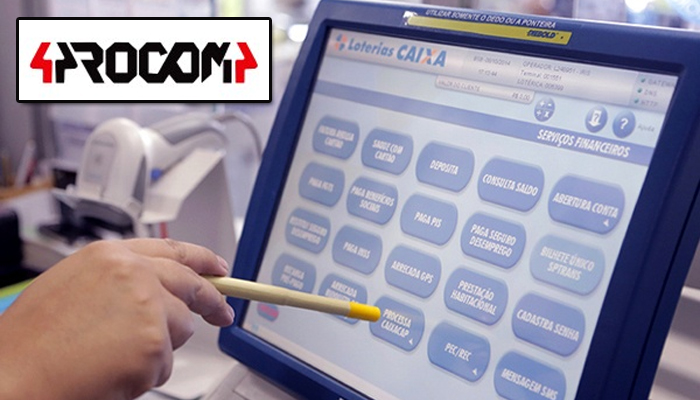
More than 50 terminals spread across the 13 units of the Lottery Network need maintenance. A large portion of them are between 11 and 13 years old. And the bill to keep them running has just arrived: R$ 116 million.
On Wednesday (August 19th), Caixa Econômica Federal signed Continuous Services Contract No. 07740/2026 with Procomp Indústria Eletrônica Ltda for the maintenance of Lottery Financial Terminals (TFLs) installed throughout the national network. The agreement, published in the Official Gazette of the Union this Friday (August 21st), has a total value of R$ 115.997.981,28 and a term of 24 months starting on August 20th. Procomp won the Caixa Tender No. 150/2026, linked to Process 0350/2026, managed by the National Contracting Center of the Ministry of Finance.
Procomp Indústria Eletrônica Ltda. is a Brazilian technology and automation company that became widely known in the national market for its historical work with computer equipment, banking and commercial automation, and which today has ties to Diebold Nixdorf.
The bill that more than doubled in thirteen years.
The amount is striking when placed in historical perspective. In 2013, ATP Tecnologia e Produtos SA won Electronic Auction 043/7066-2013 with a bid of R$ 57.230.000,00 to service 31.250 terminals for the same 24-month period and equivalent scope of service. The new contract represents more than double that amount in nominal terms, R$ 115,99 million versus R$ 57,23 million, for a network now estimated at more than 50 terminals.
Part of this difference can be attributed to the accumulated monetary correction between 2013 and 2026. Another part, however, raises a question that simply updating the IPCA (Brazilian inflation index) does not answer: does the increasing cost reflect the larger size of the fleet, the volume of technical calls, or simply the aging of the equipment?
A park that hasn't been renovated.
The last major large-scale replacement of TFLs occurred between 2014 and 2015. In that cycle, Caixa replaced 25 terminals and, through a 25% addendum to the original purchase contract, expanded the renewal to more than 31 devices by mid-2015. Since then, there is no public record of a new wave of national replacement, which means that a significant portion of the terminals currently in operation have accumulated between 11 and 13 years of use.
This timeframe is well above the average lifecycle for banking hardware and point-of-sale (POS) terminals, typically estimated at between 5 and 7 years. Caixa itself acknowledged this logic in an institutional statement, stating that terminals older than five years would be included in a renewal program. There is no public evidence that this replacement has progressed on a large scale in subsequent years.
Outdated equipment generates more failures, requires replacement parts that are often discontinued by manufacturers and therefore more expensive, in addition to demanding corrective maintenance calls with increasing frequency. If this pattern is ongoing in the current fleet, the R$ 116 million contract may be funding the maintenance of a technologically outdated infrastructure, postponing a renewal that, with each cycle, tends to become more inevitable and more costly.
The return of Procomp and the history of exchanges.
Procomp is not a newcomer to the Lottery Network. Until 2013, the maintenance of the TFLs (Lottery Terminals) was the responsibility of Diebold Procomp. In that year, Caixa (the Brazilian lottery operator) migrated the service to ATP Tecnologia e Produtos SA, a transition described by lottery operators at the time as turbulent, marked by the new company's lack of technical preparedness and delays in answering calls.
In March 2020, another change occurred; Wyntech Serviços em Tecnologia da Informação Ltda, based in Florianópolis (SC), took over the national maintenance contract. An internal Caixa circular from that period revealed that, during that transition, calls opened before the signing of the new agreement continued to be handled by Diebold and regional providers, evidence that the coexistence of a national contract and residual local contracts is not an exception in the network's operational model.
This same pattern is repeating itself now. According to BNLData's investigation, the maintenance of the TFLs is currently divided between at least two fronts; partly handled by Wyntech and partly by Diebold. With the formalization of the contract with Procomp, the expectation is that the company will fully assume the national service, centralizing the operation again as occurred in the transitions of 2013 and 2020.
The context surrounding the signature
The contract was signed amidst a period of pressure on the Lottery Network. In the preceding weeks, lottery retailers across the country faced a supply crisis of tickets and rolls, a problem serious enough to prompt Febralot (Brazilian Federation of Lottery Retailers) to conduct a national assessment. In June, a system failure paralyzed service throughout Brazil for two hours. The annual adjustment of fees has remained without a defined date or percentage since August.
In this scenario, a long-term maintenance contract tends to be received by business owners as a sign of operational stability. The question that remains open, however, is whether stabilizing the maintenance service solves the central problem or merely postpones the more structural decision: when and how to renew a fleet of terminals that time itself has transformed into the greatest risk to the network's continuity.

