
Who is Tigrinho's father? In the debate, Lula and Flávio disputed the narrative, not the facts.
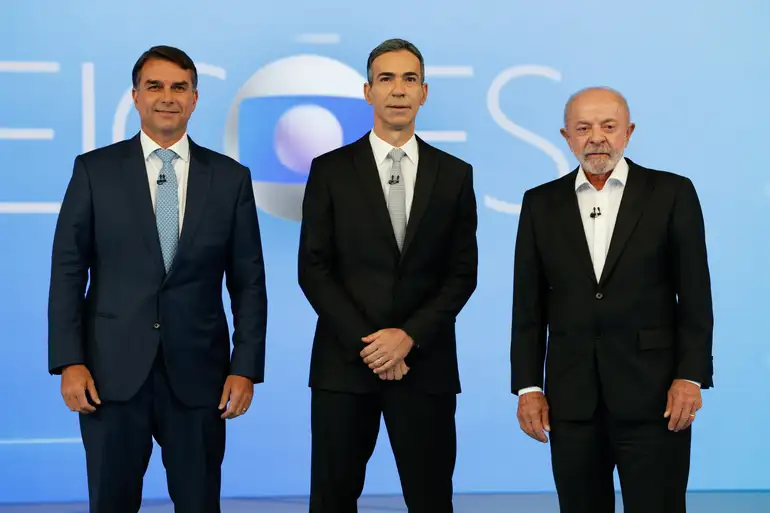
The topic of betting came up in the last presidential debate of the second round, held by TV Globo on Friday night (23), but not in the way the sector expected. Instead of a discussion about regulation, collection, protection for bettors or combating the illegal market, what was seen was a dispute over the “paternity” of Tigrinho, as the Fortune Tiger game is known.
The topic came up in the third segment. In response to a question from Flávio Bolsonaro (PL) about family debt, President Lula (PT) presented the ban on gambling as a measure to protect family income.
“And that’s why I had the courage to end the betting. I know my opponent didn’t like it, I know other people didn’t like it, but we ended the betting because it was turning into a living hell for people, not only consuming part of their money, their milk and bread, but also leading people to violence, to attempt suicide, to hang themselves.”
The president also said he was "certain that the women of this country are in favor, because they want their husband's money, their own money, to be used to take care of the children and not for gambling." He presented no data to support either of these statements.
Later, before asking about full-time education, Flávio resorted to provocation:
"The current president of the Republic has two sons who have done a lot of harm to the country: Lulinha and Tigrinho. He is Tigrinho's father, he is the father of online casinos, he created them, he legalized them. As the election approaches, he goes and cancels them, thinking he's going to fool you. He has already harmed football teams and destroyed the legal security of this country."
Lula responded in the same tone:
"The cynicism reaches an absurd level, claiming that Tigrinho was created by you in 2022. Not only is your father Tigrinho's father, but you're his brother. Not only are you his brother, you share the same DNA. Tigrinho was created by your father. Explain why your father created Tigrinho."
The checks
The Lupa Agency classified both Flávio's and Lula's statements as false. The Fato ou Fake section of g1 also classified Lula's statement as #FAKE. Both agencies remind readers that fixed-odds betting was legalized by Law No. 13.756/2018, sanctioned by Michel Temer (MDB) in December 2018. The law gave two years, extendable for another two, for regulation. The deadline expired on December 12, 2022, during Jair Bolsonaro's government, without any rules being issued.
During that period, the companies operated without regulations, without collecting taxes in the country, and without any control over advertising, payment methods, or protection for the bettor.
What the 2018 law did not foresee.
There is a point that is often lost in the public debate, and which helps to understand why neither candidate told the truth. Law 13.756/2018 only authorized fixed-odds betting on real sporting events. It did not include online games such as crash games and slots like 'Tigrinho', launched in 2022 by the Maltese producer PG Soft. (see details below)
Online games only gained legal recognition with Bill 3.626/2023, sent by the Lula government to Congress in July 2023. The Chamber of Deputies included virtual games in the text in September. The Senate removed them in December, but the Chamber reinstated them ten days later. On December 30, 2023, Lula sanctioned Law No. 14.790/2023 with online games included in the text. The technical rules came with Ordinance SPA/MF No. 1.207, of July 29, 2024, and the regulated market began operating on January 1, 2025.
In other words, Tigrinho was not "created" by either government. The legalization of online gambling, however, was approved by Congress and sanctioned by Lula. Saying that Tigrinho was "created in 2022" by the Bolsonaro family has no basis whatsoever. Saying that Lula "created" the game is also untrue, but it is a fact that it was during his administration that this type of gambling went from being illegal to being regulated, taxed, and monitored.
War of narratives
Both candidates used the "Little Tiger" (a reference to Lula's alleged gambling) as an electoral weapon. Lula signed the provisional measure that banned betting and presents it as a cause of violence and suicide attempts, without citing studies or numbers. At the same time, he pushes the origin of the problem onto his predecessor and omits that the activity was legalized by the law he sanctioned. Flávio tries to link the negative impact of online casinos to his opponent and accuses the government of an electoral reversal. His most consistent argument, that of legal uncertainty and the impact on football clubs, was overshadowed by the provocation.
Who controls the game?
Every time the topic of gambling returns to the political scene in Brazil, the discussion is divided into two extremes: legalization or prohibition. The Globo debate was yet another example of this. The two candidates argued over who was responsible for the problem and said nothing about how to address it. This simplification ignores a central reality of public policy: certain activities don't disappear by decree. Gambling exists as a social and economic phenomenon, and the real question is not whether it should exist, but who will govern it: the State or illegality.
History shows that prohibition alone rarely ends such widespread practices. What it does is push the activity underground, where there is no transparency, consumer protection, or oversight. In the case of betting, this means bettors without guarantees, tax evasion, and more social risks—exactly the scenario that existed before Law 14.790/2023. As BNLData has been repeating for years, gambling is either legal or illegal; not gambling is impossible.
BNLData Narrative Seal: both speeches receive the BNLData Narrative Seal.
What is Fortune Tiger, the "Little Tiger Game"?

Fortune Tiger is a slot game : a virtual slot machine, with operation practically identical to similar games offered on betting platforms worldwide. It was launched in 2022 by PG Soft (Pocket Games Software Limited), a producer founded in 2015, based in Malta and with offices in Europe, Asia and North America. The company holds licenses from the Malta Gaming Authority, Gibraltar and the UK Gambling Commission, and its games are certified by the independent laboratories BMM Testlabs and Gaming Associates Europe. PG Soft also develops titles with the same logic, such as Fortune Rabbit, Fortune Mouse, Fortune Ox and Fortune Gods.
How it works: The game's theme is a journey to ancient China, where a golden tiger grants mystical powers. The player wins by matching three identical symbols on the paylines, and the result is determined exclusively by a random number generator. On the platforms that offered the game, bets ranged from R$0,50 to R$600 per round. The RTP ( Return to Player ), a percentage indicating how much of the wagered amount returns to players in the long term, was reported by the platforms as 96,96%. Part of its popularity comes from the 10x multiplier and bonus rounds ( re-spins ), which can multiply the bet up to 2.500 times.
Legal status: Law 14.790/2023 included online games among the permitted modalities, and Ordinance SPA/MF No. 1.207/2024 defined the technical rules. From January 1, 2025, it could only be offered by operators authorized by SPA/MF, with game certification, bettor identification, and tax collection. With Provisional Measure No. 1.394/2026, published on September 25, the offering of fixed-odds betting, including online games, was prohibited. The Provisional Measure is still pending a vote in Congress and is being challenged in the Supreme Federal Court (STF).
The controversy: a large portion of the cases investigated by the police do not involve the original game, but rather the misuse of the brand. These are manipulated demo versions and fake copies used to perpetrate scams, as well as influencers promising unrealistic winnings. The problem has never been the game itself, but the lack of rules and the fraud, precisely what the regulations existed to combat.

