
Safety as a culture: how Legitimuz structured governance and achieved ISO 27001 certification.
By Thomas Hannickel, DPO – Legitimuz
Information security in the digital identification market is not an extra benefit. It's a prerequisite. The data circulating is sensitive, the risks are constant, and customer trust depends on solid and auditable processes.
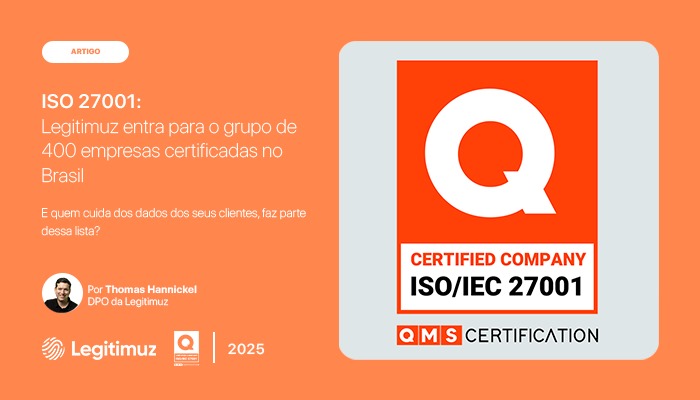
Legitimuz has always considered this a cornerstone. But simply talking about it wasn't enough. It was necessary to go further and seek ISO 27001 certification to truly structure governance, raise internal standards, and demonstrate maturity in a clear and auditable way.
Today, certification is part of how the operation works. It's in the decisions made, the processes followed, and what is delivered to customers.
ISO 27001: When compliance becomes credibility.
ISO 27001 is often seen as a technical compliance certification. And it is. But when truly implemented, it goes beyond that. It shows the market that processes exist, function, and are monitored, reviewed, and improved all the time.
Incidents happen, failures occur, legal uncertainty is a reality. And the question Legitimuz hears most often from clients is: "Can I trust my operations to your controls?"
The certification made it possible to answer that with concrete evidence.
To put it more clearly, safety is no longer just an item on a checklist. It has become the language the company uses to build trust with customers, partners, and regulators.
Continuous auditing and living controls
One of the biggest lessons learned on this journey was understanding that auditing is not an annual event, it's an ongoing discipline.
The Information Security Management System (ISMS) helped the company to:
⇒ Transforming controls into operational routines
⇒ Create systematic review rituals;
Strengthen the governance chain;
⇒ Ensure end-to-end traceability;
⇒ To structure consistent responses to risks.
This change in mindset reduced vulnerabilities, brought predictability to operations, and allowed Legitimuz to treat information security as a fundamental principle, not just a formality.
Culture above documentation
Documentation is necessary, of course. But culture is what truly sustains everything.
Certification required a real shift in how people understand safety within the company. It wasn't just about creating a manual and following protocols. It was:
Communicate clearly and consistently;
⇒ Train the team continuously;
⇒ Raise awareness about the real risks;
⇒ Distribute responsibility among everyone;
⇒ To empower individuals to make informed decisions.
The maturity that comes from culture is more solid, deeper, and far more lasting than any document.
Value perceived by the customer
In addition to transforming internal processes, ISO 27001 has changed how the market views Legitimuz.
Customers and partners can tell when a company has real controls in place, when governance works, and when policies are put into practice. They notice proactive risk management, clear metrics, and preventative processes that actually exist.
That is, negotiations become faster, relationships with regulators are strengthened, and the tone of trade talks changes completely.
The demands are only increasing. And when it comes to hiring, three things are important: knowing what you'll receive, trusting that it will work, and having a clear understanding of how everything is done.
The certification delivers exactly that.
From conformity to trust.
Information security, when truly matured, ceases to be a cost and becomes an asset. It ceases to be a requirement and becomes an advantage. It ceases to be just a process and becomes part of the company culture.
This is the main transformation that ISO 27001 brought to Legitimuz, in addition to emerging as:
⇒ A concrete way to demonstrate institutional commitment. It's not just talk, it's verifiable practice.
⇒ A genuine demonstration of responsibility towards clients, partners, and regulators.
⇒ An active risk reduction mechanism that protects the operation every day.
⇒ A seal of credibility perceived by the market that opens doors and shortens cycles.
⇒ A tangible competitive advantage , especially in a sector where trust is scarce.
When safety becomes part of the culture, it ceases to be reactive and becomes structural. And that's what makes the difference between having processes and having real operational maturity.
Security as a foundation, not as a goal.
ISO 27001 doesn't end anything. It opens a cycle of continuous monitoring, constant learning, and permanent evolution.
For Legitimuz, certification has become more than just a technical benchmark. It has become the foundation of the trust the company builds with clients, partners, and regulators every day.
In a market where sensitive data circulates constantly, where incidents happen frequently, and where legal uncertainty is still a reality, trust is not a minor detail. It's what separates operations that grow from those that merely survive.
ISO 27001 has proven that safety can be measured, audited, and clearly communicated. But it has also proven something more important: that it can be lived as a culture, felt in operations, and perceived by those on the other side.
It is this trust that underpins every decision, every process, and every delivery at Legitimuz.
Legitimuz is a Brazilian company specializing in compliance, KYC , and anti-money laundering solutions for the Brazilian regulated market. With proprietary technology and regulatory expertise, the company serves licensed operators throughout the country, offering identity verification, behavioral biometrics, transaction monitoring, and automated AML/FTP tools.

