
The rule of the game: betting enters a regulated market and becomes a target of government over fiscal issues.

Debuting among the top five in global revenue, the regulated betting market in Brazil boosted government coffers, spurred sponsorship of football clubs, generated formal jobs, and provided greater protection for bettors in its first year of operation. According to a survey by the international consulting firm Regulus Partners, Brazil is only behind the USA, the United Kingdom, Italy, and Russia in terms of the value of bets transacted, as reported by O Globo.
The sector is still struggling, however, to combat illegal platforms, which represent at least 40% of the betting market in the country, and to improve its reputation with the public. There is also concern about gambling addiction, which led the government to create the Brazilian Health Observatory for Electronic Betting, with actions to support users seeking services from the SUS (Brazilian Public Health System).
Companies in the sector fear that the tax increase, approved at the end of 2025, will reduce the competitiveness of legitimate sites, favoring illegal ones that circumvent regulation by offering, for example, more advantageous odds of winning. But the government argues that the additional taxation is essential to pay for the costs incurred by gambling, including combating gambling addiction (a mental health disorder characterized by an uncontrollable urge to gamble or bet), similar to what happens with cigarettes.
Online gambling was legalized in the country in 2018, but companies operated indiscriminately until 2023, when regulations were approved, defining criteria for firms, oversight, taxes, and control measures. Throughout 2024, the Secretariat of Prizes and Betting (SPA), an arm of the Ministry of Finance, finalized the market regulations, which formally began operating in January.
Almost 12 months later, 79 companies are authorized to operate a total of 184 betting sites, serving the 27,5 million Brazilians who placed bets this year — more than 10% of the Brazilian population, according to data from the Treasury. The majority of players are men (67,8%) and are between 31 and 40 years old (28,6%).
Revenue totaled R$ 32,2 billion in the accumulated period of 2025, based on the balance between the value received in bets and the prizes paid out — the gross gaming revenue (GGR). Data from the sector indicate the creation of 10 direct jobs and 5,5 indirect jobs.
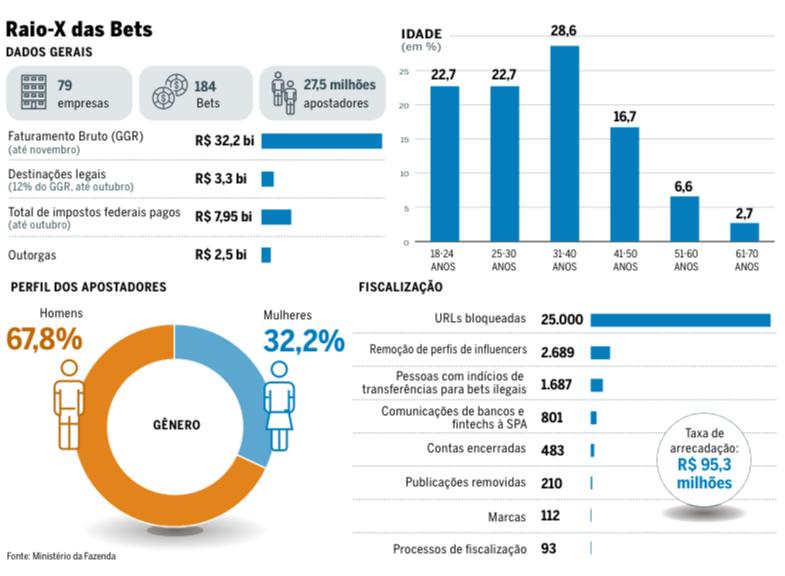
Up to October, R$ 7,95 billion was collected in federal taxes on the sector, including the 12% of legally mandated allocations on the GGR (Gross Revenue Management), which totaled R$ 3,3 billion, excluding grants and inspection fees.
Research by LCA Consultoria Econômica and Cruz Consulting, commissioned by the National Association of Games and Lotteries (ANJL) and the Brazilian Institute of Responsible Gaming (IBJR), estimates that, also considering municipal taxes, the revenue collected reaches R$ 9 billion. This amount is expected to increase in the coming years, since the law that raises the taxation on GGR to 15% in 2028, with an increase of 1 percentage point each year, was approved in December.
Since the middle of the year, the government had been trying to push through the tax increase amid the need to balance the budget and meet fiscal targets, even creating a campaign for the "BBB" tax, for banks, billionaires, and bettors. But part of Congress resisted due to lobbying from the sector.
The first attempt was a provisional measure (MP) aimed at compensating for government setbacks in increasing the Tax on Financial Operations (IOF). After the MP expired, the Senate, in coordination with the economic team, proposed a bill with the initiative, but it ended up stalling. Only after Senator Alessandro Vieira (MDB-SE), in his version of the "anti-faction bill," foresaw the creation of a Contribution for Intervention in the Economic Domain (Cide) on bets to fund a public security fund, did the Chamber incorporate the increase in the tax on the GGR into the bill to cut tax benefits.
The sector complains that the tax increase creates legal uncertainty, discouraging investment. Executives admit, however, that an increase in the GGR tax rate is less harmful than the Cide tax, which, in the extreme, could make the regulated market unviable—a view shared by the economic team.
According to Plínio Lemos Jorge, president of ANJL, the expectation of increasing revenue from betting could be thwarted, since the increase in taxes tends to favor illegal platforms and shrink the regular market. Industry estimates, calculated by LCA, indicate that the share of illicit betting ranges from 41% to 51% in the market.
It's like a bakery. If my bread is more expensive because it's all perfect, the customer will cross the street and buy from my competitor, even if the product is worse.
Within the government, the argument is that activities that generate "negative externalities" need to be taxed more.
"This applies to cigarettes, alcohol, and gambling. I have to provide the health system with resources to combat lung cancer, alcoholism, and psychological dependence on gambling," said Finance Minister Fernando Haddad in an interview with GLOBO.
Associations representing licensed betting sites complain that the government's focus should be on actions to dismantle pirate companies, something that, in itself, would generate increased revenue. LCA estimates that a 5 percentage point reduction in the illegal market share towards the legal market would generate additional revenue of R$ 870 million to R$ 1,1 billion annually.
Initiatives to combat the "pirate" market include taking down irregular websites, monitoring banks and fintech companies that channel illicit money, and removing illegal advertising. According to data from the Secretariat of Prizes and Betting (SPA), there were 93 inspection processes, involving 112 bets in the first eleven months of the year. Of these processes, 77 are currently underway to apply sanctions.
In the case of financial institutions, the secretariat reported that 36 banks and fintechs made 801 communications to the SPA (Secretariat of Public Administration) related to 1.687 people suspected of making unauthorized transfers of funds to betting sites. As a result, 483 accounts were closed, with 209 already identified as illegal and the rest still under analysis.
Approximately 25 illegal websites have been taken offline in partnership with the National Telecommunications Agency (Anatel) since October 2024. In the fight against illegal advertising on social media, 329 inspection processes against digital influencers have been completed, resulting in the removal of 2.689 influencer profiles and an additional 210 posts.
"The data above shows that SPA's efforts are gradually having an effect in the Secretariat's three lines of action: taking down illegal websites, removing illegal advertising on social networks, and monitoring and inspecting financial institutions (FIs) and payment institutions (PIs)," says SPA.
However, sources point out that the actions have been insufficient to stop illegal betting. Taking down websites is often followed by another page linking to the irregular platform, and financial oversight requires proactive monitoring, which is more difficult without the participation of the Central Bank.
"The market is understanding how to combat illegal betting, which has no commitment to the player and their families, and does not pay taxes. It is a challenge that the government wants to insist on next year," says Plínio Lemos Jorge, president of the National Association of Games and Lotteries (ANJL).
Jorge says the association has reached a cooperation agreement with SPA and Anatel to improve the takedown of illegal websites, and the effect should be felt starting in January. Other actions to reduce the pirate market include regulating the economic chain of betting, such as game developers, and campaigns about the risks of the illegal market.
On another front, following a cooperation agreement between the Ministry of Finance and the Ministry of Health, the government launched a self-exclusion platform for gambling, a tool that will allow the voluntary blocking of access to websites and advertising in the sector for a specific period. It is part of the "responsible gambling" package for regulating betting.
The difficulties in combating illegal betting stem from the lean structure of the SPA (Sociedade de Apoio ao Jogo - Game Support Service). An audit by the Federal Court of Accounts (TCU) assessed that the secretariat established a set of rules that are "robust and aligned with best practices." Among the rules are the mandatory registration in the country, with at least 20% of the share capital from Brazilian sources, use of the bet.br domain, and an operating license, with a cost of R$ 30 million for the use of three brands for 5 years.
The regulatory body requires facial biometrics for registration, prohibits payment by credit card, cash or cryptocurrency, and forbids the granting of sign-up bonuses as a marketing strategy. Betting companies must monitor customer behavior and adopt measures to prevent gambling addiction.
On the other hand, the TCU (Brazilian Federal Court of Accounts) identified problems in the SPA's (Special Audit Unit) performance, such as weaknesses in the authorization process, with only a declaration of Anti-Money Laundering (AML) policies being required, and the absence of manuals to standardize oversight. It cited a shortage of personnel, technological, and budgetary resources and ordered the Treasury to take steps within 120 days to strengthen the agency.
SPA reported that it is analyzing the TCU's request and that the points raised will be considered, but that, since its creation, it has sought to improve its structure. It also stated that it is already working on developing specific analytical tools for AML (Anti-Money Laundering) in conjunction with the Ministry of Justice.
“As with any regulatory process, periodic adjustments are desirable and healthy, with the aim of improving flows and controls. Such adjustments were already planned, including for the first quarter of 2026.”

