
Analysis: Gross revenue from sports betting in Brazil advances 1,7%, contradicting the sector's overall growth.

BNLData's reporting team requested confirmation from the Ministry of Finance's Prize and Betting Secretariat (SPA-MF) regarding the figures published in the Metrópoles report, " Brazilians place 15,2 million bets on regulated betting sites in the first quarter of 2026. " As the famous saying goes, "Silence implies consent," expressing the idea that those who do not speak up or contest a statement or action agree with it. Following this logic, BNLData decided to analyze the figures presented by Metrópoles.
The number of bettors with accounts on more than one betting platform has grown. The volume of registrations with operators has increased by double digits. And the sector's gross revenue has barely moved.
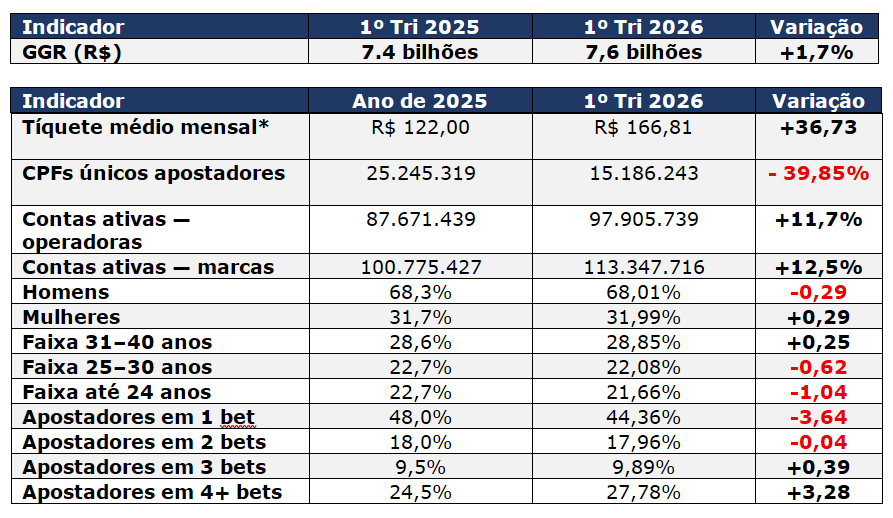
This is the picture that emerges from the first direct quarterly comparison of the regulated sports betting market in Brazil: between January and March 2026, Gross Gaming Revenue (GGR) — an indicator that measures the net revenue of platforms after prize payments — totaled approximately R$ 7,6 billion, an increase of only 1,7% over the R$ 7,4 billion recorded in the same period of 2025.
The 1,7% growth in the sector's main financial indicator contradicts the thesis of an explosion in betting circulating in statements by political and social actors, and weakens the narrative that betting platforms are the central cause of the increase in Brazilian household debt. If there were a real expansion in the volume wagered, the GGR (Gross Gambling Index) should keep pace with—or exceed—the growth rate of registrations. This did not happen.
More bills, same revenue.
During the same period in which GGR (Gross Revenue Generation) increased by 1,7%, the number of active accounts with operators grew by 11,7%, and the number of active accounts with betting brands rose by 12,5%. The discrepancy between the two indicators is the central data point of this analysis: double-digit growth in registrations coexisting with virtually stagnant revenue.
The most likely explanation lies in the behavior of the bettors themselves. The share of users with accounts at only one operator fell from 48,0% to 44,36% between the two quarters. At the other extreme, the group with four or more active accounts jumped from 24,5% to 27,78%, a variation of 3,28 percentage points — the largest among all categories analyzed. In practical terms, a significant part of the growth in the total number of accounts reflects bettors who were already in the market spreading out across more platforms, and not the entry of a new contingent of people.
The average monthly ticket price in the first quarter of 2026 was R$ 166,81. A direct comparison with 2025 faces a methodological limitation: the available data for that year is the annual total — R$ 122,00 — without an equivalent quarterly breakdown. There is also a structural distortion at the base: in the first quarter of 2025, the regulated market was in its initial phase, with a much smaller number of establishments operating than in the same period of 2026, which compromises any direct comparison between the two quarters.
The profile that hasn't changed.
Demographic data reinforces the view of stability. The gender composition varied by less than half a percentage point: men represented 68,01% of active bettors in 2026, compared to 68,3% in 2025; women increased from 31,7% to 31,99%. The age distribution remained practically unchanged, with the 31-40 age group maintaining its lead — 28,85% in 2026, compared to 28,6% in 2025.
The absence of relevant demographic variation has direct implications for the public debate: the data shows no evidence that the market is massively attracting new user profiles at an accelerated pace. The visible growth of the sector is concentrated in the number of accounts and registrations, driven by the expansion of multi-registration among bettors already present in the market—not by a wave of new entrants.
What the SPA-MF figures still don't answer is whether the official confirmation of the GGR data for the first quarter of 2026 will be enough to reorient the regulatory debate towards evidence, rather than narratives built on registration indicators disconnected from actual financial transactions.
Brazilians will place 15,2 million bets on regulated betting sites in the first quarter of 2026.

