Fixed-odds betting and lotteries will generate R$ 26,6 billion for public policies in Brazil during 2025.

The Brazilian lottery system generated R$ 26,6 billion in public funds during 2025. These funds were allocated to health, education, sports, public safety, culture, and social security. The total includes traditional lotteries run by Caixa Econômica Federal and regulated fixed-odds betting.
Waldir Eustáquio Marques Jr., Director of Regulatory Affairs at TQJ, gave an interview to BNLData. The executive was Undersecretary for Regulation of Lotteries, Prizes and Raffles at the Ministry of Finance and CEO of Caixa Loterias SA. He addressed aspects of regulation and the social function of lottery modalities operated in the country.
The modalities include numerical, sports, number, instant, and fixed-odds betting. The executive highlighted characteristics of the regulatory functioning of these activities.
Public debate focuses on risks.
Fixed-odds betting has gained prominence in Brazilian public debate in recent years. Gambler debt, problem gambling, advertising strategies, and consumer protection are all part of discussions involving authorities, media outlets, and various sectors of society.
Discussion about the sector is considered legitimate, but to generate effective results, it needs to be based on complete, transparent, and contextualized information. When only part of the facts reaches the public, it constitutes a phenomenon studied by economic theory: information asymmetry.
This phenomenon occurs when different agents have unequal access to relevant data. The State possesses extensive knowledge about regulatory structure, oversight mechanisms, taxes collected, and the social allocation of generated resources. Society predominantly receives information about the risks of the activity.
The public does not have the same level of detail regarding the legal nature, regulatory functioning, and public purpose of the sector. This disparity results in the formation of frequently incomplete perceptions about the sector.
Law No. 13.756/2018 established the lottery modality known as fixed-odds betting, and Law No. 14.790/2023 created conditions for the subsequent regulation of the activity. From a legal standpoint, fixed-odds betting is part of the Brazilian lottery system.
This type of betting operates under a regime of state authorization and oversight. This characteristic places betting within a historical tradition of the Brazilian legal system. The model uses lotteries as instruments for raising revenue and financing public policies.
The system stipulates that part of the funds raised be allocated to paying prizes. Another part remunerates the operation. Part is returned to society.
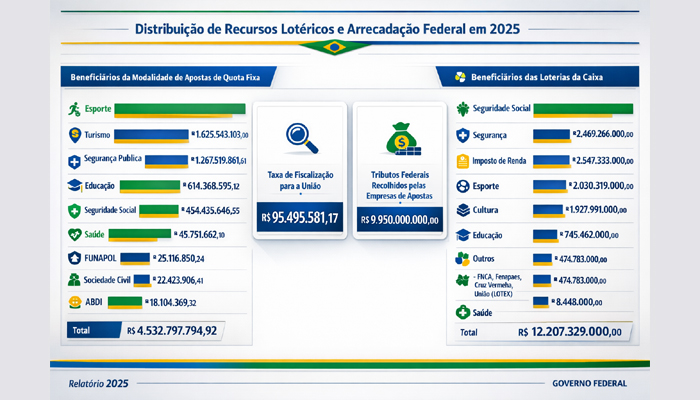
Brazilian lottery operator Caixa allocated R$ 12,2 billion to social programs.
Caixa Lotteries raised approximately R$ 25,1 billion in 2025. Of the total raised, about R$ 12,2 billion was allocated to social programs. The resources benefited health, education, sports, public safety, culture, and social security.
Approximately 48% of all revenue was returned directly to society. This return occurred through public policies and government programs. For example, the 2025 Mega da Virada lottery alone raised over R$ 3 billion.
The legitimacy of traditional lotteries is not in question. The social benefits generated by these methods are widely publicized and recognized by the population. The model of public financing through lotteries has consolidated itself over the decades as a revenue-raising instrument for the Brazilian State.
The regulated fixed-odds betting market in Brazil transferred R$ 14,45 billion to the government and society during 2025. Of this total, R$ 4,5 billion was directed to the legal beneficiaries established by Law 14.790/23. The Federal Revenue Service collected R$ 9,95 billion through federal taxes. These amounts include Corporate Income Tax (IRPJ), Social Contribution on Net Profit (CSLL), PIS/Cofins, and Social Security Contributions collected by companies authorized to operate in the country. The Ministry of Finance reported that the gross revenue of the regulated fixed-odds betting sector reached R$ 36.959.783.379,70 in Gross Gaming Revenue (GGR) during 2025.
Official data indicates that 25.245.319 Brazilians placed bets during that period. The number of bettors corresponds to 12,96% of the Brazilian population. The average monthly bet was R$ 122,00.
Industry representatives compare this value to the cost of tickets for concerts or theatrical performances. The comparison aims to contextualize the amount spent monthly by bettors.
Current legislation mandates that a portion of the revenue generated by fixed-odds betting be allocated to various areas of public interest. Among the main beneficiaries of these social transfers are Sports, Tourism, Public Security, Education, Social Security, Health, the Federal Police, and welfare organizations.
The distribution of these resources follows the criteria established by the laws approved by the National Congress that instituted the lottery modality in the country and regulated by the Executive Branch through the Secretariat of Prizes and Bets of the Ministry of Finance. The sports sector received approximately R$ 1,6 billion in resources during 2025. These funds were allocated to the development of athletes, sports entities, and public programs to promote sports.
Federal tax revenue generated solely from fixed-odds betting reached approximately R$ 9 billion. These resources contributed to the overall financing of state activities. Adding together legal allocations and tax revenue, the regulated market generated over R$ 13 billion in public funds in 2025 alone.
Among the legal beneficiaries of the fixed-odds lottery betting modality, sports received R$ 1,6 billion in 2025. Tourism was allocated R$ 1,2 billion. Public security received R$ 614 million.
Social security received R$ 454 million. Education received R$ 459 million. Health received R$ 45,7 million. Civil society received R$ 22,4 million.
FUNAPOL received R$ 25,1 million. ABDI obtained R$ 18,1 million. The total resources allocated to legal beneficiaries reached R$ 4,5 billion. The oversight fee for the Union reached R$ 95,4 million.
Traditional lotteries operated by Caixa allocated R$ 1,9 billion to sports. Social security received R$ 4,4 billion. Public security obtained R$ 2,5 billion.
Culture received R$ 745 million. Education received R$ 474 million. Health received R$ 3,7 million. Other entities received R$ 8,4 million.

Between public narrative, regulation, and the social function of lotteries.
The existence of public benefits derived from the activity does not eliminate its risks. “Recognizing the social function of betting does not mean ignoring the challenges related to responsible gambling, consumer protection, or combating over-indebtedness. When institutional campaigns exclusively highlight the negative effects of betting, without differentiating between authorized and illegal operators, or without contextualizing the regulatory structure created by the State, citizens only receive part of the available information. Authorized operators are subject to rigorous obligations,” commented Marques Jr.
These obligations include user identification, anti-money laundering measures, transaction monitoring, data protection, responsible gaming policies, and ongoing oversight by the Ministry of Finance. Illegal operators do not comply with any of these requirements.
By treating regulated and clandestine activities indiscriminately under the same generic term " bets ," public understanding of the legal nature of this lottery modality may be compromised. The lack of clarity regarding the differences between regulated companies and illegal platforms hinders the formation of an opinion based on complete information.
The terminology used in public debate often fails to distinguish between state-authorized platforms and unregulated operations. This general approach can obscure precisely the distinction most relevant to consumer protection.
The Brazilian government has established a specific model for fixed-odds betting. The activity has undergone processes of regulation, oversight, and taxation. Part of the revenue collected is allocated to financing public policies in various areas.
“This institutional model places the modality within a structure similar to that of traditional lotteries, with mechanisms for control and social allocation of resources. Simultaneously with the regulatory structuring, part of the public debate presents the activity predominantly from the perspective of its potential negative effects,” commented Waldir Eustáquio.
Citizens have the right to know the risks associated with gambling. Likewise, they have the right to know the legal nature of the activity, its regulatory model, its oversight mechanisms, and its social function.
"Information asymmetry doesn't just lie in what is disclosed. It often lies in what is withheld from the public. In a democracy, more legitimate public decisions are made when individuals have access to all relevant information," he concluded.