
Bets: the minority that doesn't change its vote can change the election.
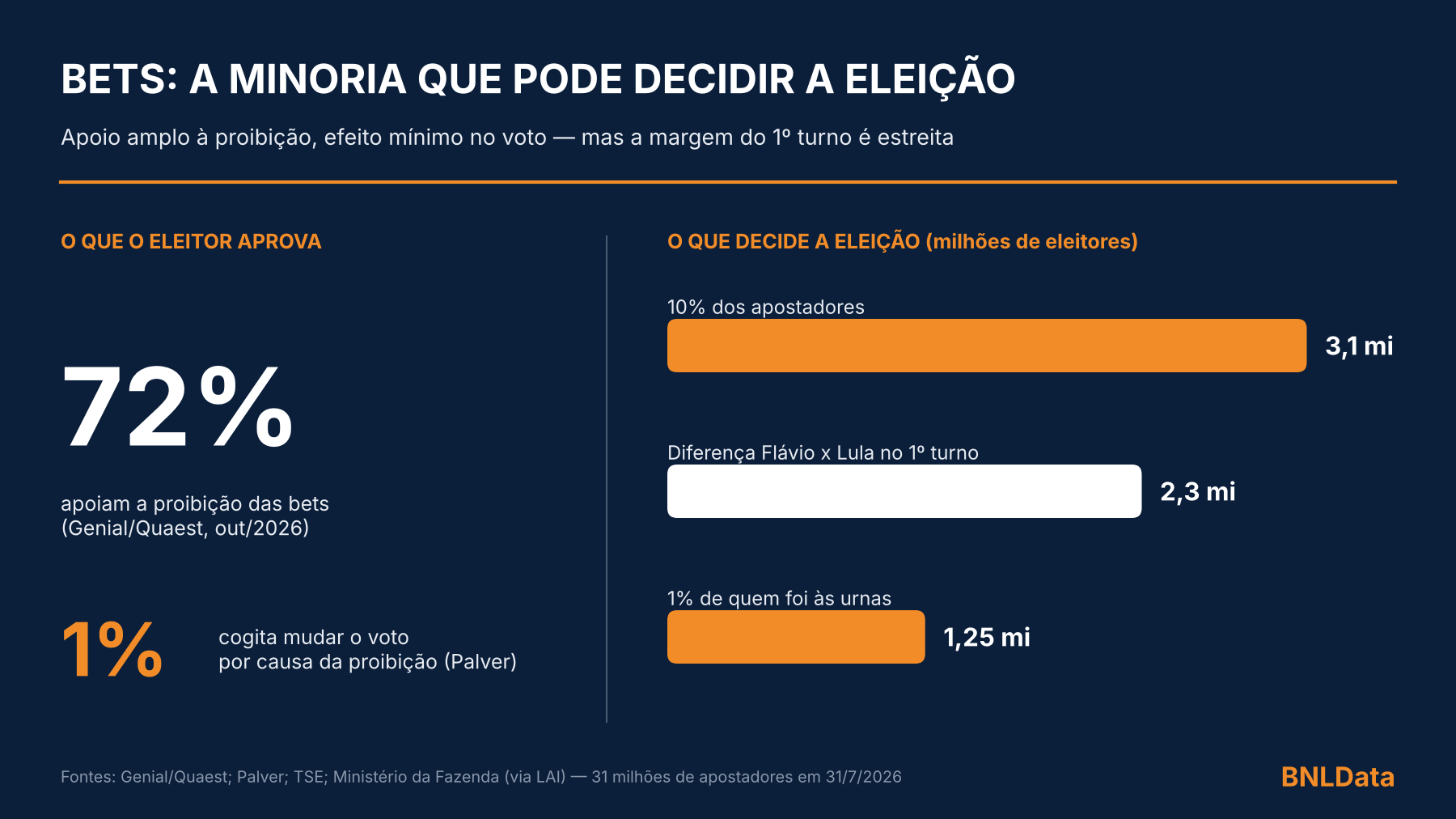
According to a Genial/Quaest survey released on Wednesday, the 14th, 72% of Brazilians support the ban on betting. Of the total, 64% were already aware of the proposal and approved of it, and another 8% came to support it after being informed. Rejection totals 21%: 17% were already aware of it and disapproved, and 4% evaluated the measure negatively upon learning of it. Another 7% did not know or did not answer.
With numbers like these, it would be natural to expect that President Lula, author of the provisional measure prohibiting gambling, would make the issue a central theme in the second round. That's not what we see. The explanation lies in the difference between what voters approve of and what makes them change their vote.
The warning was in the polls.
The polls conducted before the first round, compiled by BNLData in the report "Numbers Don't Lie," already pointed to the pattern: broad support for the ban, with almost no effect on the vote.
⇒ Cruz Consulting/ANJL , among beneficiaries of social programs: 68,1% said that the candidates' position on betting would not change their vote, and only 1% would switch to a candidate who advocated for the end of betting.
⇒ More in Common/Ipsos-Ipec : 58% of the electorate will not change their vote because of the bets.
⇒ Indexa/Broadcast : 70% in favor of the ban, but 63% say the issue does not influence their vote; only 14% say it has a significant influence.
⇒ Palver : only 1% of voters are considering changing their vote after the ban.
In other words: the ban is popular, but it doesn't win votes for those who defend it.
When 1% becomes decisive
The problem for Lula is that the 2026 election is not being decided by large waves. With 100% of the votes counted in the first round, Flávio Bolsonaro had 47,03% of the valid votes (56,1 million) and Lula, 45,16% (53,8 million). The difference was about 2,3 million votes, out of a total of 119,3 million valid votes.
On this scale, 1% of voters who went to the polls is equivalent to about 1,25 million people, more than half the distance between the two candidates. A percentage that seems negligible in an opinion poll can be decisive in a close race.
The calculation that BNLData made before the Provisional Measure
On September 16th, nine days before the announcement of the Provisional Measure, BNLData published "Why banning betting could cost Lula the election." According to data obtained from the Ministry of Finance through the Access to Information Law, Brazil had more than 31 million gamblers on July 31, 2026. The calculation was simple: it would only take 10% of these recreational gamblers, about 3 million voters, to be bothered by the decision to compromise his re-election. A month later, the margin in the first round was below that number.
Warm majority, intense minority
It is this asymmetry that explains the silence. Those who support the ban do so diffusely: they consider it a good idea, but decide their vote based on economy, security, or rejection of the opponent. Those who are against it, for the most part, are gamblers and lose something concrete with the measure. An intense minority weighs more heavily at the ballot box than an indifferent majority.
There is also an aggravating factor: the profile of the gambler, young and concentrated in social classes C and D, overlaps with the electorate that Lula needs to win back. Insisting on the issue yields few votes among the 72% and may cost votes precisely where the campaign needs them most.

