
The Economics Committee of the Legislative Assembly of Rio Grande do Sul (ALRS) is debating the impact of online betting on the economy and health of the people of Rio Grande do Sul.
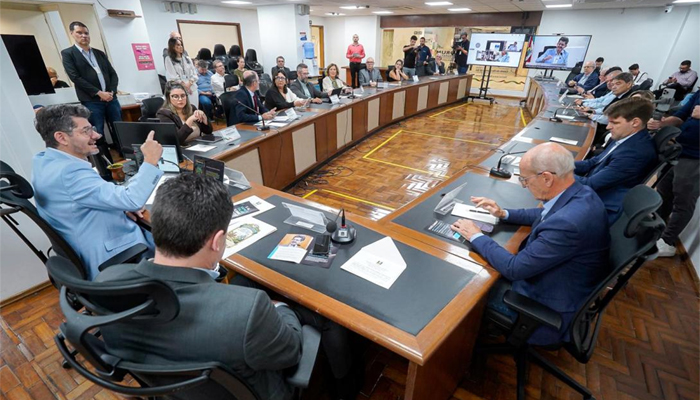
A public hearing of the Committee on Economy, Labor, Sustainable Development and Tourism of the Legislative Assembly, held this Wednesday (19), assessed the impacts of online betting (Bets) on the economy and health of Rio Grande do Sul and discussed the implementation of the state Lottery. The debate was led by deputy Tiago Simon, who also requested the event.
At the opening of the hearing, Representative Tiago Simon (MDB) spoke about the reasons that motivated him to request the second public hearing on the topic. Among the reasons, the parliamentarian cited the impacts on the income of families in Rio Grande do Sul, on the mental health of the population, and also on the educational system of Rio Grande do Sul (RS). “We have almost 2% of our country's GDP being reinvested in online gambling; we are talking about hundreds of billions of reais being drained from small businesses and universities.”
Tiago Simon emphasized that what worries him most is the growing and more intensive process of gambling addiction*. "Chronic cases of depression, over-indebtedness, leading to extreme situations where people reach the brink of despair," he added. The congressman also stated that the sector has, on several occasions, been linked to money laundering activities.
Regarding the State Government's bill to implement the State lottery, the deputy said he senses opposition to the proposal from Rio Grande do Sul's parliamentarians. "This is not an activity the state should focus on. On the contrary, the government should, more than ever, engage in processes to protect society," he pointed out.
The representative also informed that the bill, authored by him, which deals with restrictions on advertising by sports betting platforms, may be voted on next week by the Plenary of the Legislative Assembly.
According to Vilson Noer, president of the Federation of Retail Associations of Rio Grande do Sul, the activity of betting goes beyond the economic aspect and invades the behavioral sphere, even touching on public health issues. In economic terms, Noer stated that 64% of bettors have negative credit scores and 86% are completely indebted. "Furthermore, the money from bets doesn't stay in Brazil, as most betting companies are headquartered in other countries," he emphasized.
“From a psychological point of view, betting sites are not just leisure. They are designed to keep the user playing,” stated the president of the Regional Council of Psychology, Jeniffer de Mello. According to her, people, young people, and even children are being diagnosed with intense anguish, family conflicts, and cases of suicidal behavior. For her, it is a business model that preys on loss and those with greater economic and emotional vulnerability. “This is aggravated when dealing with children and adolescents, who, due to developmental characteristics, are more impulsive and more easily influenced by aggressive advertising and digital influencers,” she reinforced.
The president of the Rio Grande do Sul Supermarket Association (AGAS), Lindonor Peruzzo Junior, emphasized that the sector selling essential products was also affected. He indicated that, starting in May 2025, the sector experienced a sharp decline after a period of strong growth. He believes that household debt, due to the Bets (a Brazilian term for large-scale, often fraudulent, loans), will not be resolved in the short term. "Many of them have payroll loans with repayment terms exceeding 30 months, with absurdly high interest rates," he stated.
Wambert Di Lorenzo, executive director of Procon in Porto Alegre, spoke about the structure of the support center for over-indebted individuals, especially in debt renegotiation hearings. “The debt collection agencies are responsible for the indebtedness, but Procon is responsible for renegotiating legitimate debts. People become impoverished because of these agencies, but they don't participate in the negotiations; however, poverty and insolvency are the root cause,” he explained.
Also speaking were public defender Felipe Kirchner; Cremers representative Silzá Tramontina; Federasul vice-president Rafael Goelzer; public prosecutor André Marchesan; psychiatrist Thiago Pianca; Cremers director Ricardo Nogueira; Government Relations and Research Advisor for Sindilojas Porto Alegre Victor Pires; director of the Brazilian Society of Psychology Maria Rita Soares; Abrasel representative Fabiane Vargas; and the Executive Coordinator of Procon Santa Maria, Márcia da Rocha. ( With information from the News Agency of the Legislative Assembly of Rio Grande do Sul )

