Anticipatory compliance: how Legitimuz already meets SPA requirements for the Digital ECA.

In effect since March 17th, the new Digital ECA (Law No. 15.211/2025) expands the Statute of Children and Adolescents to the digital world, becoming a legal requirement with the force of law and ceasing to be just a vague recommendation on online protection (learn more about it by clicking here and here ). This signifies a new phase of responsibility for electronic platforms, with a direct impact on how children and adolescents access digital services and how companies need to handle data and identity.
The Digital ECA (Brazilian Statute for Children and Adolescents) now legislates on digital services from various sectors, such as applications, social networks, electronic games, app stores, and others, including the iGaming sector. But here we have two pieces of good news.
First, the regulation by the Secretariat of Prizes and Betting (SPA) of the Ministry of Finance already works with the Digital ECA; second, Legitimuz already offers identity verification and fraud prevention solutions. This means that 70% of betting operators in the Brazilian market are already in compliance with the new regulations.
Now, the bad news: it's possible that the other 30% of iGaming operators in the country are not yet operating in accordance with the new law.
But Legitimuz can provide the solution for them. Check out six questions and answers that show how their solutions can help iGaming companies adapt to the new regulations:
If my sector already has regulations regarding minors, do I need to worry about the Digital ECA (Statute of Children and Adolescents)?
Yes, and the distinction matters. The Digital ECA (Law 15.211/2025) applies to all providers of digital products and services, regardless of sector. It does not replace sectoral regulation, but adds specific obligations. For operators in already regulated sectors, compliance structures reduce effort and adaptation, but it is still necessary.
How does Legitimuz comply with the Digital ECA (Brazilian Statute of Children and Adolescents)?
Legitimuz already operates in compliance with the ECA (Brazilian Statute of Children and Adolescents) because it serves regulated markets that require the filtering of CPF numbers (Brazilian taxpayer identification numbers) of minors under 18 years of age, preventing access and registration, and retains only the minimum necessary data — without exposing the child's identity at any stage of the process.

I already have KYC. Do I need to change it?
Not necessarily. LegitFace fits into the existing workflow via API, adding facial biometrics and liveness without redoing the architecture.
How does biometrics work?
Legitimuz has a facial analysis layer trained to identify children's features. If detected, access is automatically blocked—even if the child is using an adult's document. The company does not capture or store images or data of children; it only identifies if there are childlike features and, if so, blocks the flow. Furthermore, it holds ISO/IEC 27001 certifications, all in compliance with the LGPD (Brazilian General Data Protection Law).
Does it work on any device?
Yes. Cutting-edge technology that works on any device — from the most basic to the most modern cell phone. No specific hardware requirements, no friction for the end user.
How long does it take to integrate?
From our side at Legitimuz, it's fast. The company delivers complete documentation, dedicated support, and stays by your team's side until production begins. The pace matches that of your engineering pipeline.
Child Check and Age Check: two features that make LegitFace the best solution for the Digital Child and Adolescent Statute (ECA Digital).
Legitimuz's liveness verification solution (or proof of life, if you prefer), LegitFace, offers two features tailored for the Digital ECA: Child Check and Age Check. But how do they work within the ecosystem? That's what you'll find out now:
Child Check acts as the first layer of defense through real-time facial biometrics. Using artificial intelligence to read the user's features, the system infers age and automatically identifies childlike characteristics. This process is integrated into the platform, allowing for immediate detection of minors attempting to access the service without the need for external redirects.
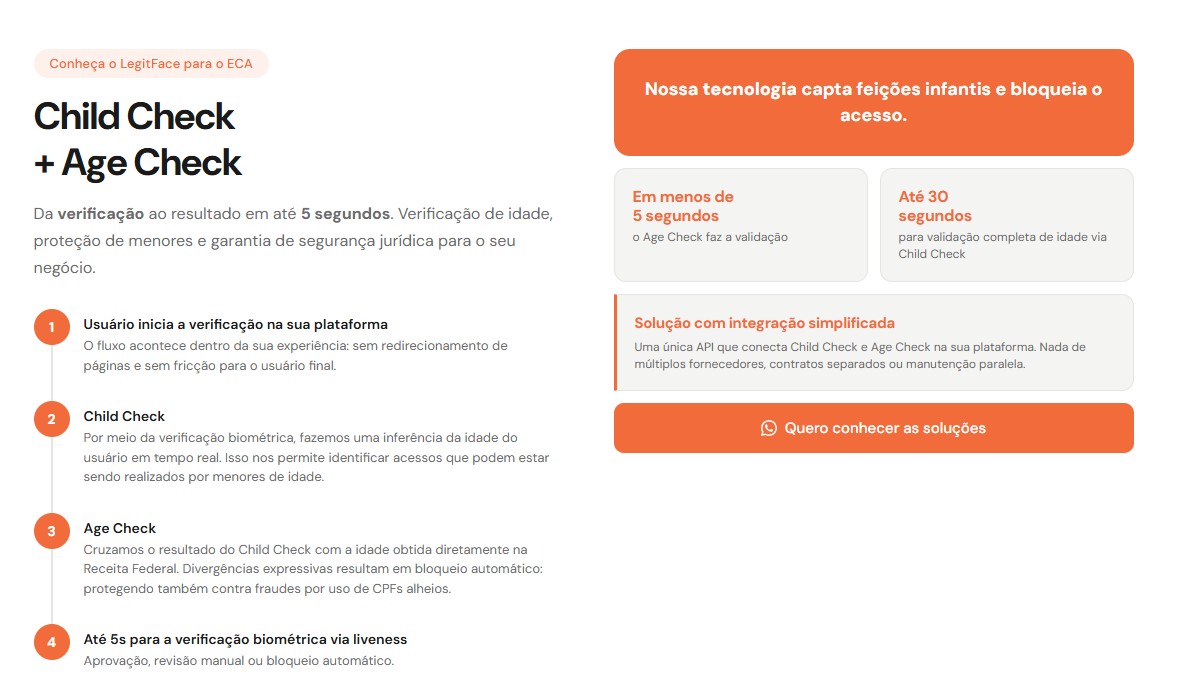
Next, Age Check validates the collected information by cross-referencing biometric data with the official database of the Brazilian Federal Revenue Service. This step ensures the legal security of the transaction, as it identifies discrepancies between physical appearance and the chronological age registered in the provided CPF (Brazilian taxpayer identification number). If there is a significant inconsistency, the system automatically blocks the transaction, protecting it against unauthorized access by minors and identity fraud.
Important : Age Check performs the initial validation in less than 5 seconds; while Child Check completes the validation in up to 30 seconds. All this without friction and without disrupting the user experience.
Stay ahead of regulation with cutting-edge technology.
Compliance is no longer an option: it's the new rule of the game. Secure a solution that adapts to your business, with dedicated support at every stage. Choose Legitimuz!
Contact our team and schedule a demo.