From zero to 24 hours a day: permanent defense for iGaming and player security.

It's 3 a.m. The office is silent, but the SOC screens glow like a wall of restless eyes. High-priority alerts are fired incessantly. Because in iGaming there is no downtime. Real money circulates in real time, and hackers know that the night shift is not a truce, but an opportunity.
Unlike banks, which can at least rely on settlement times, or telecommunications companies, where traffic peaks are relatively predictable, iGaming platforms are global and operate continuously. A blackjack session in Cape Town, a sports bet in São Paulo, or a slot machine game in Madrid—they all use the same infrastructure. Any delay, breach, or impact instantly spreads across brands, jurisdictions, and regulatory bodies.
The risks go beyond just financial gain. The trust of players, regulatory bodies, and partners is the foundation of iGaming. Let's suppose the roulette wheel freezes or withdrawals are interrupted because a ransomware agent took down a database at 2 AM. In that case, the damage is measured not only by financial loss but also by compromised licenses and a tarnished reputation.
That's why having 24/7 SOC operations isn't optional in this sector. The competition doesn't respect business hours. In fact, they count on those loopholes. And the last three years have brutally demonstrated what happens when even the biggest names in real-money platforms are caught off guard.
Why is SOC important?
The reasons for ensuring permanent security are not merely theoretical. Over the past three years, the iGaming sector and related industries have witnessed some of the most devastating incidents in digital history, each highlighting that attackers don't care if it's midnight or Monday morning.
Stake.com (2023) — $41 million, Lazarus Group
On September 4, 2023, the cryptocurrency sports betting site Stake.com had approximately $41 million in digital assets stolen. Within days, the FBI attributed the breach to the North Korean Lazarus Group (APT38), a state-backed criminal group known for attacking financial systems to fund the regime of the Democratic People's Republic of Korea.
What this means for iGaming: when a sports betting site that handles millions daily can be compromised through its wallet infrastructure, criminals are reminded that platforms operating with real money are perfect targets in terms of liquidity. Attributing the risk to a nation-state makes it more than "just another case of fraud."
MetaWin (2024) — ~$4 million, exploiting withdrawal flows
On November 3, 2024, the online casino MetaWin suffered an attack involving an exploitation of a vulnerability in its hot wallet, resulting in a loss of $4 million. The attackers exploited a vulnerability in a "simple withdrawal" mechanism to steal the funds. Subsequently, the operator "reloaded" the hot wallets and recovered most of the withdrawals, but only after a major disruption.
What this means for iGaming SOCs: the user experience with payments in iGaming is often optimized for speed and simplicity, but every shortcut creates an opening for attacks. Having a mature SOC isn't just about monitoring firewalls and endpoints. It's also necessary to monitor transaction flows in real time, validate anomalies, and escalate the situation when payment behavior is out of the ordinary. Without this capability, even small operators risk reputational damage that no amount of "wallet top-ups" can reverse.
Other recent incidents reinforce the same trend. In February 2024, cryptocurrency casino Duelbits lost approximately $4,6 million after a private key was compromised: a reminder that wallet security is not an administrative matter, but a responsibility of the SOC that requires real-time monitoring and containment. And, in August 2025, Bragg Gaming revealed an internal IT breach. Although no customer data was exposed, the mere act of disclosing the breach shook market confidence and showed how easily it can trigger regulatory reviews.
Together, these cases reinforce the pattern: criminals (from the Lazarus Group to profit-driven ransomware groups) are attacking the foundation of iGaming, where real money meets real-time opportunity.
What makes the iGaming SOC unique?
Operating an iGaming SOC is not the same as operating a bank or a telecommunications company. The main differences can be summarized in three words: permanent, multi-brand, regulated.
The platforms never sleep: global spikes occur throughout the day, with bets and payments being processed in real time. A latency spike at 4 a.m. isn't just an IT failure; it can affect multiple brands and jurisdictions. With fragmented infrastructures and regulators watching every move, the SOC becomes more than just monitoring; it's the backbone of financial trust and compliance.
It is precisely in this context that SOFTSWISS created its 24-hour SOC. Over time, our teams have had to face challenges that go beyond what off-the-shelf controls or commercial SOAR tools can solve. Therefore, we believe it is valuable to openly share our approach with the iGaming industry: what worked, what didn't work, and how we currently measure maturity.
The problem we are solving
When we started structuring a 24-hour SOC for iGaming, we quickly realized that standard playbooks and commercial products didn't immediately fit the industry. The weaknesses were evident:
01. There are no ready-made security controls for iGaming that work for everyone.
Traditional SOC tools are designed for banks, telecommunications companies, or large enterprises. However, iGaming brings together real-time money flows, multi-brand operations, and regulatory bodies across multiple jurisdictions.
02. The high cost of commercial SOAR/IRP solutions
Tools like DFLabs or Tines are powerful, but their licensing models are priced towards Fortune 500 companies, not rapidly growing iGaming operators with dozens of brands and subsidiaries. Paying hundreds of thousands for orchestration isn't viable when margins are distributed among multiple entities with different SLAs.
03. Fragmented infrastructure and inconsistent risk appetite
For SOFTSWISS, the challenge was clear: how to align security across a portfolio with multiple proprietary products, each running on its own infrastructure, developed on different technology stacks, integrated with various corporate systems, and shaped by different business processes, risk appetites, and regulatory obligations in various jurisdictions.
In practice, this meant that a single security team needed to maintain control over a variety of systems, escalation rules, and compliance checklists, without letting incidents go unnoticed.
These findings influenced our design choices. Instead of trying to adapt generic corporate tools to the iGaming universe, we focused on open-source solutions with an automation focus that we could scale, adapt, and control internally.
The SOFTSWISS SOC approach: stack and why
“It’s not possible to protect real-time betting with off-the-shelf enterprise software. iGaming demands speed, not generic, ready-to-use solutions.” — Evgeny Zaretskov, Chief Information Security Officer of the SOFTSWISS Group.
Instead of seeking maturity by purchasing expensive enterprise platforms, we designed a SOC stack that is open source at its core, highly automated, and adapted to the 24/7 reality of iGaming. See how it works and why it matters.
ClickHouse as a registration hub
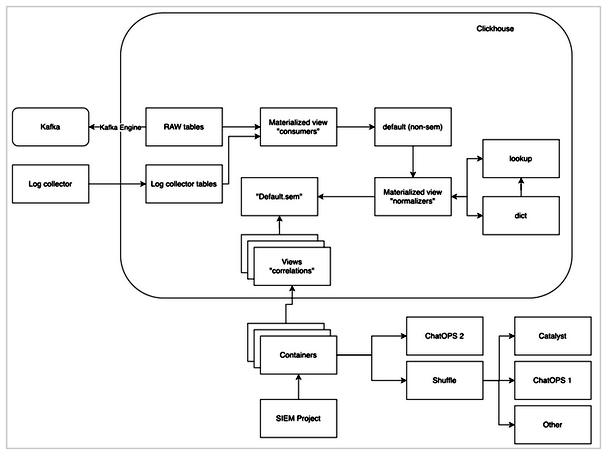
At the heart of our SOC is ClickHouse: an open-source columnar database known for its speed and efficiency. We use it as a record generator, not just for storage.
⇒ Materialized displays normalize the events received during ingestion.
⇒ Storing highly active data enables ultra-fast queries for real-time correlation.
Storing rarely read data ensures regulatory retention at a low cost.
⇒ Clusters and replication offer resilience and scalability.
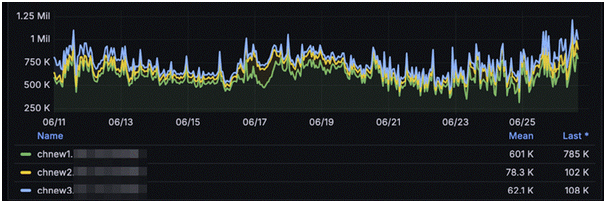
Why this matters: ClickHouse allows us to reduce MTTD from minutes to seconds, meeting retention obligations with a fraction of the TCO. At the iGaming scale, with peaks of hundreds of thousands of events per second, including enrichments, we need ultra-fast ingestion, low-latency correlation, and cost-effective long-term storage. ClickHouse's distributed, columnar engine gives us the performance headroom to retain months of highly active data and years of read-only historical data without slowing down detection.
Sigma + MITRE ATT&CK: knowledge about portable detection
Rules are not just code; they are knowledge. That's why we adopted Sigma, an open format for detection rules.
⇒ We have executed hundreds of use cases in production, with new cases constantly being tested and adjusted.
Each one corresponds to the techniques of MITRE ATT&CK, ensuring consistency and coverage.
⇒ The rules are automatically generated in ClickHouse queries to perform the correlation and generate alerts through our own solution.
Each rule is linked to playbooks and SLA triggers.
Why this is important: Instead of restricting SOC knowledge to a single vendor's black box, Sigma allows for the transfer of detections between tools and teams, accelerating maturity.
Catalyst (IRP) + Shuffle (SOAR): open source instead of Tines/Phantom
Commercial SOAR/IRP platforms are powerful, but with six-figure licensing costs, they are not scalable for iGaming brands. Instead, we developed based on:
⇒ Catalyst (open-source IRP) for case management.
⇒ Shuffle (open-source SOAR) for automated playbooks.
Automation includes:
Disable or revoke accounts via identity providers.
Isolate the affected hosts.
⇒ Enrich alerts with external intelligence sources.
⇒ Proactively rotate credentials when leaks are detected.
⇒ And many others throughout the incident lifecycle.
Why this is important: MTTA has improved many times over, while MTTR has been reduced thanks to ready-made playbooks and orchestration.
Flare for threat intelligence and data leaks.
“Credential leaks are nothing new, they're a countdown.” — Amir Aliev, Deputy Director of Security at SOFTSWISS.
With Flare, the SOC monitors clandestine sources in real time, detecting exposed credentials before attackers can exploit them. Suspicious entries trigger immediate actions, such as access revocation, password changes, and strengthening account security. In an industry where credential theft accounts for more than 20% of breaches, leak detection is not optional. It is the first line of defense.
ChatOps: Taking the SOC to where the teams already are.
Incidents don't wait for analysts to switch tabs. In iGaming, where every second of downtime can mean lost bets, alerts need to reach the right people instantly. That's why we've incorporated SOC alerts directly into our corporate messaging system, where teams already spend most of their time.
When a high-severity event is triggered, analysts see it in the channel, can confirm it, and even initiate playbooks without leaving the message. Escalations work the same way, going directly to the right channel or person, without the need for extra dashboards.
The result: fewer missed notifications, fewer context switches, and faster responses. Industry experience proves it: ChatOps consistently reduces MTTA by keeping people and automation in the same flow.
Integrations with ticketing systems
Each company in the SOFTSWISS Group uses its own ITSM. Our SOC stack is integrated with Jira so that:
⇒ Tickets should be created automatically with the correct severity.
⇒ SLA time countdowns begin immediately.
⇒ On-call teams receive shift assignments without manual routing.
Why this is important: accountability. Each alert finds a destination, is assigned an accountable person, and follows consistent escalation pathways across the Group, ensuring nothing goes unnoticed.
People, not just playbooks.
Technology is a force multiplier, but even the most advanced stack is only as good as the people who operate it. At SOFTSWISS, automation has changed not only how incidents are handled, but also how the SOC team itself is structured.
A mindset focused on automation. With automated screening, enrichment, and containment processes, analysts are no longer burdened with repetitive tasks. Instead, they focus on alerts that arrive pre-evaluated and enriched—those that truly require human judgment.
Changes in analyst roles. The core work of the SOC has ceased to exist; first human eyes are now investigating anomalies that are beyond the reach of automation. Meanwhile, senior analysts are dedicating more time to threat detection, malware analysis, and improving detection logic.
The Incident Manager as commander. In serious incidents, an Incident Manager coordinates the response, applies playbooks, manages communication with leadership, and aligns decisions with company priorities, with the support of a cross-functional CSIRT.
Human judgment matters when it matters. Machines manage volume, people deal with the unknown. This balance defines an effective SOC in iGaming, where uptime is synonymous with trust, and trust can vanish in a matter of minutes.
Metrics that matter: from record quality to response speed
In iGaming, every line of data is associated with real money. A single blind spot, a wallet that stopped reporting, a system that ceased to function can put millions at risk before anyone realizes it. That's why the maturity of a SOC doesn't begin with the dashboards, but with the quality of the data that feeds them.
Records assurance: integrity and accuracy
A Security Operations Center (SOC) is only as good as its records. The expression "Garbage in, garbage out" is a brutal truth in security operations. Without guaranteed coverage and high-fidelity data, even the most intelligent automation operates blindly.
⇒ Integrity guarantee. Assets don't always report as expected. To avoid subtle blind spots, we maintain an inventory-based approach: all systems that should send records are checked against what actually reaches ClickHouse. If something is hidden, an automated daily report flags it and opens a ticket for investigation.
⇒ Maintaining accuracy. Records must be structured, accurate, and reliable. An unanalyzed or malformed record is almost as bad as no record at all. Automated checks continuously audit data quality, identifying sources that omit fields, break formats, or deviate from standards.
This constant feedback loop bridges the gap between infrastructure and security, ensuring that SOC analysts always work with complete and reliable data.
Accelerating security: key metrics
The maturity of a SOC is not measured by the number of alerts processed. What matters is the speed and effectiveness with which incidents are stopped before they cause damage to the company.
⇒ MTTD (Mean Time to Detection): With real-time ingestion and correlation, anomalies are detected in seconds. The IBM Cost of a Data Breach 2024 report showed that, without automation, breaches took more than 250 days to be identified.
⇒ MTTA (Mean Time to Recognize): Automated routing and 24-hour shifts ensure that alerts never go unanswered; the right team is dispatched almost immediately.
⇒ MTTR (Mean Time To Response): predefined playbooks and orchestration reduce response time several times compared to manual processes. According to the Mandiant M-Trends 2024 report , the global average wait time is still 10 days, which is too long for platforms that handle real money.
⇒ False positive rate: low noise equates to greater analyst focus.
⇒ Coverage and automation: Identity threats and credential leaks remain the primary attack vectors, as confirmed by the Verizon DBIR 2024 report . Monitoring and automation in these areas are indicators of a SOC's true maturity.
For iGaming, these numbers aren't just for show. They prove to regulators, partners, and players that the SOC is doing its job.
The lesson for iGaming
In iGaming, downtime isn't just about lost revenue. It involves a loss of player trust in the operator and the possibility of regulatory bodies suspending or revoking a gaming license. Therefore, having a 24/7 SOC (Standard Operating Conditions) isn't just a matter of compliance, but of survival.
Open source and automation not only reduce costs, but also allow security teams to respond with the speed demanded by the industry, across multiple jurisdictions and infrastructures. The real return is trust: from players, partners, and regulatory bodies.
“In this sector, you don’t create a SOC to be compliant. You create it to survive,” Evgeny Zaretskov, Group Information Security Director, SOFTSWISS.