Betting companies generate 27,6 mandatory notifications to COAF (Council for Financial Activities Control) after regulation.

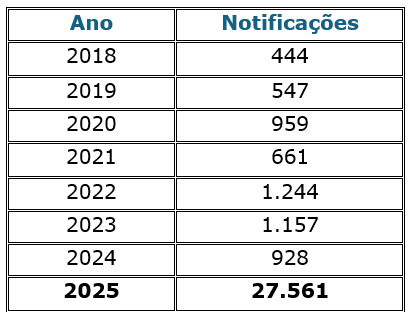
The Council for the Control of Financial Activities (Coaf) recorded 27,6 reports of suspicious transactions related to online betting and lottery companies in 2025. This number represents a significant increase compared to 2024, when 928 occurrences were registered. The jump occurred after the entry into force of the regulatory framework for the betting sector in the country; the regulation established that betting companies must notify Coaf when they identify suspicious transactions. The rules came into effect in January 2025. The information was initially released by Globo Online.
In 2023, 1.157 reports were registered. In 2022, the number was 1.344.
Betting became legal in Brazil in 2018. Regulation was supposed to be completed by 2022. It was carried out during the government of Luiz Inácio Lula da Silva.
Leap in suspicions
Communications made by financial institutions regarding lotteries and fixed-odds betting.
Market studies indicate that illegal betting companies still account for 40% of the market.
Betting became legal in the country in 2018, but regulation of the sector only came into effect in 2025.
(Source: COAF)
Financial institutions identify illegal operators.
In 2025, 54 financial and payment institutions submitted 1.255 reports to the Prizes and Betting Secretariat indicating evidence of illegal operators. Analysis of these reports led to the identification of 265 illegal operators. This process resulted in the closure of 550 bank accounts.
Market studies indicate that illegal betting companies represent 40% of the sector. The Secretariat of Prizes and Betting of the Ministry of Finance is responsible for regulating and overseeing the sector. The National Telecommunications Agency works in partnership to shut down illegal websites .
The agency considers that the fight against money laundering is still a weakness in the sector, given the high number of illegal bets . Some of these transactions are still not identified by the traditional control systems of financial institutions.
Coaf structures preventive work with banks.
The COAF (Council for Financial Activities Control) is structuring preventative work with banks to improve the identification of accounts linked to betting platforms. Guidance was previously provided irregularly. The idea is to structure this partnership, scheduling regular meetings.
The same strategy has been used with other emerging sectors, such as fintechs and crypto assets. In the case of virtual assets, regulation came into effect in February 2026.
Sources within the agency claim that COAF has been providing a kind of "consulting" to banks on types and patterns of transactions that may indicate the activity of betting schemes . The idea is that financial institutions can adopt preventive measures to close loopholes for criminals.
Many companies do not use CNPJs (Brazilian tax ID numbers) explicitly registered as betting houses. They operate under other business classifications. This makes automatic tracking by financial institutions difficult.
According to sources familiar with the matter, it is common to use the CNPJ (Brazilian tax ID) of previously created companies, so-called "shelf companies." This makes it more difficult to identify whether that registration is a legitimate business or not.
Requirements for platform regularization
To become legal, platforms need to be registered with the Prizes and Betting Secretariat of the Ministry of Finance. They must pay a fee to the federal government. They need to follow a series of rules, such as having representation in the country and the bet.br domain.
SPA has partnered with Anatel to take down websites . It attempts to stifle the financial flow of illegal betting sites through sanctions against banks and fintech companies.
Fintechs have until May to comply with regulations.
Fintechs represent a specific challenge for the control of financial activities. For years, some of these institutions operated without needing a license from the Central Bank. This also exempted them from providing information to COAF (Council for Financial Activities Control).
The increase in cases involving the use of these institutions by organized crime led COAF (Council for Financial Activities Control) to participate directly in the tightening of rules implemented by the Central Bank in 2025. Fintechs have until May 2026 to request authorization from the Central Bank.
COAF anticipates an adaptation period until the flow of information from the entire financial sector reaches the agency in its entirety. Simultaneously, the institution is developing improvements to the system to enhance the quality of analysis in light of the expected growth in data volume.
The COAF is a financial intelligence unit administratively linked to the federal government. Its work focuses primarily on preventing and combating money laundering. The agency does not make judgments about transactions; it is limited to reporting suspicious financial transactions in accordance with legislation and market rules.
Editor's comment:
BNLData spoke with Fred Justo, Director of AML at Legitimuz, who stated that one of the reasons for the growth in mandatory notifications in 2025 could be interpreted as defensive communications from operators fearing sanctions due to Article 25 of Ordinance SPA/MF No. 1.143/2024, which stipulates that betting operators must apply "special attention" and rigorous analysis to bets and transactions involving evidence of money laundering, terrorist financing, or related crimes, including suspicious clients or activities without economic justification.
"Another factor contributing to this number may be the failure to identify what is suspected of money laundering; when in doubt, they end up reporting everything," Justo commented.
Article 25 of Ordinance SPA/MF No. 1.143/2024:
Article 25. Special attention should also be paid to the analysis of bets and related transactions involving:
I – a person involved or suspected of being involved in activities classified as money laundering and crimes against the financial system;
II – a person who has committed or attempted to commit, facilitate, or participate in acts of terrorism, proliferation of weapons of mass destruction, or their financing, as provided for in Law No. 13.260 of 2016 and Law No. 13.810 of 2019;
III – a person domiciled in a jurisdiction considered by the Financial Action Task Force (FATF) to be high-risk or to have strategic deficiencies in matters of AML/CFT, or in countries or dependencies qualified by the Special Secretariat of the Federal Revenue of Brazil (RFB) as having preferential taxation or a privileged tax regime;
IV – resistance by the bettor or platform user to provide additional information requested by the betting operator;
V – providing false or difficult-to-verify information, particularly for the formalization of registration, account opening, bet registration, or other operation on the betting platform;
VI – contribution of funds whose origin is suspected;
VII – payment of a premium suspected of being used for money laundering/freezing of currency or fraud;
VIII – payment of a betting prize suspected of being a match-fixing transaction, pursuant to Article 177 of Law No. 14.597, of June 14, 2023 (General Sports Law);
IX – incompatibility between the transactions carried out by the bettor and their usual pattern of activities, their occupational information, or their apparent financial situation;
X – unusual movement of funds in a way that may suggest the use of automated tools by the bettor;
XI – deposit or withdrawal of funds, in a short period of time, that may suggest the splitting or concealment of the transaction;
XII – withdrawal, or attempted withdrawal, of funds from a bettor's transactional account immediately after making a deposit, without placing a bet;
XIII – improper use of an account by someone other than its owner;
XIV – evidence of the use of an account by an intermediary who places bets for other people;
XV – contributions in amounts that may suggest the practice of brokering bets;
XVI – betting on a betting exchange where there is evidence of an arrangement between two or more bettors to bet on different outcomes, with the purpose of transferring funds between them, aiming to engage in money laundering/free transfer;
XVII – accounts opened in the name of a politically exposed person (PEP);
XVIII – difficulty or infeasibility of collecting, verifying, validating, or updating registration information of bettors or users of the platform; and
XIX – any characteristics that signal, particularly due to their unusual or atypical nature, a possible indication of money laundering/freezing of property or other related offenses.