
Hugo Motta argues for caution regarding the ban on sports betting advertising in Brazil.
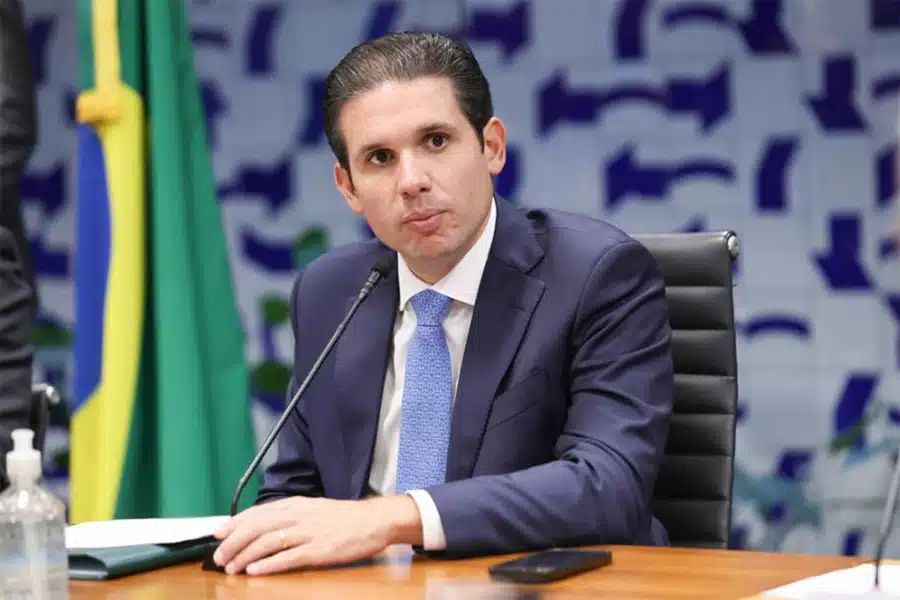
The Speaker of the Chamber of Deputies, Hugo Motta (Republicanos-PB), advocated a cautious approach to proposals aimed at banning sports betting advertising in Brazil. His statement came on Wednesday (February 5th), following the approval of a bill in the Senate's Science and Technology Committee (CCT) that prohibits advertising in the sector.
Motta highlighted to Poder360 that the issue still lacks consensus among party leaders in the Chamber of Deputies. The discussion about banning betting advertising is expected to gain traction in the National Congress in the coming weeks.
"We have to proceed with great caution in this," declared the Speaker of the House. He emphasized the economic importance of the sector for financing Brazilian sports and cultural events.
Projects in progress
Bill 3.563 of 2024, approved by the Senate's Constitution, Justice and Citizenship Committee, was authored by Senator Randolfe Rodrigues (PT-AP) and reported on by Senator Damares Alves (Republicanos-DF). The proposal prohibits advertising, sponsorship, and promotion of sports betting and online gambling in the country. The text will now proceed to the Senate's Constitution and Justice Committee for analysis.
During the session in the CCT (Committee on Science, Technology, Innovation, Communication and Informatics), Senator Damares Alves maintained the original text, despite attempts at dialogue proposed by Senator Efraim Filho (União/PB), who sought to broaden the discussion on the topic. The rapporteur expressed confidence in the next phase of the legislative process, indicating that Senator Portinho (PL/RJ) will work on modifying the text in the CCJ (Committee on Constitution, Justice and Citizenship).
The bill also expressly prohibits betting related to election results, including elections for executive or legislative positions, as well as referendums and plebiscites at all levels and spheres of power.
Congress is also analyzing Bill 2.985 of 2023, approved by the Senate in May 2025, which proposes changes to the rules for advertising sports betting. This proposal is stalled in the Chamber of Deputies, awaiting the creation of a special committee for its analysis.
Economic impact on sport
Motta expressed concern about the potential negative effects of a total ban, especially for Brazilian football, which receives significant financial support from betting companies.
“I think that today you have [advertising and sponsorship of betting ] both in the media and in football itself, events. [There is] a great dependence on this sector that helps to sponsor, to finance. That is also important to take into consideration.” “I see that perhaps the remedy is not that [to prohibit all betting advertising ] because it is a legalized activity, just as alcohol and tobacco are legalized in Brazil. This [ betting ] is also legal by law. They are paying taxes. So, the abuse may not be there [ betting advertising ]. It lies in combating the illegal, in building this in a more reasoned way,” stated the president of the Chamber.
Industry positioning
The Brazilian Institute for Responsible Gaming (IBJR), which represents online betting companies, has expressed its opposition to broad restrictions on advertising in the sector. In a statement to Poder360, the institute stated that such limitations could strengthen the illegal market, since advertising allows consumers to identify legitimate platforms and differentiate them from illegal operators.
According to a survey cited by IBJR, sports betting accounted for approximately 20% of the complaints received by Conar (National Council for Advertising Self-Regulation) in 2024. The institute reported that it has maintained a partnership with Conar since 2023 and continues to participate in discussions on advertising rules in the sector.
The penalties foreseen in Bill 3.563/2024 for cases of non-compliance include warnings, fines ranging from R$ 5 to R$ 10 million, temporary suspension, and revocation of authorization to operate betting operations. For infractions related to electoral betting, fines can range from R$ 50 to R$ 500, depending on the economic capacity of the offender and the scope of the infraction.
If the bill is approved in the Senate, the matter will proceed to the Chamber of Deputies for analysis, where Hugo Motta will play a decisive role in determining the pace of its processing.

