
IBJR: "Combating illegal betting is more effective than raising taxes"

The Brazilian Institute for Responsible Gaming (IBJR) published a special feature this Sunday in Folha de S.Paulo (Estúdio Folha) and on the UOL Notícias portal about the importance of combating the illegal betting market and clearly showing how much licensed operators already contribute in taxes to Brazil.
The material adopts the internationally used metric from the most mature markets in the sector, based on consumption tax/GGR, allowing for a technical and objective comparison with other global jurisdictions.
The Brazilian Institute for Responsible Gaming (IBJR) argues that further increasing the tax burden on companies operating within the law does not strengthen the newly regulated market. On the contrary, it opens space for the advancement of clandestine platforms, which finance organized crime and money laundering, reduces the competitiveness of licensed operators, and ultimately exposes bettors to greater risks, such as scams and fraud.
“Strengthening oversight, ensuring regulatory balance, and maintaining a competitive environment is what generates sustainable revenue, protects bettors, and effectively combats the illegal market,” says André Gelfi, director and co-founder of IBJR.
⇒ Check out the full publication:
Combating illegal betting is more effective than raising taxes.
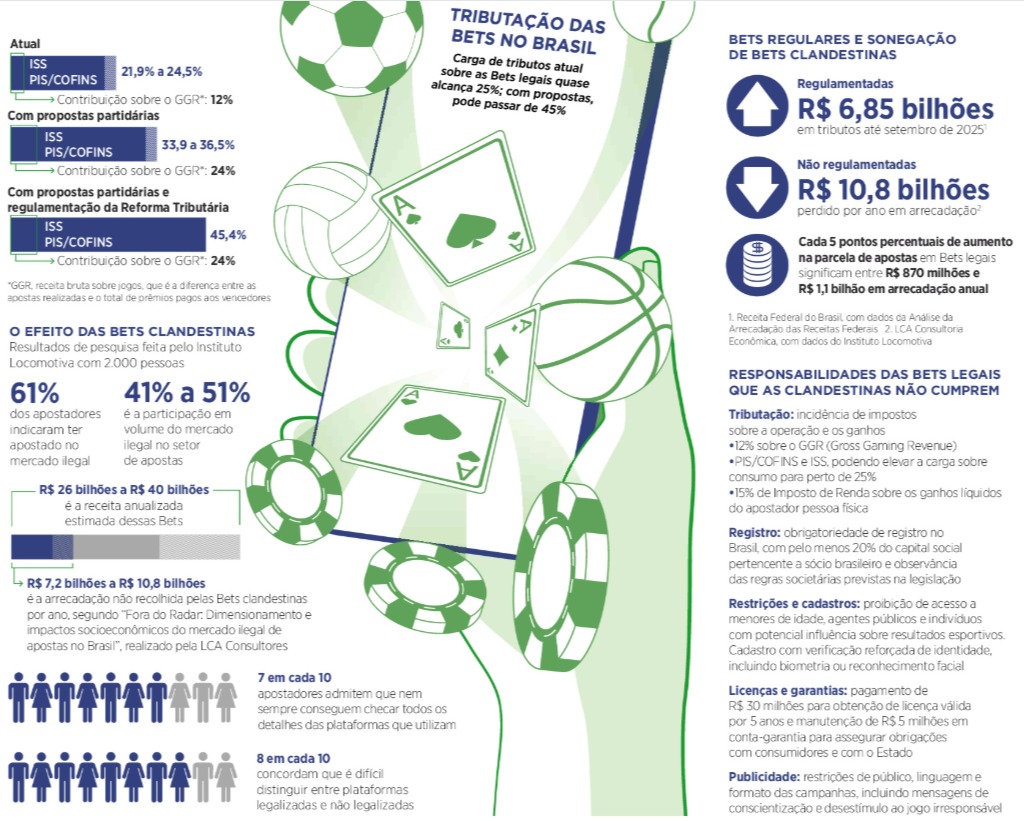
In addition to violating regulations and fueling organized crime, illegal betting sites fail to generate R$ 10,8 billion in taxes annually, says André Gelfi, director, advisor, and co-founder of the Brazilian Institute for Responsible Gaming (IBJR).
Raising the tax burden now could destroy a newly regulated market, which collected R$ 6,85 billion between January and September 2025, and push millions of bettors towards illegal platforms involving minors, false promises, and match-fixing, says André Gelfi, director and co-founder of the Brazilian Institute for Responsible Gaming (IBJR). According to the executive, the path to increasing revenue and protecting citizens begins by combating illegality, which represents 51% of the sector, according to a study by LCA Consultoria Financeira.
What does the illegal betting market represent in Brazil?
Illegal gambling still accounts for about 51% of the betting market in the country, generating approximately R$ 38 billion per year. This means we lose R$ 10,8 billion annually in revenue. Illegal gambling establishments do not pay taxes, do not follow consumer protection rules, do not adopt integrity controls, and operate outside the financial system. In practice, they harm citizens, distort competition, and compromise the credibility of the sector.
What kind of rules?
In the regulated market, there are clear rules to protect bettors and guarantee legal security. We work with measures to prevent compulsive gambling, such as time and value limits, and with tools to prevent access by minors, including facial recognition, a pioneering advancement in Brazil. There are also financial education initiatives, reinforcing that betting is entertainment, not an investment. We have an Advertising Code and work in conjunction with CONAR (Brazilian Advertising Self-Regulation Council), which included a specific annex for betting advertising. The clandestine market, however, ignores all of this and sustains itself on misleading promises, match-fixing, money laundering, and often, organized crime.
How is the sector taxed?
Since January of this year, the sector has been regulated and monitored. Current taxation reaches approximately 25%. The specific tax, GGR, alone is 12% on the difference between the amount wagered and the prizes paid. In addition, we collect PIS, COFINS, and ISS taxes. From January to September, licensed platforms generated R$ 6,85 billion, which finances areas such as sports, tourism, security, and education. Every 5 percentage points that migrate from illegality to the regulated market represent between R$ 870 million and R$ 1,1 billion in additional taxes. Therefore, combating illegality is the most efficient way to increase revenue, protecting society and providing predictability to the sector.
What could increased taxation lead to?
The proposal to raise the sector tax from 12% to 24%, as in Bill 5.076/2025, would bring the total tax burden to approximately 45,4%. This would make it impossible for many companies that came to Brazil, applied for licenses, configured systems, and began operating according to local regulations to continue operating. We are talking about a newly established market in its initial phase. An abrupt change now compromises investments, reduces the regulated base, and pushes bettors into the underground market. There are international examples: in Germany, when the amount wagered was taxed, most users migrated to unlicensed sites, resulting in lost revenue and security.
How to combat illegal betting?
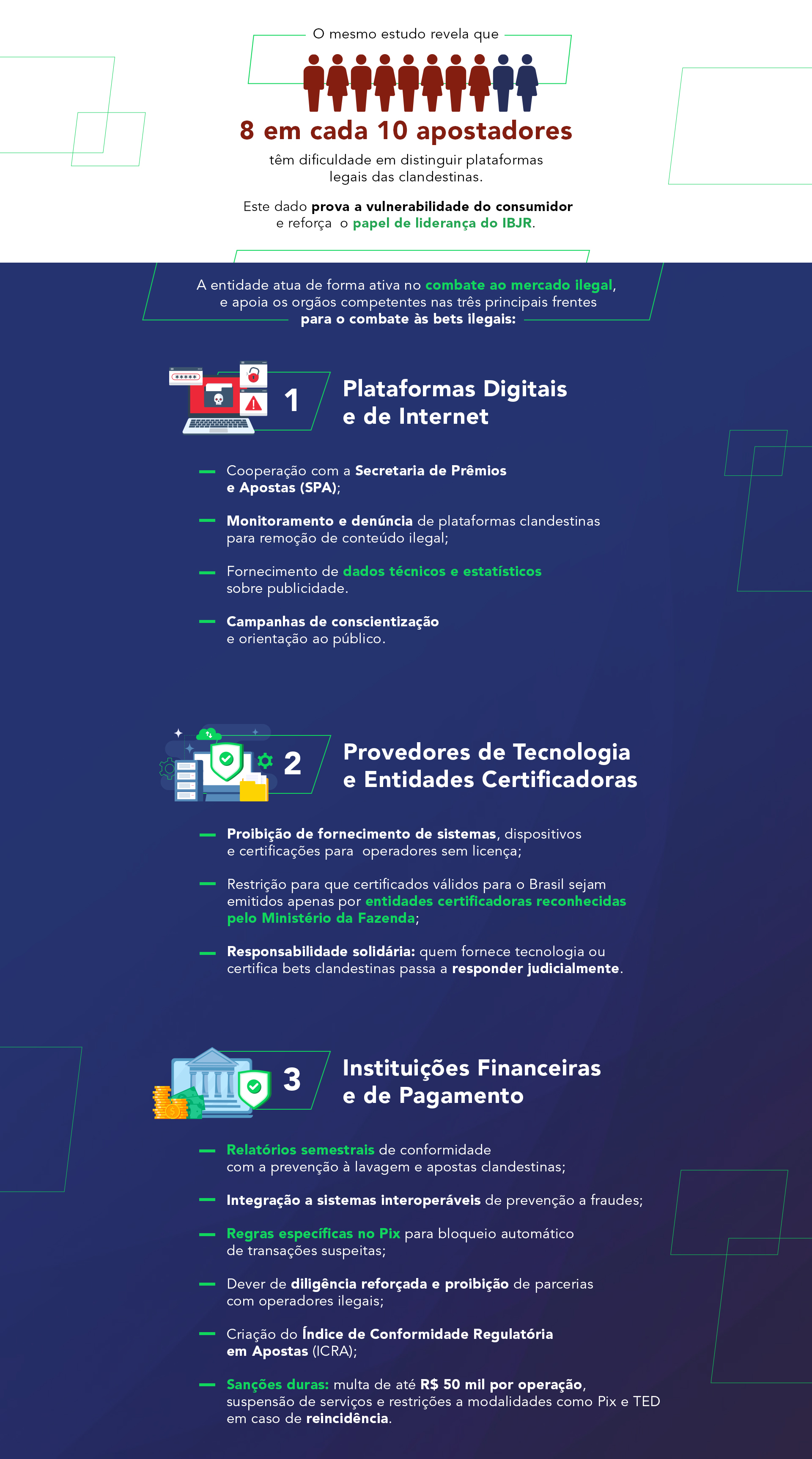
There are clear measures in place. First, all clandestine operations use Pix, a system monitored by the Central Bank. It's possible to track and block transactions to illegal platforms. Furthermore, it's necessary to hold influencers and digital platforms that promote this content accountable, because the illegal activity isn't in traditional media, it's on social networks, with unrealistic promises of quick enrichment. Another front is regulating and monitoring technology providers, punishing those who supply games to the illegal market. Finally, clear communication is crucial: if it doesn't have '.bet.br', the betting operator is not authorized by the Federal Government, and bettors need to be extra careful to avoid scams. Information and oversight go hand in hand.
UOL News
Legal gambling: Combating the illegal betting market could yield more revenue for the government than extra taxation.
Millions of Brazilians seek entertainment through betting, but the security of this market is compromised by the threat of clandestine platforms that operate outside the law and leave consumers completely unprotected. To guarantee a safe and transparent environment that effectively contributes to the country's development, the regulated sector operates rigorously. With the purpose of combating illegality and protecting bettors, the Brazilian Institute for Responsible Gaming (IBJR) was founded in 2023 and today represents approximately 75% of the national market, bringing together the main sports betting companies in Brazil and the world.
Although regulated platforms collected R$ 6,85 billion in taxes up to September 2025, according to the Federal Revenue Service, this amount is overshadowed by the volume of resources that escape state control: the clandestine market moves R$ 38 billion annually in Brazil, without collecting a single tax. This illegal activity not only subtracts resources from the State, but also attracts consumers to an environment without any protection. Without identity verification, facial recognition, or restrictions on the use of credit cards, the clandestine system exposes the bettor to risks that the regulated market seeks precisely to eliminate.
The scale of the problem is alarming: the unregulated sector is responsible for 51% of betting in Brazil, an estimated fiscal loss of R$ 10,8 billion per year, according to research by the Locomotiva Institute and a survey conducted by LCA Consultoria Econômica, commissioned by IBJR.
How does collection work?
Legalized betting operators have demonstrated a commitment to federal tax collection. Considering the taxes levied on GGR (Gross Gaming Revenue) — PIS, Cofins, and ISS, plus the Social Contribution on Net Profit (CSLL), Corporate Income Tax (IRPJ), and a monthly inspection fee of up to R$ 2 million per operator — the total tax burden can reach approximately 25% of GGR. In practice, the sector already bears an effective tax burden exceeding 25% of revenue, a rate significantly higher than the benchmark GGR of 12%.
The expectation is that the Tax Reform will raise this rate even further, approaching 33% to 36%. This level would place Brazil among the countries with the highest tax burden on consumption in the sector, according to a study by LCA Consultoria Econômica based on official data from the Ministry of Finance.
However, proposals for increased taxation, such as that suggested in Bill 5.076/2025, which would raise the tax burden to 45,4%, represent a strategic risk. Such an increase would create a direct incentive for operators and consumers to migrate to the informal market, compromising the central objective of strengthening federal revenue.
Increasing government revenue does not depend on penalizing legality. The proven solution lies in rigorously combating the illegal market. Projections show that reducing clandestine participation by just 5% generates additional revenue of approximately R$ 1,1 billion/year, a volume that exceeds the gain from doubling taxes on the already regulated sector. Overtaxing the legal sector is, therefore, a strategic error that directly benefits illegality.
Where does the money from this market come from?
The tax revenue from the regulated betting sector is directly converted into public investment, funding strategic sectors throughout the country. The main beneficiary is the Ministry of Sport and Sports Committees.
The transfer is divided into:
⇒ Ministry of Sport and Sports Committees: 36%
⇒ Tourism: 28%
⇒ Public Safety: 13,6%
⇒ Ministry of Education and Social Security: 10% (each)
The distribution is completed with resources allocated to Health, civil society entities, the Fund for Equipping and Operationalizing the Core Activities of the Federal Police (Funapol), and the Brazilian Agency for Industrial Development, with amounts ranging from 1% to 0,4%.
In short, bets placed on legal platforms translate directly into public investment, proving that the regulated sector is a financing mechanism for social development and security in Brazil.
How does the black market operate?
Attracting customers to the illegal market is based on a series of high-risk tactics aimed at deceiving the consumer and evading oversight.
IBJR warns that the tactics used by the illegal market include:
⇒ Use of names and visual identities similar to legitimate operators, seeking to mislead the consumer. These platforms constantly change their domains to evade Anatel's blocking.
⇒ The use of influencer marketing without any regulation or accountability, often associated with phishing attacks, makes accessing these pages extremely dangerous for customer data security.
⇒ Attracting an audience through unrealistic financial promotions, miraculous odds, and offering games that are prohibited or unregulated.
Such practices confirm that clandestine activities operate unethically and without commitment to the digital and financial security of consumers, prioritizing only the attraction of resources without being accountable to the State.
Legal vs. illegal market
The distinction between legal and illegal operators is marked by their commitment to the consumer, society, and the integrity of the sport.
While clandestine gambling establishments operate outside the law—without collecting the taxes levied on consumption, which can reach almost 25% when adding the 12% tax on Gross Gaming Revenue (GGR) plus PIS, COFINS, and ISS—and without collecting the 15% Income Tax on the winnings of individual bettors, authorized operators bear this entire tax burden, in addition to an initial cost of R$ 30 million for the operating license (valid for five years). These companies must also meet corporate and governance requirements: the legislation requires the participation of a Brazilian partner holding at least 20% of the authorized company's share capital, and this "Brazilian" can be either a Brazilian individual or a Brazilian legal entity headquartered and managed in the country.
The lack of regulation turns clandestine operators into open doors for money laundering and the manipulation of sports results. Furthermore, such platforms offer no commitment to preventing gambling addiction and represent a high risk of non-payment of prizes to clients.
The choice is clear: on one side, there is the clandestine sector, marked by consumer insecurity, risk of scams, and tax evasion. On the other, the regulated sector, which offers investment, fiscal rigor, and ethical commitment. The IBJR reiterates that fiscal responsibility and the protection of bettors go hand in hand. The sustainable development of the industry and maximum benefit to the State depend on the relentless fight against illegality and a tax balance that values those who comply with the law and invest in Brazil.

