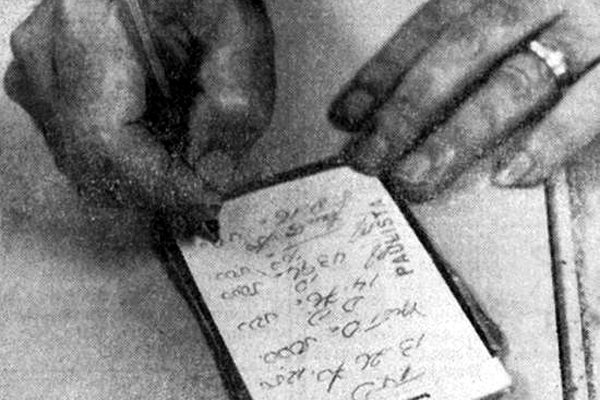
Jogo do Bicho turns 136 years old: it started legally to save a zoo and became the greatest example that prohibition doesn't end the game.
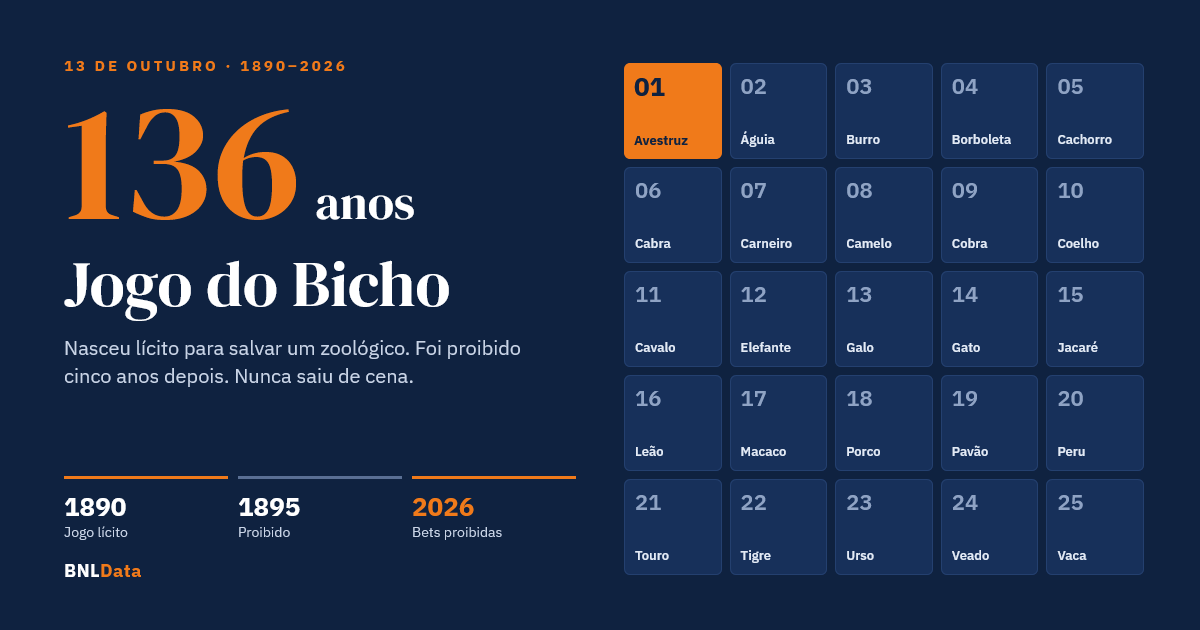
This Tuesday, October 13th, the jogo do bicho (animal lottery) celebrates 136 years since its creation. Few Brazilian institutions have survived so much time, so many regimes, and so much repression with the same vitality. The jogo do bicho survived the crumbling Empire, the Old Republic, the Estado Novo (New State), the military dictatorship, and the New Republic. Above all, it survived 131 years of prohibition.
The story begins with a cash flow problem. And, as we will see, it is precisely this origin that makes this year's anniversary so eloquent.
A zoo without money.
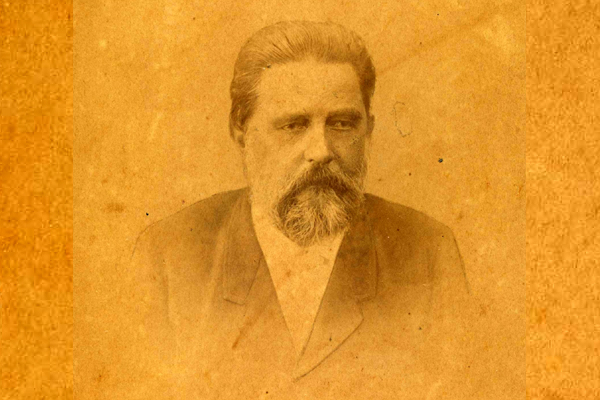
During the Monarchy, João Batista Viana Drummond, the Baron of Drummond, a prestigious figure at Court and friend of the imperial family, was the founder and owner of the Rio de Janeiro Zoo in Vila Isabel. The zoo was maintained with a generous monthly subsidy from the imperial government to feed the animals.
With the Proclamation of the Republic in 1889, the Baron lost his prestige and, with it, his subsidy. Without public funding, he even considered closing the zoo.
The idea came from a park visitor: the Mexican Manuel Ismael Zevada. Contrary to what is repeated to this day, it was not the Baron who invented the game. It was Zevada who suggested adapting the Flower Lottery, which he knew, into an "animal lottery," capable of generating revenue to maintain the zoo.
Enthusiastic, Drummond took the idea to the Municipal Council and requested permission to operate some games in exchange for a small contribution, arguing that this was the only way to keep a place so beloved by the city alive.
Date of birth
The request was accepted on October 13, 1890, with the signing of an addendum to the contract for the creation of the Vila Isabel Zoo. Drummond obtained permission to operate "legal public games." Officially, the jogo do bicho (animal lottery) was born there.
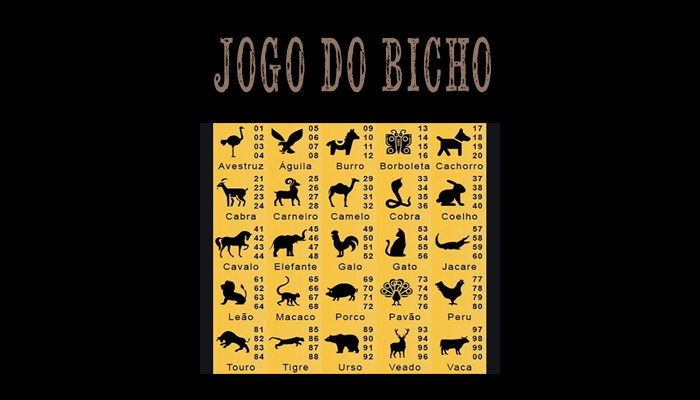
The mechanics were simple and ingenious. Whoever bought the one thousand réis ticket received a ticket with the image of an animal. At the end of the afternoon, a painting was hoisted up revealing the animal of the day. If it matched the one on the ticket, the visitor won twenty thousand réis. The Baron ordered 25 animals to be painted, the same number of groups that the game maintains to this day.
Zevada was appointed the first manager of the operation. The first official draw took place on Sunday, July 3, 1892, and the animal drawn was the ostrich, which to this day occupies group 1 of the table.

From the zoo to the streets
The success was immediate. Crowds began flocking to Vila Isabel not for the animals, but for the late afternoon lottery. The elite and the common people gambled side by side, and the game soon spilled beyond the zoo walls: merchants and intermediaries began selling tickets throughout the city, creating a parallel betting network that Drummond no longer controlled.
Between 1892 and 1894, the game operated legally under the Baron's management. But as it spread, the authorities began to associate it with "vice" and "disorder," and public opinion in Rio de Janeiro turned against it.
In 1895, under pressure and facing the growth of clandestine gambling operations, the mayor of Rio, Francisco Furquim Werneck de Almeida, rescinded the contract with the zoo and prohibited gambling. The result was the opposite of what was intended: the zoo went into decline, and the illegal gambling, which ceased to be legal, did not cease to exist. It began to be operated by networks of bookmakers who would defy repression for decades to come.

A century of laws against the animal.
From then on, the Brazilian state accumulated layers of prohibition:
⇒ 1899 — Law No. 628 introduces prison sentences for those who engage in gambling.
⇒ 1910 — Law No. 2.321 expands the penalties and expressly covers the illegal lottery game known as "jogo do bicho," with sentences of up to six months in prison.
⇒ 1917 — The Judicial-Police Conference reaffirms criminalization, but the difficulty of producing evidence and the possibility of bail make repression largely ineffective.
⇒ 1932 — During Vargas' provisional government, Decree No. 21.143 toughens penalties.
⇒ 1941 — Decree-Law No. 3.688, the Law of Criminal Offenses, explicitly includes the jogo do bicho (animal lottery) among the offenses. The law turned 85 years old on October 3rd and remains in effect.
⇒ 1946 — President Eurico Gaspar Dutra signs Decree-Law No. 9.215, which prohibits gambling and closes the country's casinos.

None of these regulations ended the illegal gambling game. The game remained accessible, cheap, and, above all, reliable: the winner received payment. This reputation for guaranteed payouts consolidated its popularity. The clandestine nature of the game, in turn, produced an increasingly organized structure, with bankers dividing territories, managers and bookmakers, and a relationship of tolerance with authorities frequently sustained by bribery. Prohibition did not eliminate the game; it only defined who would profit from it and relegated the State to the role of spectator.

The birthday numbers
⇒ 136 years since its creation (October 13, 1890)
⇒ 134 years of operation, completed on July 3rd.
⇒ 131 years of prohibition, since 1895
⇒ 85 years of the Law of Criminal Offenses
Legalization that never arrives.
Bill No. 2.234/2022, which legalizes casinos, bingo halls, and the jogo do bicho (an illegal lottery game), has been approved by the Chamber of Deputies and the Senate's Constitution and Justice Committee, but is still awaiting a vote in the plenary. The proposal provides for licensing, taxation, and oversight rules for an activity that moves billions of dollars annually outside the law.
136 years later, the same crossroads
This year's anniversary comes at a time when the history of the animal game is no longer just a memory. On September 25th, the federal government published Provisional Measure No. 1.394/2026, which prohibits fixed-odds betting, less than two years after the government itself concluded the regulation of the sector through Law No. 14.790/2023.
The government justifies the measure by citing household debt and the health problems of gamblers. But the parallels with 1895 are hard to ignore.
The illegal gambling operation was created to fund something that the government was no longer supporting: the Vila Isabel zoo. Regulated betting also funded legitimate beneficiaries, such as sports, tourism, and public safety, which lose a source of revenue with the ban.
The illegal lottery was banned under moral pressure, in an environment where a parallel market already existed outside the control of the concessionaire. Betting is prohibited in a scenario where the illegal market still accounted for more than 40% of bets, even after 22 months of regulation.
And the lesson from 1895 is unequivocal: prohibition did not make gambling disappear. It transferred it underground, where it pays no taxes, does not protect the gambler, does not offer responsible gambling mechanisms, and finances parallel power structures. It took 131 years for Brazil to seriously discuss the legalization of the jogo do bicho again, and the discussion is not yet over.
The question that the anniversary raises is whether the country is willing to repeat the experiment with illegal betting, now in the mobile age, where clandestine betting operations are just a click away and often based outside the country.
The ostrich of 1892 could not have imagined it. But the animal's history has already answered that question once.